NEET SS 2026

NEET SS 2026: Two Months Left, A Focused Roadmap to Smarter Surgical Preparation 

Estimated reading time: 3 minutes

Two months out from NEET SS, you likely already know which surgical topics feel comfortable and which ones make you hesitate. What’s hard now is revising all of it while keeping up your clinical understanding, your question practice and your duties on the ward. 

Skip the extra resources. Spend the time linking surgical concepts together, recognising clinical signs and understanding how a case is approached. Conceptual Surgery combines expert-led lectures, clinical demonstrations, mentorship and curated books to support you with that. 

How to Prepare for NEET SS in the Last Two Months? 

1. Identify the Concepts That Still Need Work 

Not every topic needs the same amount of revision. Begin with your weak areas, the mistakes you’ve made before and the concepts you can’t seem to recall. Build your weekly targets around those gaps, and keep revising the core surgical topics alongside. 

2. Connect Theory with Clinical Practice 

Knowing a condition from a textbook is one thing. Spotting it in a patient is another. Practise reading clinical signs, making sense of examination findings and structuring a case presentation. It helps your theory line up with how surgical cases are actually assessed. 

Conceptual Surgery has clinical case demonstrations, patient presentations and clinical examination videos for this kind of hands-on learning. 

3. Use Question Practice to Guide Revision 

When a question session ends, don’t stop at the score. Ask what went wrong. Did you miss a clinical clue? Confuse two conditions? Fail to apply a concept? Go back to the topic behind the question instead of just memorizing the right answer. 

Note down the mistakes you keep repeating, and use that list to plan your next revision session. 

4. Follow a Realistic Two-Month Plan 

Month 1: Revise core surgical concepts, deal with your weak areas and solve questions regularly. 

Month 2: Concentrate on mock tests, repeated revision, clinical understanding and fixing your mistakes. 

Final week: Go back to notes you already know and the important concepts. Don’t bring in a pile of new resources. 

You’re a resident, so your plan has to work around your duties. Targets you can hit every day are worth more than a timetable you can’t keep up. 

Why Conceptual Surgery? 

Conceptual Surgery gives residents and practicing surgeons a way to build up their knowledge and skills at every stage of their careers. 

  • Comprehensive HQ Video Lectures: Learn from teachers with 35–60 years of experience as MS/DNB Surgery examiners. 
  • Clinical Cases & Presentations: See demonstrations of clinical examinations, patient presentations and clinical signs. 
  • Exclusive Mentorship Programs: Take part in live interactive sessions, get your doubts cleared and receive thesis guidance. 
  • Six Curated Books: Back up your learning and revision with a well-organized set of surgical study material. 

Make Your Final Two Months Count 

Preparing for NEET SS while working as a resident takes focus. Find your weak areas, tie concepts to clinical practice, go through your mistakes, and keep revising. 

Expert teaching, clinical demonstrations and mentorship from Conceptual Surgery can support you as you prepare for NEET SS and build your surgical knowledge. 

Revise with direction. Think clinically. Prepare with purpose. 

Share

Dr. Sourav Chowdhury

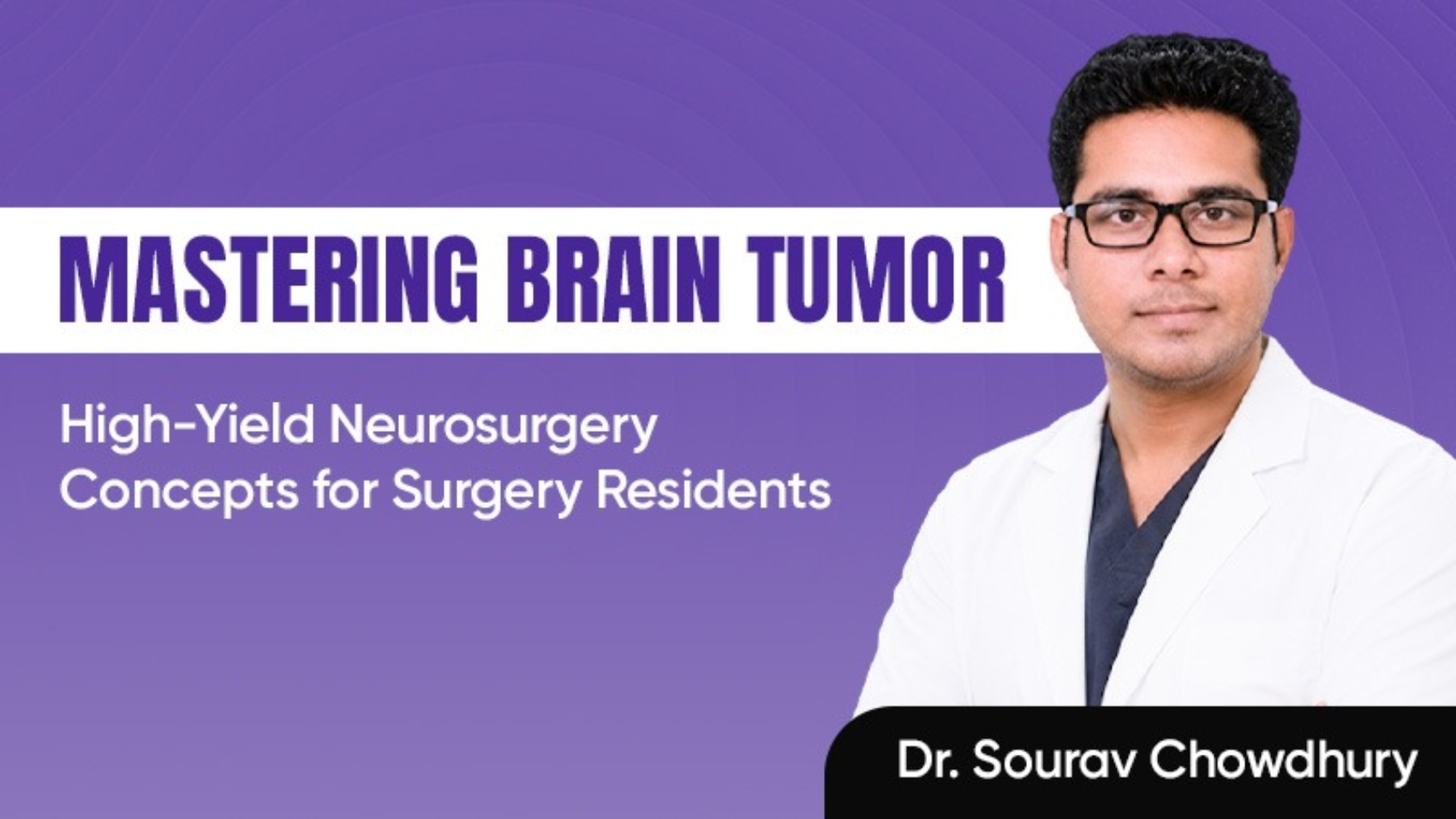
Brain Tumors Made Simple: High-Yield Neurosurgery Concepts for Surgery Residents 

Brain Tumors Made Simple: High-Yield Neurosurgery Concepts for Surgery Residents

If you’re in surgical residency, you’ve undoubtedly faced brain tumor questions during ward rounds, case presentations, or viva exams. Neurosurgery often carries a reputation for being notoriously dense, but once you anchor yourself to a few foundational principles, the pathology becomes highly logical.

At Conceptual Surgery, we focus on stripping away the unnecessary noise so you can connect textbook theory directly to clinical practice. High-yield sessions like this are regularly updated on the Conceptual App, helping postgraduates solidify their core concepts while saving precious study time.

Understanding the Intracranial Space

A brain tumor is simply an abnormal cellular growth within the cranium or its surrounding membranes. While we classify them histologically as benign or malignant, the clinical reality is that any intracranial mass is potentially dangerous. Because the adult skull is a rigid, closed vault, even a histologically benign growth can cause devastating herniation syndromes.

Clinical Pearl: Location often trumps histology. A tiny, benign tumor in the brainstem or fourth ventricle can be far more catastrophic than a large, low-grade astrocytoma in a silent area of the frontal lobe.

Where Do Brain Tumors Actually Originate?

A common misconception is that primary brain tumors arise from neurons. In reality, mature neurons rarely replicate. Instead, the vast majority of primary central nervous system (CNS) tumors originate from glial cells—the supporting framework of the brain.

  • Astrocytes: The structural anchors that maintain the blood-brain barrier. (Give rise to Astrocytomas).
  • Oligodendrocytes: The cells responsible for myelinating CNS axons. (Give rise to Oligodendrogliomas).
  • Ependymal Cells: The ciliated lining of the ventricles and central canal. (Give rise to Ependymomas).
  • Microglia: The resident macrophages of the brain.

Adult Brain Tumors: The High-Yield Breakdown

Residents often trip up on the distinction between primary and secondary lesions.

The most common brain tumors encountered in adults are actually metastatic (secondary) tumors—cells that have traveled via the bloodstream from primary malignancies elsewhere, most commonly the lung, breast, melanoma, or kidney.

When it comes to primary adult tumors, these four should be at the top of your revision list:

1. Glioblastoma Multiforme (GBM)

GBM is the most common primary malignant brain tumor in adults. It is highly aggressive, infiltrates widely along white matter tracts (often crossing the corpus callosum as a “butterfly glioma”), and carries a notoriously challenging prognosis.

2. Astrocytoma

Varying from low-grade (pilocytic) to high-grade (anaplastic), these tumors arise from astrocytes and represent a broad spectrum of clinical behavior.

3. Oligodendroglioma

Classically presenting with calcification on CT scans and a “fried-egg” appearance on histology, these are essential to recognize in exam vignettes.

4. Meningioma

This is a perennial favorite for viva exams. Meningiomas are the most common primary brain tumor overall. They arise from the arachnoid cap cells, are typically benign, and sit outside the brain parenchyma (extra-axial). Do not confuse “most common primary tumor” (Meningioma) with “most common primary malignant tumor” (GBM).

Pediatric vs. Adult Tumors: The Anatomical Divide

The presentation, types, and locations of brain tumors in children are fundamentally different from those in adults.

Feature Adult Brain Tumors Pediatric Brain Tumors 
Primary Location Supratentorial (Cerebral hemispheres) Infratentorial (Posterior fossa, cerebellum, brainstem) 
Common Malignancy Glioblastoma Multiforme (GBM) Medulloblastoma 
Common Benign Lesion Meningioma Pilocytic Astrocytoma / Craniopharyngioma 

Core Pediatric Tumors to Remember:

  • Medulloblastoma: Highly malignant tumor of the posterior fossa, prone to CSF seeding.
  • Brainstem Glioma: Diffuse tumors with a challenging surgical profile due to critical nuclei locations.
  • Ependymoma: Frequently arises in the fourth ventricle, presenting with early hydrocephalus.
  • Craniopharyngioma: Sellar/suprasellar tumors derived from Rathke’s pouch, often causing visual and endocrine deficits.

Why Pediatric Tumors Are Easily Missed?

Diagnosing intracranial masses in infants and young children requires a high index of suspicion because the early presentation is incredibly subtle.

Because infants have open fontanelles and unfused cranial sutures, their skulls can expand to accommodate a slow-growing mass. Consequently, classic signs of increased intracranial pressure (ICP) like severe headaches or projectile vomiting may not appear until the tumor is quite large.

Instead, a child might simply present with developmental regression, irritability, poor feeding, or a subtle cross of the eyes.

Red Flags for Increased ICP in Children:

  • Persistent, unexplained vomiting (especially in the morning)
  • New-onset seizures
  • Regression or delay in developmental milestones
  • Rapidly increasing head circumference (crossing percentiles)
  • “Sunsetting” eyes (downward gaze due to pressure on the midbrain tectum)

High-Yield Summary Table

If you only remember a few sentences for your next ward round or exam, make it these:

Clinical Question High-Yield Answer 
Most common brain tumor overall Metastasis (Lung, Breast, etc.) 
Most common primary brain tumor Meningioma 
Most common primary malignant brain tumor Glioblastoma Multiforme (GBM) 
Most common malignant pediatric brain tumor Medulloblastoma 
Adult tumor territory Supratentorial 
Pediatric tumor territory Infratentorial
 

Final Thoughts for the Surgical Resident

Neurosurgery can feel overwhelming when you try to memorize every classification, grading system, and molecular marker in isolation. However, if you master the structural patterns—understanding cell lineages, adult vs. pediatric anatomy, and the physics of the closed cranium—the clinical details fall into place naturally.

Rote memorization fails under the pressure of a viva exam or a busy emergency shift. That is exactly why we built Conceptual Surgery. We focus on the why behind clinical presentations so you can confidently apply your knowledge at the bedside and in the exam hall.

If you found this breakdown helpful, you can access the full, deep-dive video lecture along with hundreds of other residency-focused sessions on the app.

Watch the Full Session:

🎓 Brain Tumor: An Overview | Dr. Sourav Chowdhury | Conceptual Surgery

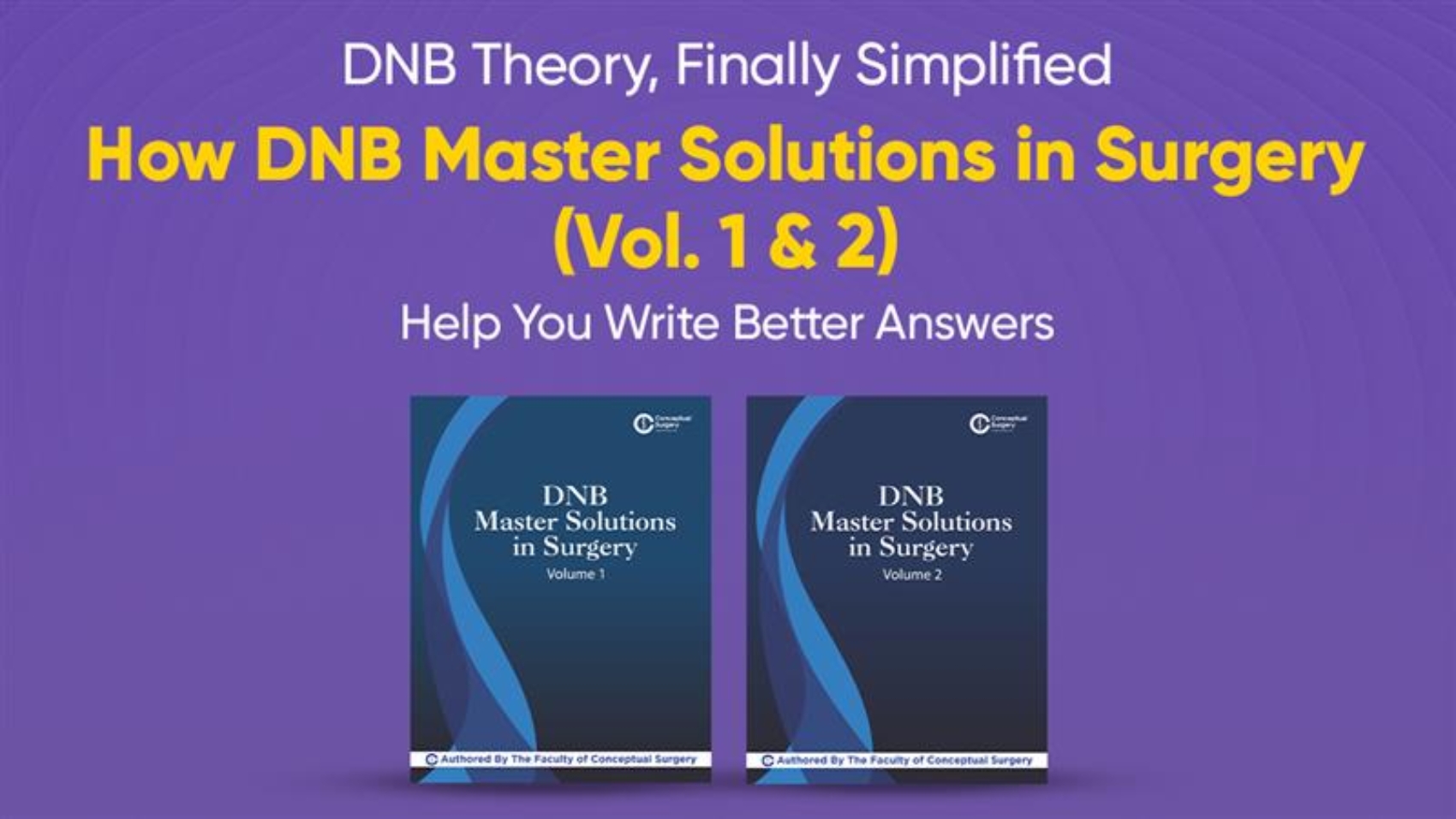
DNB Master Solutions in Surgery (Vol. 1 & 2)

DNB Theory, Finally Simplified: How DNB Master Solutions in Surgery (Vol. 1 & 2) Help You Write Better Answers 

Estimated reading time: 4 minutes

If you’re preparing for the DNB theory exam, you’ve probably realized by now that knowing the subject isn’t the main issue; it’s writing the answer the right way under exam conditions. That shift, from knowledge to presentation, is where most surgery residents people lose marks. 

That’s exactly where DNB Master Solutions in Surgery – Volume 1 & Volume 2 by the faculty of Conceptual Surgery starts to make sense. These books don’t try to overload you—they help you focus on what actually gets asked and how to answer it properly. 

Volume 1: Recent Papers, Real Exam Insight (2024–2023) 

Volume 1 feels more like working with the latest exam mindset. 

It includes: 

  • Solved papers from 2024–2023  
  • Around 40 papers and 400 questions  
  • Clear, structured answers that are easy to follow  

What makes this volume especially useful is that it reflects current trends. When you go through it, you start noticing how questions are being framed now and what examiners expect in answers today. 

It also puts a strong focus on repeated, high-yield topics like hernia, wound management, biostatistics, and radiology. Instead of reading them once, you encounter them in different forms across questions—which actually helps in retention. 

If you’re closer to the exam, this is the volume you’ll probably rely on more for fine-tuning your preparation. 

Volume 2: Building the Base with Past Papers (2022–2020) 

Volume 2 complements Volume 1 by covering slightly older papers (2022–2020), but that doesn’t make it any less important. 

It includes: 

  • Solved papers from 2022–2020  
  • Around 40 papers and 400 questions  
  • Simple, easy-to-remember answers  

This volume is more about building your foundation. 

When you start with it, you get comfortable with: 

  • Common question patterns  
  • Answer structure  
  • How much detail is actually needed  

It’s a good place to begin because it eases you into answer writing without the pressure of “latest trends.” Once that base is set, moving to Volume 1 feels much smoother. 

What Both Volumes Do Well?(And Why It Matters) 

Across both books, a few things stay consistent: 

  • Real exam questions: You’re not guessing what’s important—you’re practicing what has already been asked  
  • Answer-writing clarity: The solutions are structured in a way you can actually reproduce in exams  
  • Time-saving: Everything is compiled—no need to search multiple sources  
  • Better revision: Easy to revisit before exams without feeling lost  

And if you’re using the Conceptual Surgery app alongside, the video + book combination makes revision even stronger. 

If you want to get a quick feel of how both DNB Master Solutions in Surgery – Volume 1 & Volume 2 are structured, you can explore the sample pages here: 

Volume 1: 

Volume 2: 

How to Use Them Without Overcomplicating Things?

A simple way to approach it: 

  • Start with Volume 2 to get comfortable with patterns and answer writing  
  • Move to Volume 1 to understand recent trends and refine your approach  
  • Closer to exams, revise both with a focus on repeated questions  

The goal isn’t to finish them quickly—it’s to start thinking in the format the exam expects. 

Final Thought 

Most resources help you study more. These books help you write better. 

And for DNB theory, that’s the difference between knowing the answer and actually scoring marks, something every surgery resident aiming for NEET SS surgery or higher exams eventually realizes. 

If used properly, DNB Master Solutions in Surgery – Volume 1 & Volume 2 gives you a clear, practical edge without making preparation unnecessarily complicated. 

Share

NEET SS Preparation

Why Conceptual Surgery Is the Smartest Platform for NEET SS Aspirants

Estimated reading time: 2 minutes

Dear aspirants, as NEET SS is almost one month away, most aspirants are worried about finishing the syllabus, revising effectively, and understanding what the exam actually expects.

So it’s not the time to go for a random resource; in fact, it is time to choose where choosing the right platform can completely change your preparation.

Conceptual Surgery has become one of the most reliable choices because it focuses on clarity, clinical understanding, and exam-oriented learning.

Why Conceptual Surgery Works So Well for NEET SS Preparation?
1. Lectures by Senior MS/DNB Examiners

The classes are created and taught by teachers who have been examiners for decades.
They explain how answers are evaluated, how to approach long questions, and what not to waste time on. This helps you study smart instead of studying randomly.

2. Strong Focus on Clinical Examination and Case-Based Learning

NEET SS is shifting more toward clinical thinking.
Conceptual Surgery helps you develop that skill through:

  • Clinical examination demonstrations
  • Case presentations
  • Clinical signs shown on real patients

This builds confidence for both the exam and future surgical practice.

3. Complete Exam-Oriented Preparation in One Place

You do not have to search for different resources elsewhere.
The platform includes:

  • Updated surgical guidelines and techniques
  • Viva and practical exam training
  • Theory notes and structured discussions
  • Live PG courses
  • Live MCQ discussions
  • Recent exam questions and solved papers
  • A detailed question bank for practice
  • High-yield pearls for last-minute revision
  • Hardcopy Clinical Examination in Surgery books
  • Live discussions on rare and important cases

Everything you need is organised in a way that is easy to revise and easy to follow.

4. Teachers With Real Experience in Exam Patterns

The faculty includes some of the most respected names in surgery.
They simplify complex concepts, share practical insights from decades of experience, and guide you on how to write answers that score.

Why Conceptual Surgery Stands Out as the Best Platform for NEET SS?
  • Structured and organised preparation
  • Clear explanation of high-yield topics
  • Strong clinical foundation
  • Reliable mentorship
  • Complete coverage of theory, clinical skills, and MCQs
  • Efficient revision tools for the last month

At this stage of preparation, clarity and direction matter more than anything else and Conceptual Surgery provides you both, which makes it one of the best choices for NEET SS aspirants who want a focused, practical, and effective preparation plan.

Share

Dr. Amrit Nasta

269 in DNB Theory! Dr. Pallab Roy Shares His Secrets to Success with Dr. Amrit Nasta

Estimated reading time: 5 minutes

Hello, my dear friends, I am Dr. Amrit Nasta, your surgery faculty at the CSF, and today I have the honour of introducing and congratulating Dr. Pallab Roy, who has secured an amazing 269 score in his DNB theory papers.

First of all, Dr. Pallab, congratulations. That is truly an awesome score. Let me tell you, students are so fearful of the DNB papers. They feel passing is so difficult and wonder how to clear it with residency. But here we have a live example, and you must be in the top 10, I am sure, in the university. Officially, it has not come, sir, but mostly.

  1. So, Dr. Pallab Roy, tell me first a little bit about yourself—where you are currently working, doing a residency.

Dr. Pallab Roy: “Currently, I am a third-year postgraduate resident, sir, at District Hospital, Dharwad. It’s in Karnataka.”

  1. When you were preparing for the theory, did you get time during your DNB years? How did you start preparing?

Dr. Pallab Roy: “Sir, from first year only I started studying, sir. From first year, Bailey and Love—I started. Actually my HOD sir has a big role in this. From the very beginning he used to tell, you have to study, like these three years are like a penance to you. You have to study, you have to study, you have to work, you have to study, you have to work.”

  1. So when you used to study, you must have thought there is so much portion. How did you do it with so much work Monday to Sunday? Did you get stressed?

Dr. Pallab Roy: “In first year, I started studying, sir, but I used to study very lost. After my first FAT exam, sir, when the question paper came, it was a disaster. That habit of MBBS leaves you to write answers, right? It was so long ago and suddenly we are in a professional environment, then someone tells you to write answers on anything and everything.”

  1. Then how did you prepare for theory? You must not have got much time.

Dr. Pallab Roy: “Sir, I would like to say that before your videos, I just happily studied; there was no path, just studied. But after the videos, I got a point that yes, I have to go in this path, then I will have something in the future, I will be able to study, I will be able to retain something. The first chapter is Metabolic Response to Injury, sir, I saw your videos, sir, I used to read Bailey and Love.”

4. I heard this time the DNB theory papers, like always, had a lot of repeated questions. Did you solve the papers also? I have recorded almost all the papers on the app.

Dr. Pallab Roy: “Almost, sir, almost maximum, sir, except for the first paper. Maximum questions were repeated. There were some comedic questions, sir, but that was also almost repeated. If you solve the previous papers properly, then it makes a big difference.”

  1. So what is the plan for the future?
    You will have your practical maybe in a month’s time. We are having a lot of ongoing lectures with senior faculty on the app. Are you planning to attend them so that you are ready for the practical?

Dr. Pallab Roy: “I will utilize them, sir, for the practicals, obviously. Because theory is tough and practice is also tough. And again, we lose that track of presenting cases. On your app, I have seen senior teachers who regularly, weekly discuss different cases. And you can also present cases if you want. Then when you go in for your practicals, you will be very confident.”

  1. So what are your plans for the future?

Dr. Pallab Roy: “Sir, the plans for the future should be practical for now. Then on the 7th of November, we have our NEET SS exam. I am planning to crack the NEET SS exam this year.”

  1. I have also recorded the video explanation of our very good Q-Bank for NEET SS. You can watch that as well, if you have time. And what are you planning to take in the NEET SS exam?

Dr. Pallab Roy: “For now, sir, I would like to take Plastic Surgery. And CVTS. Plastic and CVTS—I will take either of them.”

Great, great. So, Dr. Pallab, I won’t take any more of your time. Thank you so much for joining us and congratulations. Soon, you will clear your practicals also. Then you will become a surgeon—certified—and then maybe Plastic Surgeon or CVTS Surgeon. All the best for your future.

Dr. Pallab Roy: “Thank you, sir. Thank you so much for your time. Thank you.”

Click Here to Watch: Shocking Truth About DNB Theory Exam Scores Revealed by Dr. Pallab Roy

Share

WhatsApp Image 2025-05-16 at 11.34.36 AM

Crack NEET SS Surgery with the Help of Conceptual Surgery:- Complete Guide

Estimated reading time: 3 minutes

Preparation for NEET SS Surgery can be intimidating, particularly with the huge syllabus, time management during residency, and without proper guidance. But with the right platform, proper books, and expert guides, cracking NEET SS Surgery is not only possible, it’s within reach.

If you are looking to take the super-specialty (SS) residency in Surgery, this blog will give information about the exam pattern, how to prepare strategically, and why Conceptual Surgery is the best way to prepare for NEET SS.

What is NEET SS?

NEET SS (National Eligibility cum Entrance Test for Super Specialty) is an entrance test for admission into DM/MCh courses in India. It is organised by the National Board of Examinations (NBE).

NEET SS Exam Details:
EventsDetails
Conducting BodyNational Board of Examinations (NBE)
EligibilityMS/DNB Degree holders (or appearing candidates)
Mode of ExamOnline (CBT)
Duration2.5 hours (150 minutes)
Type of QuestionsMCQs (Multiple Choice Questions)
Number of Questions150
Total Marks600
Marking Scheme+4 for correct, -1 for incorrect
NEET SS Preparation Strategy

Cracking NEET SS Surgery demands a focused strategy, particularly if you are a resident in surgery with clinical responsibilities to attend to besides studies. Here you will get the idea of how to start your preparation: 

1. NEET SS Exam Overview 

Learn the subject weightage, topics asked most commonly, and MCQ pattern. Pay attention to high-yield subjects, including oncology, trauma, thyroid, breast, and GIT.

2. Begin Early with Consistency

Make use of your MS/DNB second and third years to develop solid theoretical and clinical principles. 

3. Practice MCQs Daily

Daily MCQ practice not only enhances recall but also enhances exam temperament.

4. Revise with Purpose

The last 2 months must be kept aside for revision by way of short notes, earlier attempted MCQs, and mock papers.

Why Select Conceptual Surgery for NEET SS Preparation?
  • Complete Coverage of SS-Level Topics

Conceptual Surgery is more than PG-level education. The platform is made to educate surgery residents in such a manner that they become NEET SS-ready, through structured learning pathways, operative videos, clinical discussions, and MCQs.

  • Top Faculty Panel for Surgery Residents

Study with a panel of leading surgeons and academic guide mentors such as Prof. Dr. S. K Nair, Prof. Dr. Arun Kakar, Prof. Dr. R. C. M Kaza, and many more.

  • NEET SS-Specific Videos and Notes

All the sessions are planned to cover high-yield concepts with explanation laid out specifically for NEET SS. The app also offers NEET SS Surgery notes compiled by toppers and experts.

  • Top-Rated App for NEET SS Preparation

It could be mobile or desktop, eConceptual app offers seamless access to theory, MCQs, case discussions, and mock tests—under one umbrella.

  • Best NEET SS Preparation Books

Conceptual Surgery also offers set of 2 books are famous for their clarity, organisation, and MCQ-based learning. Starting from General Surgery to system-wise concepts, they give you just what an NEET SS aspirant requires.

  • Mock Tests, Live Tests, and Personalised Feedback

The app continuously conducts mock tests with live ranking, topic-wise MCQ sessions, and SS preparation strategy videos to keep you ahead.

Final Words

Cracking NEET SS Surgery is about smart work, right guidance, and focused learning. With Conceptual Surgery App, you’re not just preparing for an exam—you’re preparing to be a better surgeon.

Download the eConceptual App Now

Start your journey with structured courses, surgery-specific notes, and actual mentorship—all specifically designed for NEET SS aspirants.

Share