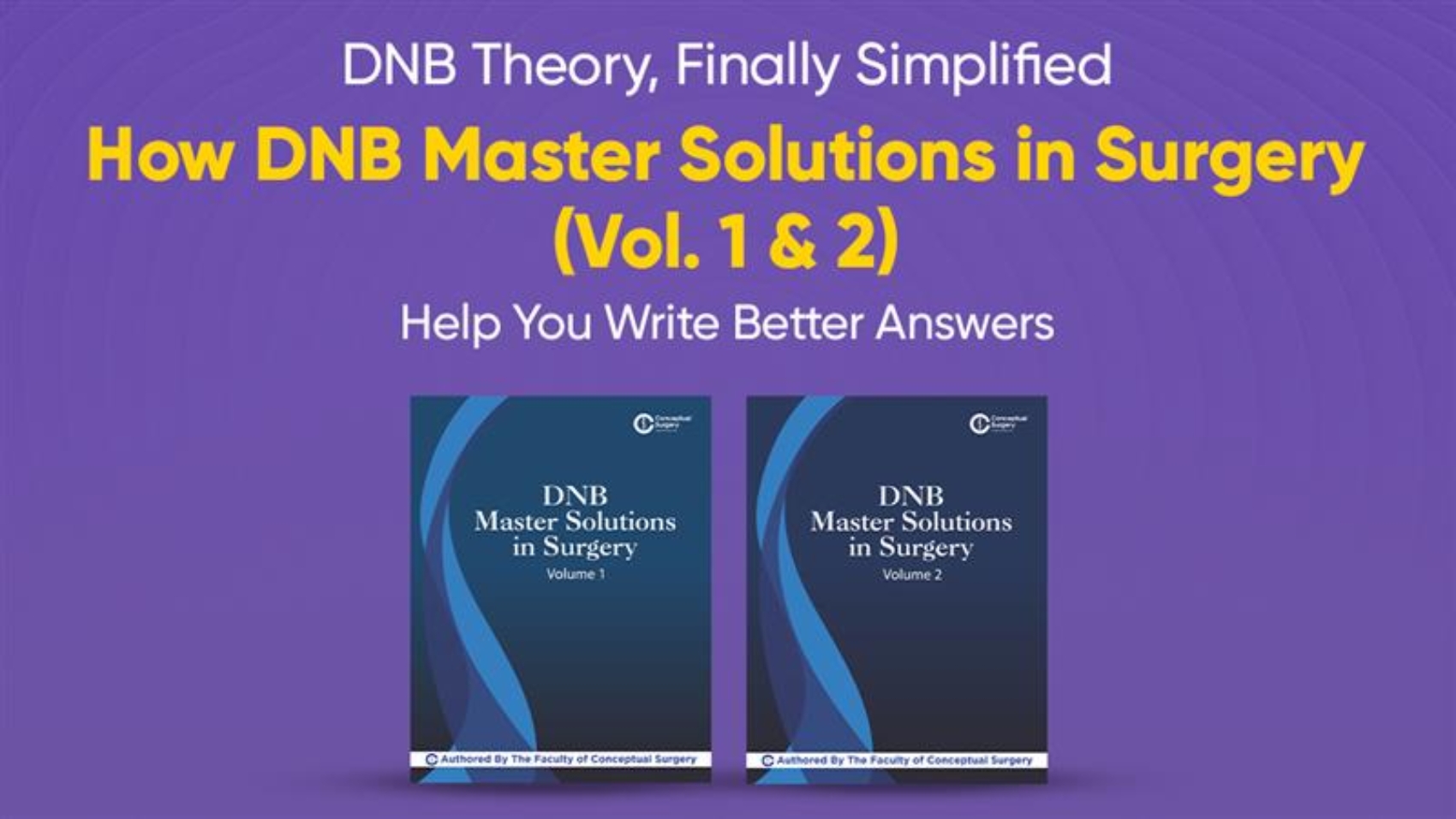
If you’re preparing for the DNB theory exam, you’ve probably realized by now that knowing the subject isn’t the main issue; it’s writing the answer the right way under exam conditions. That shift, from knowledge to presentation, is where most surgery residentspeople lose marks.
That’s exactly where DNB Master Solutions in Surgery – Volume 1 & Volume 2 by the faculty of Conceptual Surgery starts to make sense. These books don’t try to overload you—they help you focus on what actually gets asked and how to answer it properly.
Volume 1: Recent Papers, Real Exam Insight (2024–2023)
Volume 1 feels more like working with the latest exam mindset.
It includes:
Solved papers from 2024–2023
Around 40 papers and 400 questions
Clear, structured answers that are easy to follow
What makes this volume especially useful is that it reflects current trends. When you go through it, you start noticing how questions are being framed now and what examiners expect in answers today.
It also puts a strong focus on repeated, high-yield topics like hernia, wound management, biostatistics, and radiology. Instead of reading them once, you encounter them in different forms across questions—which actually helps in retention.
If you’re closer to the exam, this is the volume you’ll probably rely on more for fine-tuning your preparation.
Volume 2: Building the Base with Past Papers (2022–2020)
Volume 2 complements Volume 1 by covering slightly older papers (2022–2020), but that doesn’t make it any less important.
It includes:
Solved papers from 2022–2020
Around 40 papers and 400 questions
Simple, easy-to-remember answers
This volume is more about building your foundation.
When you start with it, you get comfortable with:
Common question patterns
Answer structure
How much detail is actually needed
It’s a good place to begin because it eases you into answer writing without the pressure of “latest trends.” Once that base is set, moving to Volume 1 feels much smoother.
What Both Volumes Do Well?(And Why It Matters)
Across both books, a few things stay consistent:
Real exam questions: You’re not guessing what’s important—you’re practicing what has already been asked
Answer-writing clarity: The solutions are structured in a way you can actually reproduce in exams
Time-saving: Everything is compiled—no need to search multiple sources
Better revision: Easy to revisit before exams without feeling lost
And if you’re using the Conceptual Surgery app alongside, the video + book combination makes revision even stronger.
If you want to get a quick feel of how both DNB Master Solutions in Surgery – Volume 1 & Volume 2 are structured, you can explore the sample pages here:
Start with Volume 2 to get comfortable with patterns and answer writing
Move to Volume 1 to understand recent trends and refine your approach
Closer to exams, revise both with a focus on repeated questions
The goal isn’t to finish them quickly—it’s to start thinking in the format the exam expects.
Final Thought
Most resources help you study more. These books help you write better.
And for DNB theory, that’s the difference between knowing the answer and actually scoring marks, something every surgery resident aiming for NEET SS surgery or higher exams eventually realizes.
If used properly, DNB Master Solutions in Surgery – Volume 1 & Volume 2 gives you a clear, practical edge without making preparation unnecessarily complicated.
You know what, there is one question which is frequently asked among young doctors is, ‘What is DNB in Surgery?’ Especially when we talk about postgraduate surgical training in India,
This is one of the most respected postgraduate qualifications, Diplomate of National Board (DNB) in General Surgery, which is identical in recognition and value to an MS (Master of Surgery) degree. However, it contains a training structure, an evaluation system, and an examination process that have their own unique features.
This is your ultimate guide that covers everything about DNB Surgery you need to know, from the DNB entrance exam to eligibility, training modules, the DNB examination, practicals, DNB theory papers, and career prospects after completion.
DNB Examination Structure and Process
1. What is DNB in Surgery? Understanding the Course
So basically, the DNB Surgery is a postgraduate surgical residency training program that is conducted by the National Board of Examinations in Medical Sciences (NBEMS). It’s a very structured program that is especially designed to train doctors in their fundamental surgical skills, which include operative decision-making and proper patient management across all major surgical disciplines.
The DNB qualification holds equal value to the MD/MS degrees awarded by universities and is recognized by the National Medical Commission (NMC) and the Government of India.
This makes it an excellent choice for aspiring surgery residentswho want high-quality, hands-on exposure in real clinical settings.
2. Duration and Course Structure of DNB Surgery
The DNB General Surgery program is basically 3 years long for post-MBBS residents. Those who have already completed their postgraduate diploma in surgery can definitely pursue a two-year secondary DNB course.
Training Overview
Year 1: Basics of surgical anatomy, wound management, aseptic techniques, and first-assist experience in surgeries.
Year 2: Rotations through surgical subspecialties (urology, orthopedics, oncology, plastic surgery), involvement in emergency care, and DNB preparation for theory exams.
Year 3: Independent case management, advanced surgeries, research work, and OSCE training for final practical evaluation.
The surgery residency training program ensures that residents develop not just operative skills but also clinical judgment and research aptitude.
3. Eligibility Criteria for DNB Surgery
If a resident wants to pursue DNB Surgery, they must:
They should have an MBBS degree from a recognized medical institution.
With that, they should have permanent or provisional registration with the NMC or State Medical Council.
Residents need to qualify in the NEET PG examination, which basically serves as the DNB entrance exam for postgraduate medical seats in India.
4. Admission Process for DNB Surgery
Admission to DNB Surgery is concentrated and conducted by the Medical Counselling Committee (MCC), which is based on NEET PG scores.
Steps to Admission
They need to qualify NEET PG / DNB entrance exam.
Then they have to register for MCC counselling, which is officially under the DNB Post-MBBS category.
Residents should be required to participate in the choice filling and locking of preferred hospitals or institutes.
Their Seat allotment is typically based on NEET PG rank and seat matrix.
The Document verification and joining are provided at the allotted center.
DNB training is offered across reputed NBEMS-accredited hospitals, including both government and private medical institutions.
5. Training Experience and Clinical Exposure
During the DNB Surgery training, residents gain subjection to multiple voluntary and emergency surgical cases in overloaded patients in hospitals.
The key features of the DNB Surgery residency program are:
They need to gain experience in various surgical procedures in multiple departments
Residents need to actively participate in ward rounds, operating theaters, and the trauma unit.
It is very much compulsory in research and composition preparation.
They can also participate in OSCE courses and exam preparation sessions before the final practical exam happens.
Regular internal assessment and evaluation by an external examiner.
6. The DNB Examination Pattern and Evaluation
The DNB examination evaluates both theoretical knowledge and clinical competence. It is known for its depth, objectivity, and national-level uniformity.
A. DNB Theory Papers
There are 4 DNB theory papers, each carrying 100 marks.
The DNB Paper pattern includes both short and long-answer questions.
Topics include general surgical principles, gastrointestinal surgery, urology, plastic surgery, pediatric surgery, trauma, and anesthesia.
Residents must achieve a minimum of 50% aggregate to qualify for practicals.
B. Practical / Clinical Examination
You know, when the residents clear their DNB theory, they have to appear for the DNB OSCE (Objective Structured Clinical Examination) and Viva Voce as well.
Residents know that OSCE training is very crucial at this stage, which typically involves simulation-based case discussions, medical image analysis, surgical instrument identification, and clinical decision-making exercises.
The DNB OSCE ensures that each candidate has strong practical skills, awareness of patient safety, and effective clinical decision-making.
7. DNB vs MS in Surgery, Key Differences
Aspect
DNB in Surgery
MS in Surgery
Conducted by
NBEMS
Medical Universities
Training Location
Accredited hospitals
Medical colleges
Evaluation
Centralized DNB exam
University exams
Exposure
High-patient-volume hospitals
Structured college setup
Difficulty Level
Higher (especially DNB theory papers and OSCE)
Moderate
Recognition
Equivalent to MS
Recognized by NMC
Both are recognized qualifications, and a DNB General Surgeon is equally eligible for super-specialty courses (MCh/DNB SS) and teaching positions across India.
8. Daily Life of a DNB Surgery Resident
A surgery residency is demanding yet deeply fulfilling. The day of a DNB trainee involves:
They have to go on early morning ward rounds
Residents have to give pre- and post-operative care
They have to assist and perform surgeries
Attending regular academic discussions and DNB preparation sessions
Residents have to prepare case presentations for the DNB exam and the OSCE course
The training nurtures precision, discipline, and decision-making, the core of every successful surgeon’s identity.
9. Career Opportunities After DNB Surgery
Upon completing DNB in Surgery, multiple paths open up:
General Surgeon: Work in hospitals or private setups.
Teaching Faculty: Eligible for Assistant Professor and higher academic roles.
Private Practice: Build a specialized surgical clinic or group practice.
Super-specialization: Pursue MCh or DNB SS in fields such as:
Urology
Surgical Oncology
Cardiothoracic Surgery
Neurosurgery
Plastic Surgery
International Recognition: Many DNB graduates successfully qualify for PLAB, USMLE, or other global licensing exams.
The DNB qualification thus serves as a solid foundation for advanced SS preparation and global surgical careers.
Conclusion: The Pathway to Surgical Excellence
Can you imagine that pursuing a DNB in Surgery is not just an academic option; it is a professional change.
Overall, the concentrated surgery residency, basically very much challenging the DNB theory, accurate DNB exams, and a practical OSCE course training, this program casts you into a surgeon who balances both of things like technology and science, as well as compassion and exactness.
It is quite difficult for those who put in the hard work and discipline, but you know, DNB Surgery proves to be one of the most rewarding journeys in modern medicine for residents. This program provides global opportunities for teaching, research, and super-specialization for secure their future.
Hello, my dear friends, I am Dr. Amrit Nasta, your surgery faculty at the CSF, and today I have the honour of introducing and congratulating Dr. Pallab Roy, who has secured an amazing 269 score in his DNB theory papers.
First of all, Dr. Pallab, congratulations. That is truly an awesome score. Let me tell you, students are so fearful of the DNB papers. They feel passing is so difficult and wonder how to clear it with residency. But here we have a live example, and you must be in the top 10, I am sure, in the university. Officially, it has not come, sir, but mostly.
So, Dr. Pallab Roy, tell me first a little bit about yourself—where you are currently working, doing a residency.
Dr. Pallab Roy: “Currently, I am a third-year postgraduate resident, sir, at District Hospital, Dharwad. It’s in Karnataka.”
When you were preparing for the theory, did you get time during your DNB years? How did you start preparing?
Dr. Pallab Roy: “Sir, from first year only I started studying, sir. From first year, Bailey and Love—I started. Actually my HOD sir has a big role in this. From the very beginning he used to tell, you have to study, like these three years are like a penance to you. You have to study, you have to study, you have to work, you have to study, you have to work.”
So when you used to study, you must have thought there is so much portion. How did you do it with so much work Monday to Sunday? Did you get stressed?
Dr. Pallab Roy: “In first year, I started studying, sir, but I used to study very lost. After my first FAT exam, sir, when the question paper came, it was a disaster. That habit of MBBS leaves you to write answers, right? It was so long ago and suddenly we are in a professional environment, then someone tells you to write answers on anything and everything.”
Then how did you prepare for theory? You must not have got much time.
Dr. Pallab Roy: “Sir, I would like to say that before your videos, I just happily studied; there was no path, just studied. But after the videos, I got a point that yes, I have to go in this path, then I will have something in the future, I will be able to study, I will be able to retain something. The first chapter is Metabolic Response to Injury, sir, I saw your videos, sir, I used to read Bailey and Love.”
4. I heard this time the DNB theory papers, like always, had a lot of repeated questions. Did you solve the papers also? I have recorded almost all the papers on the app.
Dr. Pallab Roy: “Almost, sir, almost maximum, sir, except for the first paper. Maximum questions were repeated. There were some comedic questions, sir, but that was also almost repeated. If you solve the previous papers properly, then it makes a big difference.”
So what is the plan for the future? You will have your practical maybe in a month’s time. We are having a lot of ongoing lectures with senior faculty on the app. Are you planning to attend them so that you are ready for the practical?
Dr. Pallab Roy: “I will utilize them, sir, for the practicals, obviously. Because theory is tough and practice is also tough. And again, we lose that track of presenting cases. On your app, I have seen senior teachers who regularly, weekly discuss different cases. And you can also present cases if you want. Then when you go in for your practicals, you will be very confident.”
So what are your plans for the future?
Dr. Pallab Roy: “Sir, the plans for the future should be practical for now. Then on the 7th of November, we have our NEET SS exam. I am planning to crack the NEET SS exam this year.”
I have also recorded the video explanation of our very good Q-Bank for NEET SS. You can watch that as well, if you have time. And what are you planning to take in the NEET SS exam?
Dr. Pallab Roy: “For now, sir, I would like to take Plastic Surgery. And CVTS. Plastic and CVTS—I will take either of them.”
Great, great. So, Dr. Pallab, I won’t take any more of your time. Thank you so much for joining us and congratulations. Soon, you will clear your practicals also. Then you will become a surgeon—certified—and then maybe Plastic Surgeon or CVTS Surgeon. All the best for your future.
Dr. Pallab Roy: “Thank you, sir. Thank you so much for your time. Thank you.”