DNB Surgery Final Theory 2026

DNB Surgery Final Theory 2026: Important Topics, Revision Strategy & Answer-Writing Tips 

The DNB General Surgery Final Theory Examination is an important milestone in every surgery resident’s postgraduate journey. With the examination approaching, effective revision, clinical understanding and structured answer writing become essential. 

As exma is near and limited preparation time remaining, residents should focus on important surgical concepts, previous-year question papers and practising structured answers. 

In this blog, we cover important topics for DNB Surgery Theory 2026, practical revision strategies and answer-writing tips to help you prepare effectively. 

DNB Surgery Theory Exam 2026: Important Topics to Revise 

The General Surgery syllabus covers several surgical specialties. During the final revision phase, prioritise core concepts, commonly encountered clinical conditions and management-based topics. 

1. Gastrointestinal Surgery 

  • Acute intestinal obstruction and perforation peritonitis 
  • Appendicitis and its complications 
  • Peptic ulcer disease 
  • Gastrointestinal bleeding 
  • Colorectal and oesophageal carcinoma 
  • Inflammatory bowel disease 
  • Intestinal fistulas 

2. Hepatobiliary and Pancreatic Surgery 

  • Acute and chronic pancreatitis 
  • Obstructive jaundice 
  • Gallstone disease and its complications 
  • Carcinoma gallbladder and pancreas 
  • Portal hypertension 
  • Liver abscess and hydatid cyst 

3. Surgical Oncology 

  • Carcinoma breast 
  • Carcinoma thyroid 
  • Gastric and colorectal carcinoma 
  • Oesophageal carcinoma 
  • TNM staging 
  • Principles of chemotherapy and radiotherapy 

4. Trauma and Emergency Surgery 

  • ATLS principles and initial trauma assessment 
  • Haemorrhagic shock 
  • Blunt and penetrating abdominal trauma 
  • Splenic and liver injuries 
  • Burns and fluid resuscitation 
  • Compartment syndrome 
  • Damage control surgery 

5. Breast, Thyroid and Endocrine Surgery 

  • Evaluation of breast lumps 
  • Breast carcinoma management 
  • Solitary thyroid nodule 
  • Multinodular goitre 
  • Thyroid malignancies 
  • Hyperparathyroidism 
  • Pheochromocytoma 

6. Hernia and Vascular Surgery 

  • Inguinal and femoral hernia 
  • Incisional and ventral hernia 
  • Obstructed and strangulated hernia 
  • Peripheral arterial disease 
  • Varicose veins 
  • Deep vein thrombosis 
  • Diabetic foot 

7. General Surgical Principles 

  • Wound healing 
  • Fluid and electrolyte management 
  • Surgical infections and sepsis 
  • Blood transfusion 
  • Nutritional support 
  • Postoperative complications 
  • Minimally invasive and robotic surgery 

This is a focused revision checklist, not an official prediction of examination questions. Refer to the NBEMS syllabus for complete coverage. 

How to Prepare for DNB Surgery Theory Exam 2026? 

With limited time remaining, a structured revision approach can help you make better use of your preparation hours. 

1. Prioritise Core Topics 

Revise important surgical conditions, clinical presentations, investigations, treatment protocols and operative procedures. Avoid starting multiple new books or resources at this stage. 

2. Practise Previous-Year Question Papers 

DNB Surgery previous-year question papers help you understand question patterns and identify frequently tested concepts. Practise writing answers rather than simply reading the questions. 

3. Prepare Short Revision Notes 

Keep concise notes covering: 

  • Important classifications and staging systems 
  • Diagnostic criteria 
  • Treatment algorithms 
  • Surgical indications 
  • Complications and management 
  • Important diagrams and flowcharts 

4. Focus on Clinical and Case-Based Questions 

For every major surgical condition, practise answering the following: 

  • How will you approach the patient? 
  • What investigations will you order? 
  • How will you establish the diagnosis? 
  • What is the definitive management? 
  • What complications should be anticipated? 

5. Revise Recent Advances 

Include minimally invasive surgery, robotic surgery, ERAS protocols, advances in surgical oncology and newer diagnostic techniques in your revision. 

DNB Surgery Answer-Writing Tips 

Good answer presentation helps communicate your understanding clearly. Follow these techniques during the theory examination. 

1. Start with a Relevant Introduction: Begin with a concise definition or explanation directly related to the question. 

2. Use Headings and Subheadings: Organise answers into sections such as clinical features, investigations, diagnosis, management and complications. 

3. Include Diagrams and Flowcharts: Use labelled surgical anatomy diagrams, classification charts and management algorithms wherever relevant. 

4. Write Management Stepwise: For clinical questions, follow a logical sequence: assessment, stabilisation, investigations, definitive management and postoperative care. 

5. Manage Time Effectively: Practise complete papers under timed conditions. Avoid spending excessive time on one answer. 

A 12-Day DNB Surgery Revision Strategy 

With the examination beginning on 19 November, the following plan can help residents organise their final revision from 7–18 November. 

Days Revision Focus 
7–8 Nov Gastrointestinal surgery 
9 Nov Hepatobiliary and pancreatic surgery 
10 Nov Breast, thyroid and endocrine surgery 
11 Nov Surgical oncology 
12–13 Nov Trauma and emergency surgery 
14 Nov Hernia and vascular surgery 
15–16 Nov Other surgical subspecialties 
17 Nov General surgical principles and recent advances 
18 Nov Previous-year questions and rapid revision 

Alongside daily revision, practise timed answers and revisit topics where your understanding needs improvement. 

Prepare Smarter with Conceptual Surgery 

Balancing residency duties, emergency cases and examination preparation can be challenging for surgery residents. A structured learning approach can help organise revision and strengthen clinical understanding. 

Conceptual Surgery offers expert-led academic sessions, surgical discussions and learning resources for postgraduate residents. 

For focused DNB theory preparation, explore the DNB Theory Edge Programme, designed to support residents through structured theory preparation, previous-year questions and answer-writing practice. 

Final Words 

Success in the DNB Surgery Final Theory Examination requires more than memorising facts. Strong concepts, clinical reasoning, consistent revision and clear answer presentation are equally important. 

Focus on important topics, solve previous-year question papers and practise structured answers. Make your final revision systematic and approach the examination with confidence. 

Prepare well. Revise strategically. Give your best in DNB Surgery Theory 2026. 

Frequently Asked Questions 

1. When is the DNB Surgery Theory Exam 2026? 

The DNB Final Theory Examination for the December 2026 session is scheduled from 19–22 November 2026. 

2. Which topics are important for DNB Surgery Theory? 

Gastrointestinal surgery, hepatobiliary surgery, surgical oncology, trauma, breast and thyroid surgery, hernia and general surgical principles are important revision areas. 

3. Are previous-year papers useful for DNB Surgery preparation? 

Yes. They help residents understand question patterns, identify recurring concepts and practise structured answer writing. 

4. How can I improve my DNB Surgery answer writing? 

Use clear headings, labelled diagrams, flowcharts and stepwise management approaches. Practise complete answers under timed conditions. 

Share

NEET PG 2026 Counselling

NEET PG 2026 Counselling: General Surgery Career Scope, Super-Specialisation


NEET PG counselling is not just about getting a seat in a preferred college. It is also about choosing a branch that fits your interests, working style and long-term career plans. 

General Surgery is an important option for candidates who enjoy operating, solving clinical problems and seeing the direct impact of their decisions on patient outcomes. However, the reality of surgical residency goes beyond the operating theatre. It involves patient assessment, preoperative planning, postoperative care, emergency management and communication with patients and their families. 

If you are considering MS General Surgery or DNB General Surgery during NEET PG 2026 counselling, here are some important factors to consider before filling your choices. 

1. Is General Surgery the Right Branch for You? 

The first question to ask yourself is simple: Do you genuinely enjoy surgery? 

During MBBS, it is easy to get influenced by popular branches, rank trends, peer opinions or the choices of seniors. But residency is a long-term commitment, and choosing a branch only because it is available at your rank may not be the best decision. 

General Surgery may suit you if you: 

  • Enjoy working in the operating theatre and learning surgical techniques. 
  • Like practical, hands-on clinical work. 
  • Are interested in anatomy, operative decision-making and patient management. 
  • Can handle pressure and take responsibility during emergencies. 
  • Are willing to improve your skills through continuous practice and training. 

It is equally important to understand that surgery is not limited to performing operations. You will also need to assess whether a patient is fit for surgery, identify potential complications, manage recovery and explain treatment options. 

During branch selection, consider the kind of work you want to do every day, not just the name of the speciality. 
 
Watch: Why Choose Anesthesia or Surgery as a Branch? | NEET PG 2026 | eConceptual Live 

2. MS General Surgery vs DNB General Surgery: Which Should You Choose? 

This is one of the common dilemmas during NEET PG counselling. You may find themselves choosing between MS General Surgery at one institution and DNB General Surgery at another. 

Rather than making the decision based on the degree alone, look closely at the training environment. 

Consider these factors before deciding: 

  • Operative exposure: Will you get sufficient opportunities to assist and perform procedures under appropriate supervision? 
  • Patient load: Does the hospital manage a broad range of surgical cases? 
  • Emergency exposure: Will you gain experience in managing surgical emergencies? 
  • Teaching and mentorship: Are seniors available to guide you through clinical decisions and operative skills? 
  • Academic environment: Will you have adequate support for theory preparation, practical examinations and future entrance exams? 
  • Location: Does the city align with your personal circumstances and long-term career plans? 

A busy hospital with good case variety and structured training can offer valuable learning opportunities. However, a high patient load alone is not enough; supervision, hands-on experience and the quality of teaching matter too. 

There is no universal answer to the MS versus DNB question. Compare the actual institutions, training opportunities, current regulations and your future goals before making a decision. 
 

3. What Can You Do After MS/DNB General Surgery? 

General Surgery offers several possible career directions. Your final choice will depend on your interests, training, available programmes and eligibility requirements. 

Some common super-specialisation options include: 

  • MCh/DrNB Surgical Gastroenterology: For those interested in gastrointestinal and related surgical conditions. 
  • MCh/DrNB Surgical Oncology: For candidates interested in cancer surgery. 
  • MCh/DrNB Urology: For those interested in the surgical management of urinary tract conditions. 
  • MCh/DrNB Neurosurgery: For candidates interested in surgery involving the brain, spine and nervous system. 
  • MCh/DrNB Plastic Surgery: For those drawn to reconstructive and specialised surgical procedures. 
  • MCh/DrNB Pediatric Surgery: For candidates interested in surgical care for children. 

Other areas of interest may include vascular surgery, bariatric surgery, minimally invasive surgery and trauma surgery, depending on the available training pathways and qualifications required. 

You do not necessarily need to decide your exact super-speciality before entering residency. General Surgery can help you explore different areas before narrowing your focus. 

However, if you already have a clear interest in a particular field, it is worth understanding the relevant eligibility criteria and entrance examination pathway early. 
 
Also Read: DNB vs MD Anesthesia: Understanding the Two Pathways 

4. Is Super-Specialisation Necessary After General Surgery? 

There is no single answer that applies to every surgeon. Your decision should depend on the type of practice you want to build, the location where you intend to work and the opportunities available to you. 

Super-specialisation may be worth considering if you want to develop expertise in a focused surgical field, pursue specific consultant roles or compete for certain positions in large tertiary-care hospitals. 

At the same time, some surgeons build careers in general surgical practice or develop focused interests through suitable fellowships and additional training. 

Before deciding, ask yourself: 

  • Do I enjoy a broad range of surgical procedures, or do I prefer one specific area? 
  • Am I prepared for additional years of training? 
  • Do I want to work in a large corporate hospital, a government institution or my own practice? 
  • What qualifications are expected for the positions I may want in the future? 

The important thing is to understand your options rather than assume that every surgeon must follow the same path. 

5. Career Opportunities and Earning Potential After General Surgery 

General Surgery can lead to careers in government hospitals, private hospitals, teaching institutions and private practice. Some doctors also explore healthcare management, medical consultancy and other roles that use their clinical expertise. 

However, career growth and income vary considerably. They depend on factors such as experience, location, additional qualifications, surgical skills, patient referrals and the type of employment. 

For example, a government hospital position may offer greater job stability and a structured academic career. A private hospital role may provide opportunities to develop expertise in a particular area. Private practice, meanwhile, often requires time to establish professional relationships and build patient trust. 

It is worth remembering that a higher earning potential may come with longer working hours, greater responsibilities or additional years of training. 

Instead of selecting General Surgery based on salary expectations alone, consider the career you want to build over the next 10–15 years. 

6. Work-Life Balance During and After Surgical Residency 

Surgical residency is demanding. Long working hours, emergency cases, night duties and unpredictable clinical situations are part of the training experience in many institutions. 

The experience can differ significantly depending on the hospital, department, patient load and support available to residents. 

After residency, work-life balance can also vary by subspeciality and practice setting. Some areas involve frequent emergencies, while others may have more predictable schedules. A busy private practice can bring professional independence but may also require considerable time and effort. 

Before choosing a college, try to understand the actual residency schedule, duty patterns, resident support and working environment. Speaking with current residents can help you get a clearer picture than relying on a college’s reputation alone. 

7. How to Choose the Right General Surgery College During NEET PG Counselling 2026 

Once you have decided that General Surgery interests you, the next step is to compare your available colleges carefully. 

Use this checklist before finalising your NEET PG choice filling: 

  • Check the actual surgical case load and diversity of cases. 
  • Understand how much supervised operative exposure residents receive. 
  • Review the availability of faculty guidance and academic teaching. 
  • Ask about emergency duties, workload and resident support. 
  • Explore the institution’s infrastructure and postoperative care facilities. 
  • Consider the location, bond conditions, fees and other applicable service obligations. 
  • Check the latest official counselling rules and the eligibility requirements for your future plans. 

Do not select a college solely because it is in a major city or carries a familiar name. A strong training environment should offer the clinical exposure, supervision and academic support you need to develop as a surgeon. 

Final Thoughts: Choose the Training You Want, Not Just the Seat You Get 

NEET PG 2026 counselling is an important step, but your branch choice will shape much more than your postgraduate degree. It will influence your daily work, professional interests, and future training options. 

If you enjoy operating, hands-on learning and managing patients through different stages of surgical care, General Surgery may be worth serious consideration. 

Take time to compare MS and DNB options, understand the clinical exposure available at each institution and explore the pathways after residency. 

A well-informed branch selection can give you a stronger starting point for the years of learning ahead. 

Joining MS/DNB Surgery Soon? Get Ready with Conceptual Surgery! 

As NEET PG 2026 counselling progresses, your MD/DNB Surgery residency is one step closer. The journey ahead will bring new clinical responsibilities, challenging concepts, and theory exams. Preparing for residency can help you begin with greater clarity and confidence. 

Conceptual Surgery is here to support you throughout your residency journey. With structured lectures, comprehensive learning resources, and app features designed for residents, hardcopy books. You can strengthen your concepts, revisit important topics, and make your learning more organised. Whether you are preparing to join as a new JR or looking for academic support during residency, Conceptual Surgery is here to help you learn and grow at every step.

Share

DNB Surgery Practical Exam

DNB Surgery Practical Exam: Common Mistakes That Can Cost You Marks 

Estimated reading time: 5 minutes

The DNB Surgery Practical Exam isn’t just about what you know. It’s about how you examine a patient, present a case, interpret findings, explain your thinking, and answer questions from the examiner. 

Most residents prep hard for theory. Then they treat practical prep differently. And that’s where small mistakes happen. A wrong examination step. A messy case presentation. Fumbling during viva. Any of these can hurt your score. 

The point isn’t to give long answers or show off everything you know. It’s to show you can handle a surgical case logically, safely, and with confidence. 

Here’s what to actually avoid during your DNB Surgery Practical Exam. 

1. Starting the Examination Without a Clear Approach 

Common mistake: diving into patient examination without any plan. 

Before you start, know how you’ll approach the patient. Introduce yourself. Build some rapport. Check their general condition. Get relevant history. Do the right examination. Find important clinical signs. 

Having a system keeps you organized. Shows the examiner you actually know how to work through a case. 

2. Giving an Unstructured Case Presentation 

A good case presentation? Clear. Concise. Clinically relevant. 

Don’t jump between history, examination, tests, and diagnosis. Present it logically. Highlight findings that actually support your assessment. 

Simple flow: 

Patient Profile → History → Examination → Investigations → Diagnosis → Management Plan 

You don’t need to mention everything you saw. Focus on what actually matters for this case. 

3. Memorizing Findings Without Understanding Their Significance 

Just identifying a clinical finding isn’t enough in a practical. 

Mention an investigation or clinical sign? Be ready when the examiner asks what it means and how it changes your approach. 

Stop memorizing random facts. Instead ask yourself: 

What is this finding? Why does it matter? How does it change what I’ll do? 

This makes your answers actually clinical. Not just textbook facts. 

4. Jumping to Management Without Explaining Your Reasoning 

Some candidates hear a surgical case and immediately start listing procedures and drugs. 

Don’t do that. 

Explain how you’re thinking through it. 

Consider the patient’s condition. Diagnosis. Severity. Relevant risks. Available tests. Surgical options. Postoperative care. Then present your plan. 

Doesn’t have to be long. The examiner just needs to understand why you’d pick that approach. 

5. Overcomplicating Viva Answers 

Viva gets harder when you try to pack too much into every answer. 

Know the answer? Say it clearly. Don’t add random details just to look smart. 

Try this: 

Think → Answer → Explain if They Ask 

Keeps it focused. Gives the examiner room to dig deeper if they want. 

6. Ignoring Communication and Bedside Manner 

The practical exam evaluates how you work with the patient too. 

Don’t rush through examination, ignore patient comfort, or do things without explaining. Simple stuff matters: introduce yourself, explain what you’re doing, stay professional, communicate clearly. 

These things make you look confident and organized. 

7. Preparing Only Through Reading 

Just reading notes? Not enough for practical prep. 

You need to actually practice. Present cases out loud. Examine real patients. Interpret tests. Discuss management. Answer viva questions aloud. 

Practice with colleagues. Figure out gaps in your thinking. Make your answers sound natural. 

Make DNB Surgery Preparation More Exam-Focused 

Practical prep gets stronger when you connect it to theory. Going through previous DNB questions helps you see what gets tested repeatedly and how to frame answers better. 

That’s where Conceptual Surgery’s DNB Master Solutions can help your prep. 

DNB Master Solutions in Surgery – Volume 1 

Volume 1 has solved DNB Surgery papers from 2024–23. Actual exam questions with structured solutions. Focused on making answers easier to understand, revise, and use during the exam. 

Works with the Conceptual Surgery App. Combine book revision with video learning. 

DNB Master Solutions in Surgery – Volume 2 

Volume 2 covers solved DNB Surgery papers from 2022–20. Another set of previous year questions to practice and revise. 

Together, they help you get familiar with DNB question style while improving your answer-writing and revision. 

How to Practice Before the Practical Exam?

As exam time gets closer, make your prep more active: 

  • Practice presenting common surgical cases out loud. 
  • Revise important clinical signs and tests. 
  • Discuss management plans for common cases. 
  • Practice short direct viva answers. 
  • Review previous DNB questions. 
  • Figure out where your clinical thinking needs work. 

The more you explain your thinking aloud, the easier it gets to talk confidently during the actual exam. 

Final Takeaway 

The DNB Surgery Practical Exam isn’t about remembering massive amounts of information. It’s about showing how you approach a patient and think through surgical problems. 

Be systematic during examination. Keep your case presentation structured. Understand why your findings matter. Explain your management decisions. Keep viva answers clear. 

Know the case. Think clinically. Present clearly. Answer confidently.

Share

DNB Final Surgery

One Month Strategy for DNB Final Surgery Exam : A Survival Guide for Surgery Residents 

One Month Strategy for DNB Final Surgery Exam : A Survival Guide for Surgery Residents ​

Estimated reading time: 5 minutes

The last month before DNB Final Surgery should focus on revision, clinical case presentation, viva preparation, instruments, and commonly asked surgical topics. Instead of trying to read everything again, residents should stay focused on practical understanding, repeated revision, and confidence building. 

Introduction 

Every surgery resident knows how stressful the month before DNB Finals can get. 

There are emergency duties, long OT hours, ward work, pending revisions, sleep issues, and that constant feeling that no matter how much you study, something is still left. 

Most residents enter the final month thinking they need to study harder than ever. But honestly, the last few weeks are not about reading every textbook again. 

What Should Surgery Residents Focus on in the Last Month? 

The final month should mainly focus on high-yield and commonly discussed surgical topics. 

Gastrointestinal Surgery 

This is one area you simply cannot ignore. 

Focus on: 

  • Intestinal obstruction  
  • Perforation peritonitis  
  • Hernia  
  • GI malignancies  
  • Pancreatitis  
  • Colorectal surgery basics  
  • Upper GI bleed  

Try to understand management flow instead of memorizing isolated points. 

During viva, examiners usually want to see whether your approach is logical and clinically safe. 

Hepatobiliary and Pancreatic Surgery 

A very common area in theory and practical discussions. 

Important topics: 

  • Gallstone disease  
  • Obstructive jaundice  
  • Liver abscess  
  • Portal hypertension  
  • Pancreatic tumors  

Focus more on investigations, staging, and management planning. 

Trauma Surgery 

Trauma remains one of the most important areas for DNB Surgery. 

Focus on: 

  • ATLS principles  
  • Polytrauma  
  • Splenic injury  
  • Chest trauma  
  • Fluid management  
  • Shock  

Most residents study trauma theoretically but struggle when viva becomes practical and case-based. 

Try to think clinically while revising. 

Breast, Thyroid, and Vascular Surgery 

These are commonly asked in long cases and viva. 

Important topics: 

  • Breast carcinoma  
  • Thyroid swellings  
  • Varicose veins  
  • Diabetic foot  
  • Peripheral vascular disease  

Practice differential diagnosis and clinical approach properly. 

How Should Surgery Residents Study During the Last Month? 

You do not need unrealistic 16-hour study schedules during residency. 

A simple and consistent routine works much better. 

Morning 

Revise one major topic and make short notes or flowcharts. 

Afternoon 

Use OT and ward exposure for practical learning: 

  • Instruments  
  • Surgical anatomy  
  • Case discussions  
  • Postoperative management  
Evening 

Practice viva questions and long case presentation. 

Night 

Rapid revision of staging systems, classifications, and investigations. 

The goal is retention and confidence, not exhaustion. 

Why Are Clinical Presentation and Viva So Important? 

Because DNB Surgery is heavily clinical. 

Many residents know the answer in their head but struggle while presenting it confidently during viva. 

Practice: 

  • Long cases  
  • Short cases  
  • Differential diagnosis  
  • Investigations  
  • Operative planning  
  • Complications  

Whenever you answer, try to follow a structure: 

  1. Diagnosis  
  1. Differential diagnosis  
  1. Investigations  
  1. Management  
  1. Complications  

Structured answers automatically sound better and more mature. 

Topics Residents Often Ignore 
Instruments and Sutures 

Most residents postpone instruments till the final few days, but this is one of the most important scoring areas in practicals. 

Know: 

  • Basic instruments  
  • Staplers  
  • Drains  
  • Sutures  
  • Laparoscopic instruments  
  • Energy devices  

Also know: 

  • Uses  
  • Advantages  
  • Complications  
Postoperative Management 

This is commonly discussed during viva but often ignored during revision. 

Focus on: 

  • Fluid management  
  • Electrolyte imbalance  
  • Sepsis  
  • DVT prophylaxis  
  • Nutrition  
  • Wound infection  

Practical decision-making matters a lot in surgery viva. 

Looking for the Right Resource? 

One of the biggest problems during DNB Final Surgery preparation is finding a resource that is simple, practical, and actually useful during the last month. 

That’s why many surgery residents now prefer Conceptual Surgery for structured and exam-oriented preparation. Over the years, Conceptual Surgery has slowly become a preferred choice for residents preparing for DNB Finals, NEET SS, and higher surgical studies because of its 360-degree approach toward surgical learning. 

Many residents find it useful because the teaching stays clinically relevant and practical instead of becoming unnecessarily complicated. Its lectures and revision content focus heavily on: 

  • Case-based discussions  
  • Clinical reasoning  
  • Viva preparation  
  • Operative concepts  
  • Instruments  
  • High-yield surgical topics  

A lot of residents especially use it during the final month for rapid revision and concept clarity because it helps simplify difficult topics and keeps preparation focused. 

And honestly, in the last month, having one trusted resource is much more useful than collecting ten different notes. 

A Simple 4-Week Plan for the Final Month 
Week 1 

Focus on: 

  • GI surgery  
  • Trauma  
  • Hepatobiliary surgery  
  • Breast and thyroid  
Week 2 

Revise: 

  • Instruments  
  • Sutures  
  • Postoperative management  
  • Fluids and electrolytes  
Week 3 

Start: 

  • Mock viva  
  • Long case presentation  
  • Previous year discussions  
  • Integrated revision  
Week 4 

Only revise: 

  • High-yield notes  
  • Staging systems  
  • Instruments  
  • Common complications  
  • Viva flowcharts  

Avoid starting new topics during the final week. 

Conclusion 

The last month before DNB Final Surgery is not about trying to study everything again. 

It is about becoming clinically confident and exam-ready. 

You need: 

  • Repeated revision  
  • Better presentation  
  • Clinical understanding  
  • Viva confidence  
  • Consistency  

Stay focused, keep revising, and trust the preparation you have already done over the years. 

A structured final month can genuinely improve both confidence and performance during DNB Finals. 

FAQs 

Ques 1: How many hours should surgery residents study in the last month? 

Ans 1: Consistent revision with clinical discussion is much more effective than studying continuously for very long hours. 

Ques 2: Which subjects are most important for DNB Final Surgery? 

Ans 2: GI surgery, trauma, hepatobiliary surgery, postoperative management, and instruments are among the highest-yield topics. 

Ques 3: Are instruments important in DNB practicals? 

Ans 3: Yes. Instruments, sutures, and operative discussions are extremely important during practical exams and viva. 

Ques 4: Should residents start new books in the final month? 

Ans 4: No. The final month should mainly focus on revision, practical preparation, viva discussion, and strengthening concepts already studied. 

Share

Dr. Rakesh Mittal

Lynch Syndrome in Surgery: The “80% Cancer Risk” Topic Every Resident Should Know 

Lynch Syndrome in Surgery : The "80% Cancer Risk" Topic Every Resident Should Know

Estimated reading time: 5 minutes

Some topics in surgery keep showing up again and again — in ward discussions, viva, case presentations, and entrance exams. Lynch syndrome is one of those topics. 

Recently, Dr. Rakesh Mittal discussed the important concepts related to Lynch syndrome in a simple and practical way, especially the points students usually confuse with FAP. If you’re a surgery resident preparing for exams or trying to strengthen your GI surgery basics, this is one topic worth revising properly. 

What is Lynch Syndrome? 

Lynch syndrome, also known as HNPCC (Hereditary Non-Polyposis Colorectal Cancer), is the most common hereditary colorectal cancer syndrome. 

The important thing to remember is that these patients usually do not develop hundreds of polyps like FAP patients do. Even without multiple polyps, their risk of developing colorectal cancer remains very high because the actual problem lies in defective DNA repair. 

That’s what makes this condition clinically important.

Watch Video: 80% Cancer Risk? 🤯 Lynch Syndrome Explained by Dr. Rakesh Mittal 

Why Does Everyone Remember the “80% Risk”? 

One of the most commonly asked facts about Lynch syndrome is its cancer risk. 

The lifetime risk of colorectal cancer is nearly 80%. 

That number alone makes it an important exam topic. 

Many residents compare it directly with FAP. In FAP, the risk of colorectal cancer is almost 100% if untreated, which is why FAP is considered more aggressive overall. But Lynch syndrome is still dangerous because cancers develop early and often without the warning sign of diffuse polyposis. 

So the absence of multiple polyps should never make you think the condition is harmless. 

It’s Not Just About Colon Cancer 

Another important point discussed was that Lynch syndrome is associated with cancers in other organs too. 

Common associated cancers include: 

  • Endometrial cancer  
  • Ovarian cancer  
  • Gastric cancer  
  • Small bowel cancer  

In female patients, the risk of endometrial carcinoma is especially significant and may reach around 30–50%. 

So whenever a younger patient presents with colorectal cancer along with a strong family history or associated gynecological cancers, Lynch syndrome should always be kept in mind. 

The Typical Site of Cancer 

One classic exam point is the location of the tumor. 

In Lynch syndrome, cancers are more commonly seen in the proximal colon, meaning the right side of the colon is more frequently involved. 

That makes it different from many sporadic colorectal cancers seen in older patients. 

The average age of diagnosis is usually around 45 years, which is much younger than the usual colorectal cancer population. For surgery residents, that age difference itself can become an important clinical clue. 

The Genetics You Should Definitely Remember 

This is the part that frequently appears in MCQs and viva. 

Lynch syndrome occurs because of mutations in DNA mismatch repair genes. 

The two most important genes are: 

  • MLH1  
  • MSH2  

These are the genes most commonly associated with Lynch syndrome and are repeatedly asked in exams. 

The mutation leads to defective DNA repair and causes microsatellite instability (MSI), which eventually increases the risk of cancer development. 

A simple way to remember it: 

Lynch syndrome = mismatch repair defect + microsatellite instability 

Lynch Syndrome vs FAP: Easy Way to Differentiate 

Students often mix these two hereditary colorectal cancer syndromes, but the comparison becomes easy if you focus on the basics. 

FAP 
  • Hundreds to thousands of polyps  
  • APC gene mutation  
  • Nearly 100% cancer risk  
Lynch Syndrome 
  • Few or no polyps  
  • Mismatch repair gene defect  
  • Strong association with right-sided colon cancer and extracolonic cancers  

Once these points are clear, most exam questions become straightforward. 

Why This Matters During Residency?

Lynch syndrome is not just an exam topic. In real clinical practice, identifying hereditary cancer syndromes changes the entire approach to patient management. 

It affects: 

  • screening strategies,  
  • family counseling,  
  • surveillance plans,  
  • and long-term follow-up.  

Recognizing these patterns early can make a huge difference not only for the patient, but also for family members who may be at risk. 

That’s why surgery residents are expected to know these syndromes well — not just theoretically, but clinically too. 

Quick Revision Before You Leave 

If you want to revise Lynch syndrome in one minute, remember these points: 

  • Most common hereditary colorectal cancer syndrome  
  • Lifetime colorectal cancer risk around 80%  
  • Right-sided/proximal colon cancers are common  
  • MLH1 and MSH2 are the key genes  
  • Associated with endometrial and ovarian cancers  
  • Autosomal dominant inheritance  

These are the exact points that repeatedly appear in surgery exams, GI discussions, and oncology postings. 

Conceptual Surgery — Supporting Residents Throughout Residency 

Surgical residency can feel overwhelming at times. Between long duties, emergency calls, ward work, academics, presentations, and exam preparation, finding the right guidance becomes extremely important. 

That’s where Conceptual Surgery continues to help surgery residents across the country. 

From experienced faculty and structured teaching to high-yield discussions, study material, practical concepts, books, and the right academic resources — everything is designed to make residency learning more focused and manageable. 

Every year, thousands of residents join Conceptual Surgery to strengthen their concepts, improve confidence during residency, and prepare better for exams and clinical practice. 

Whether it’s ward learning, viva preparation, theory revision, or surgical concepts, Conceptual Surgery aims to support residents at every step of their journey.

Share

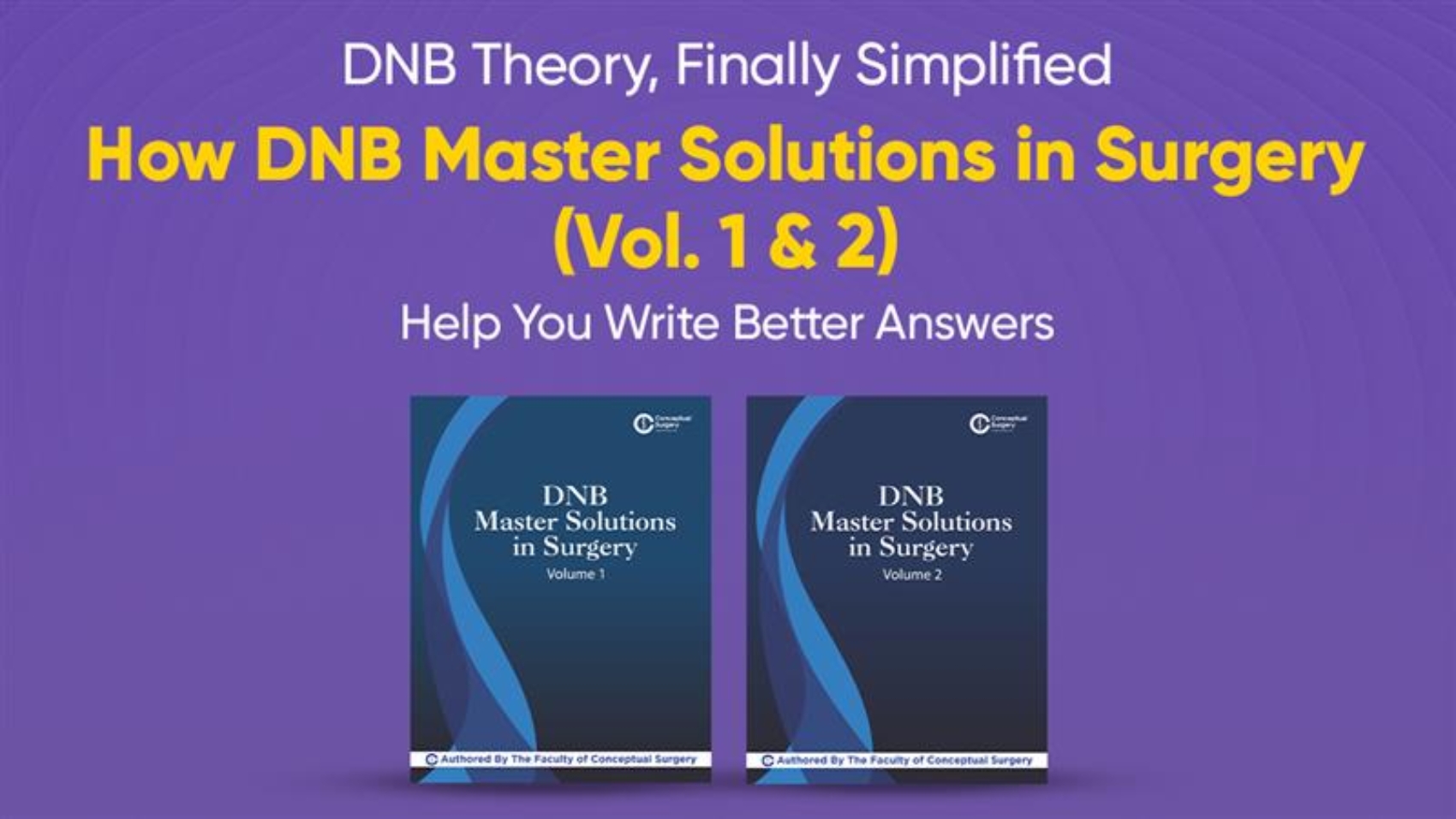
DNB Master Solutions in Surgery (Vol. 1 & 2)

DNB Theory, Finally Simplified: How DNB Master Solutions in Surgery (Vol. 1 & 2) Help You Write Better Answers 

Estimated reading time: 4 minutes

If you’re preparing for the DNB theory exam, you’ve probably realized by now that knowing the subject isn’t the main issue; it’s writing the answer the right way under exam conditions. That shift, from knowledge to presentation, is where most surgery residents people lose marks. 

That’s exactly where DNB Master Solutions in Surgery – Volume 1 & Volume 2 by the faculty of Conceptual Surgery starts to make sense. These books don’t try to overload you—they help you focus on what actually gets asked and how to answer it properly. 

Volume 1: Recent Papers, Real Exam Insight (2024–2023) 

Volume 1 feels more like working with the latest exam mindset. 

It includes: 

  • Solved papers from 2024–2023  
  • Around 40 papers and 400 questions  
  • Clear, structured answers that are easy to follow  

What makes this volume especially useful is that it reflects current trends. When you go through it, you start noticing how questions are being framed now and what examiners expect in answers today. 

It also puts a strong focus on repeated, high-yield topics like hernia, wound management, biostatistics, and radiology. Instead of reading them once, you encounter them in different forms across questions—which actually helps in retention. 

If you’re closer to the exam, this is the volume you’ll probably rely on more for fine-tuning your preparation. 

Volume 2: Building the Base with Past Papers (2022–2020) 

Volume 2 complements Volume 1 by covering slightly older papers (2022–2020), but that doesn’t make it any less important. 

It includes: 

  • Solved papers from 2022–2020  
  • Around 40 papers and 400 questions  
  • Simple, easy-to-remember answers  

This volume is more about building your foundation. 

When you start with it, you get comfortable with: 

  • Common question patterns  
  • Answer structure  
  • How much detail is actually needed  

It’s a good place to begin because it eases you into answer writing without the pressure of “latest trends.” Once that base is set, moving to Volume 1 feels much smoother. 

What Both Volumes Do Well?(And Why It Matters) 

Across both books, a few things stay consistent: 

  • Real exam questions: You’re not guessing what’s important—you’re practicing what has already been asked  
  • Answer-writing clarity: The solutions are structured in a way you can actually reproduce in exams  
  • Time-saving: Everything is compiled—no need to search multiple sources  
  • Better revision: Easy to revisit before exams without feeling lost  

And if you’re using the Conceptual Surgery app alongside, the video + book combination makes revision even stronger. 

If you want to get a quick feel of how both DNB Master Solutions in Surgery – Volume 1 & Volume 2 are structured, you can explore the sample pages here: 

Volume 1: 

Volume 2: 

How to Use Them Without Overcomplicating Things?

A simple way to approach it: 

  • Start with Volume 2 to get comfortable with patterns and answer writing  
  • Move to Volume 1 to understand recent trends and refine your approach  
  • Closer to exams, revise both with a focus on repeated questions  

The goal isn’t to finish them quickly—it’s to start thinking in the format the exam expects. 

Final Thought 

Most resources help you study more. These books help you write better. 

And for DNB theory, that’s the difference between knowing the answer and actually scoring marks, something every surgery resident aiming for NEET SS surgery or higher exams eventually realizes. 

If used properly, DNB Master Solutions in Surgery – Volume 1 & Volume 2 gives you a clear, practical edge without making preparation unnecessarily complicated. 

Share

Web 20 copy

The First Year of Surgery Residency: What You’re Not Prepared For  

Estimated reading time: 4 minutes

You’ve made it. After years of preparation, exams, and uncertainty, you finally have your surgery seat. But as your first reporting day gets closer, a different kind of anxiety kicks in: “What is this year actually going to be like?” 

The truth? Your first year will challenge you in ways no entrance exam ever did. It isn’t just about what you know; it’s about how you function under pressure. 

The Reality Check: It’s Not   Just Books 

You might walk in thinking your medical knowledge will carry you through. But as a first-year resident (JR1), you are the backbone of the unit. You’ll be expected to: 

  • Manage the Chaos: Wards, admissions, paperwork, and blood samples. 
  • The OT Transition: Moving from a quiet observer to an active assistant. 
  • The Physical Toll: Staying functional on minimal sleep and maximum caffeine. 

It feels overwhelming because it is overwhelming. Consistency beats brilliance in the wards, and learning how a hospital actually runs is just as vital as knowing the steps of a cholecystectomy. 

Bridge the Gap with Conceptual Surgery 

While the hospital teaches you survival, Conceptual Surgery teaches you mastery. We provide residents and practitioners with the learning material to enhance their skills at every stage of their career, ensuring you aren’t just “getting through” the year, but truly growing. 

Learn with Clarity, Not Confusion 

Instead of figuring everything out through trial and error, having the right guidance can save you time and effort. Learning from experienced faculty who have spent decades teaching and examining surgery helps you focus on what truly matters—understanding concepts clearly and approaching them the right way, both for exams and real clinical practice. 

Master Clinical Exams 

The ward is fast-paced, and sometimes you miss the nuances. Our platform offers: 

  • Demonstrations of clinical examinations. 
  • In-depth case presentations. 
  • Real-world identification of clinical signs in patients. 
Exclusive Mentorship & Support 

You don’t have to figure it out alone. Our mentorship programs ensure you achieve standard-setting education through: 

  • Live Interactive Sessions to discuss real-world scenarios. 
  • Doubt Clearing Sessions for those “why did we do that?” moments. 
  • Thesis Guidance to take the weight off your academic requirements. 
Choose Your Subscription Plan 

Ready to start? We have flexible options to fit your needs, whether you’re studying alone or with a colleague: 

  • Solo Plan: One subscription. Full access to every feature on the eConceptual App. 
  • Buddy Plan: Two users, same specialty. Share the cost and unlock the full platform individually on both accounts. 
  • Combo Buddy Plan: Two users, different specialties. Each gets complete access to their own specialty plus all common features. 
Survival Tip: Take Feedback Seriously, Not Personally 

There will be days when you feel you’ve failed or when a senior’s critique hits hard. Remember: Every surgeon you admire once stood exactly where you are. They were tired, unsure, and figuring it out. 

The first few months are about showing up and staying organized in the chaos. It does get better. You will become faster, sharper, and more confident. 

Special Offer for New Subscribers 

Ready to turn your residency into a success story? Get the complete collection of 6 expert-curated books when you join the Conceptual Surgery family today. 

“Conceptual Surgery provides a chance to all residents and practitioners to enhance their knowledge and skills every day, every year, and every decade.” 

[Order now your books and elevate your residency] 

Share

Surgery Books

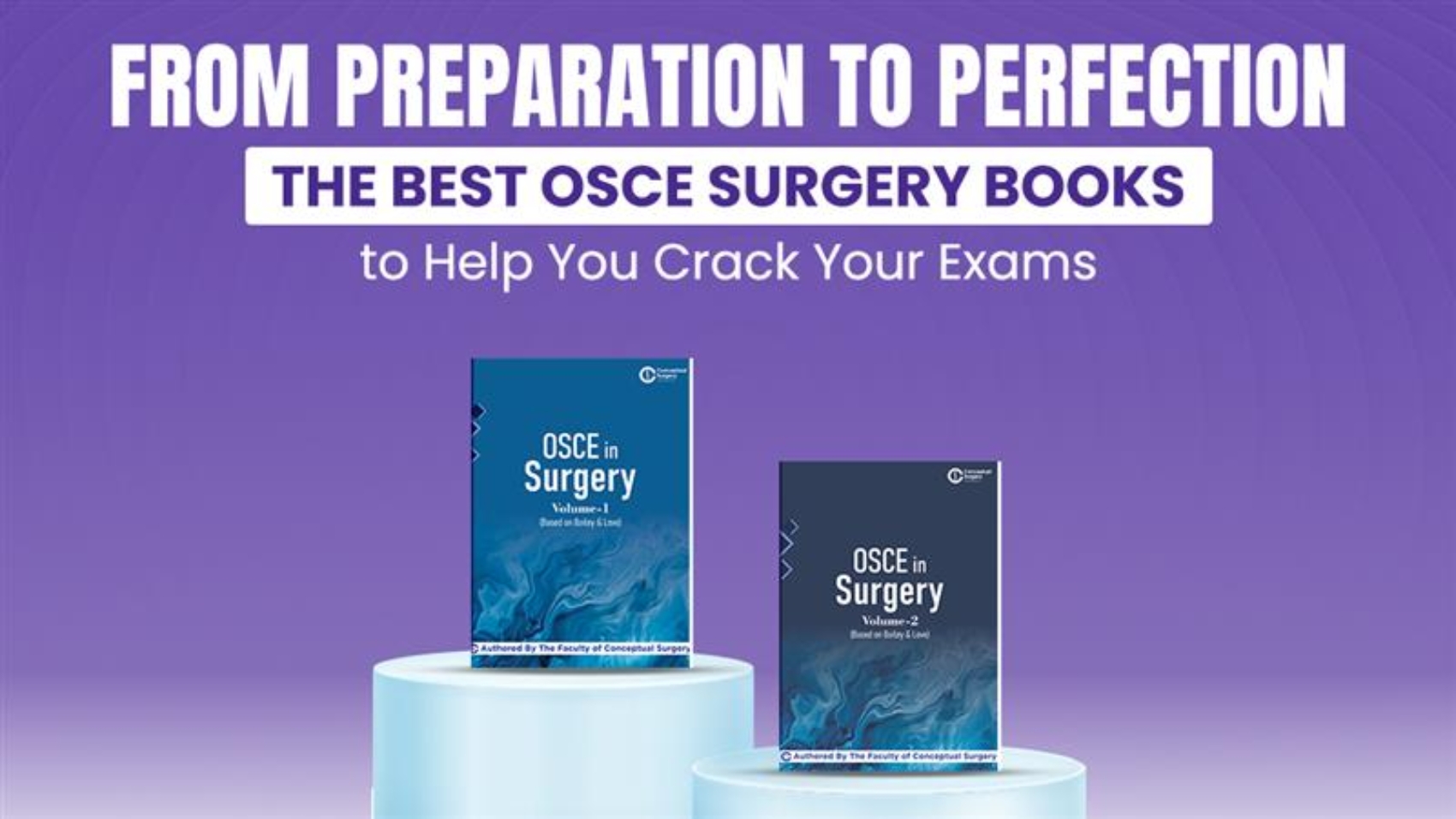
From Preparation to Perfection: The Best OSCE Surgery Books to Help You Crack Your Exams 

Estimated reading time: 3 minutes

Preparing surgical practical can feel sometimes very overwhelming, especially when OSCEs (Objective Structured Clinical Examinations) play such a conclusive role in clearing your exams. But what if you had a resource designed specifically to simplify this process? 

Dr. Apurv Mehra from Team eConceptual introduces one of the most powerful tools for surgery residents: the Conceptual Surgery OSCE books, crafted under the guidance of Dr. Amrit Nasta and supported by a team of expert educators. 

Here you can see the full detailed video

Why OSCE Preparation Matters More Than Ever?

In today’s exam pattern, OSCEs have become a crucial component for DNB residents. They are not just another section—they often determine whether you pass your practical exams. This makes focused and structured preparation absolutely essential. 

What Makes These OSCE Books Stand Out? 

These books are not your typical theory-heavy guides. Instead, they are designed to match the real exam format: 

  • Chapter-wise and topic-wise structure which is actual for easy way to learn 
  • Clinical scenarios with questions and answers to replicate the real OSCE stations  
  • Concise, exam-oriented content to help you revise your syllabus faster  
  • Color-coded format (questions and answers that are clearly separated) for quick learning  

This approach keeps you very well engaged and helps you cover the vast syllabus in minimal time, which is something every resident actually needs. 

What’s Inside the Two Volumes? 

The OSCE series is divided into two comprehensive volumes: 

Volume 1 includes:    
  • General Surgery  
  • Pediatric Surgery  
  • Preoperative Care  
  • Trauma & Burns  
  • Plastic Surgery and Head & Neck  
Volume 2 continues with: 
  • The topics will be advance and extended clinical scenarios  
  • The same structured has Q&A format for consistency and ease  

Each topic is broken down into very simple, quick-flow questions and answers, which making it easier to grab the core key concepts and recall them during exams. 

How These Books Can Transform Your Preparation?

What truly sets these books apart is their ability to train your mind for the OSCE format. Instead of passively reading, you actively engage with clinical scenarios, understand examiner expectations, and learn how to present precise answers. 

According to Dr. Apurv Mehra, if you follow the structure and intent behind these books, they can genuinely elevate your performance and give you an edge in your exams. 

Final Thoughts 

However, If you’re also aiming to clear your surgical practical with so much confidence, along with structured preparation is the key, and these OSCE books are exactly built for that purpose. 

So, gear up, stay consistent, and step into your exams better prepared than ever. 

Happy learning—and see you on the other side of success!  

Share

How-to-Crack-Any-Thyroid-Case

How to Crack Any Thyroid Case — Complete Surgical Approach By Prof. Dr. Anurag Mishra 

Estimated reading time: 4 minutes

When it comes to surgical cases, thyroid is one topic you simply cannot afford to get wrong. The good part? If your basics are clear and your approach is structured, you can confidently handle almost any thyroid case in exams or clinics. 

Let’s break it down in a simple, practical way. 

Understanding the Thyroid — A Quick Recap 

Before jumping into cases, you need a mental picture of the thyroid gland. 

The thyroid lies in the front of the neck, just below the thyroid cartilage. It has: 

  • A central isthmus 
  • Two lobes on either side 

It is often described as a shield-shaped organ, sitting prominently in the anterior neck. 

👉 A very important clinical point: 
Any swelling in the front of the neck should be considered thyroid unless proven otherwise. 

Why Thyroid Swellings Matter 

As the thyroid enlarges, it can extend into the thoracic inlet — the space between: 

  • Vertebra posteriorly 
  • First ribs laterally 
  • Manubrium sterni anteriorly 

When this happens, the gland may compress nearby structures, especially veins, since they are easily compressible. This leads to pressure symptoms, which are clinically important. 

Key Anatomical Relations You Must Remember 

  • The thyroid is firmly attached to the larynx, so it moves with swallowing (deglutition). 
  • A pyramidal lobe may be present, extending upwards. 
  • It is connected embryologically to the tongue via the thyroglossal duct. If this persists, it can form a thyroglossal cyst, which moves with tongue protrusion. 
  • The gland is closely related to: 
  • Parathyroids 
  • Inferior thyroid artery (important surgical landmark, located deep behind the gland) 

How to Clinically Classify a Thyroid Swelling 

When you examine a thyroid swelling, classify it into: 

  1. Diffuse (smooth enlargement) 
    → Entire gland enlarged, no nodules 
  1. Solitary thyroid nodule 
    → Single nodule in one lobe 
  1. Multinodular goiter 
    → Multiple nodules in one or both lobes 

👉 If it’s a solitary nodule, always specify which lobe is involved. 
 

The 5 Questions You Must Answer in Every Thyroid Case 

This is the core of cracking any thyroid case. 

Whenever you present or think about a case, answer these five things: 

1. Anatomy 

  • Is it thyroid? 
  • Which lobe is involved? 
  • Is the isthmus involved? 

2. Pathology 

  • Diffuse / nodular / multinodular 
  • Benign or malignant (if possible) 

3. Etiology 

  • Iodine deficiency 
  • Familial 
  • Malignancy-related mutations 

4. Stage of Disease 

  • Size of swelling 
  • Local pressure effects 
  • Lymph node involvement 
  • Metastasis 

5. Effect on the Patient 

  • Functional impact 
  • Symptoms affecting daily life 

👉 If you can answer these five points clearly, your diagnosis is almost complete. 

History Taking in Thyroid Cases 

History is where your diagnosis begins. 

1. Neck Swelling 

Ask about: 

  • Duration 
  • Progression 
  • Rapid increase in size → may suggest malignancy 

2. Pressure Symptoms 

Large thyroid swellings can compress nearby structures: 

  • Esophagus → Dysphagia 
  • Trachea → Dyspnea 
  • Recurrent laryngeal nerve → Hoarseness 
  • Severe cases → Stridor 

3. Functional Symptoms 

You must always assess thyroid function. 

Hyperthyroidism (High activity) 

Think of it like a high adrenaline state: 

  • Weight loss 
  • Palpitations 
  • Tremors 
  • Heat intolerance 
  • Anxiety 

👉 This happens because thyroid hormones increase adrenergic receptor activity, making the body more responsive to adrenaline. 

Hypothyroidism (Low activity) 

Opposite picture: 

  • Weight gain 
  • Lethargy 
  • Cold intolerance 

4. Endemic History 

Earlier, goiter was common in iodine-deficient regions like the Himalayas. 
Interestingly, it was once seen as a normal or even desirable feature in some communities. 

Now, with widespread use of iodized salt, this has reduced significantly. 

5. Important Risk Factors 

Always ask about: 

  • Radiation exposure in childhood 
  • Family history of thyroid cancer or endocrine disorders 
  • Previous thyroid disease or surgery 

👉 One practical tip: 
When taking history from female patients, make sure you clarify maternal family history, as they may sometimes refer to the husband’s side instead. 

Final Takeaway 

Thyroid cases are not difficult if your approach is systematic. 
Don’t try to memorize everything randomly—just stick to a structured framework: 

  • Identify the swelling 
  • Classify it 
  • Answer the 5 key questions 
  • Take a focused history 

Do this every time, and you’ll rarely go wrong. 

Share

Dr. Prof. Anurag Mishra

How to Choose the Right Field and College: A Practical, No-Confusion Guide By Dr. Prof. Anurag Mishra 

Estimated reading time: 5 minutes

Choosing your postgraduate field and college is one of those decisions that stays with you for life. Yet, most students reach this stage feeling unsure, anxious, and pulled in different directions by advice from seniors, parents, friends, and social media. 

Some say, “Take the best college you’re getting.” 
Others insist, “Never compromise on your branch.” 

So what should you really do? 

This blog breaks down a simple, logical, and very practical way to choose both your field and your college, based on how doctors actually think once they’ve spent years in practice. 

Course or College: Which One Comes First? 

This is usually the first dilemma. 

Imagine this: 
You introduce yourself and say, “I’m a surgeon.” 
Only later do you add where you studied. 

Your specialty becomes your identity for the rest of your life. The college matters, yes, but the branch defines your daily work, your lifestyle, your stress, and your satisfaction. 

A simple rule that works: 
  • If you are very clear about your dream branch → choose the course first 
  • If you are confused between multiple branches → a good college is a safer choice 

There’s no one-size-fits-all answer. Clarity about yourself is what matters. 

Step One: Understand Yourself Before Choosing Any Branch 

Every medical branch is good. 
But not every branch is good for every person. 

Before asking others which branch to take, ask yourself: 

  • What kind of life do I want? 
  • What excites me and what drains me? 
  • How much sacrifice am I realistically okay with? 

This is something no counselor or senior can answer for you. 

Step Two: List What Actually Matters to You 

Sit down and write your priorities. Don’t overthink it. Common factors include: 

  • Passion for the subject 
  • Money and financial stability 
  • Work–life balance 
  • Professional satisfaction 
  • Ease of practice after residency 
  • Opportunities in India 
  • Scope abroad 
  • How early you want to settle 
  • Respect and recognition 

Some people value money more. 
Some value peace of mind. 
Some want intense clinical work. 

None of these are wrong. 

Step Three: Decide What Matters More (This Is Crucial) 

Now comes the honest part. 

Give importance scores out of 100 to each factor—but keep this rule in mind: 

👉 The average should be around 50 

This forces real choices. 

If passion is extremely important to you and you give it 90, something else has to drop. Maybe work–life balance gets a 30. That’s how real life works. 

You can’t have everything at 90. 

Step Four: Rate Each Branch Based on Reality 

Now look at the branches you’re considering—medicine, surgery, radiology, or any others. 

For each branch, rate how well it fits your criteria: 

  • Does it actually give early settlement? 
  • Is the work–life balance truly manageable? 
  • How is practice after 10–15 years? 
  • What do people already in the field say? 
One important mistake to avoid: 

Don’t speak only to first-year residents. 

Also talk to: 

  • Senior residents 
  • Doctors 10–20 years into practice 
  • Faculty members 

Social media opinions are loud—but not always reliable. 

Step Five: Let Logic Do the Work 

Multiply: 

  • How important something is to you 
  • With how well the branch offers it 

When you add everything up, you’ll see something interesting: 
One branch naturally starts standing out for you. 

Not because it’s popular. 
Not because someone told you to take it. 
But because it fits your priorities. 

Now That the Branch Is Clear — How Do You Choose a College? 

The same thinking applies. 

Different colleges shine in different ways. 

Step One: Decide What You Want From a College 

Think about: 

  • Clinical exposure 
  • Work environment 
  • Teaching quality 
  • Brand value 
  • Research opportunities 
  • Technology and infrastructure 
  • Alumni network 
  • Bond rules 
  • Hostel and location 
  • Language and city comfort 

A surgical resident may value clinical load more. 
Someone else may value academics or alumni support. 

Step Two: Give Importance to Each Factor 

Again, be realistic. 
Residency is temporary—but its impact is permanent. 

Some discomfort is okay for two or three years. Some things aren’t. 

Step Three: Talk to the Right People 

For colleges: 

  • Speak to current residents (they know the ground reality) 
  • Talk to alumni (they know the long-term impact) 
  • Faculty can give insight into academics and future direction 

Online reviews help—but take them lightly. 

Step Four: Rank, Don’t Guess 

When you score and rank colleges honestly, the list becomes clear. 

No overthinking. 
No regret. 
No last-minute panic. 

Final Thoughts 

Big career decisions shouldn’t be made on: 

  • Random advice 
  • Fear of missing out 
  • “Everyone is taking this branch” 

When you take time to understand yourself, gather real information, and apply basic logic, your decision feels calm, even if it’s difficult. 

And that calm is a good sign. 

Choose what fits you, not what impresses others. 

Share