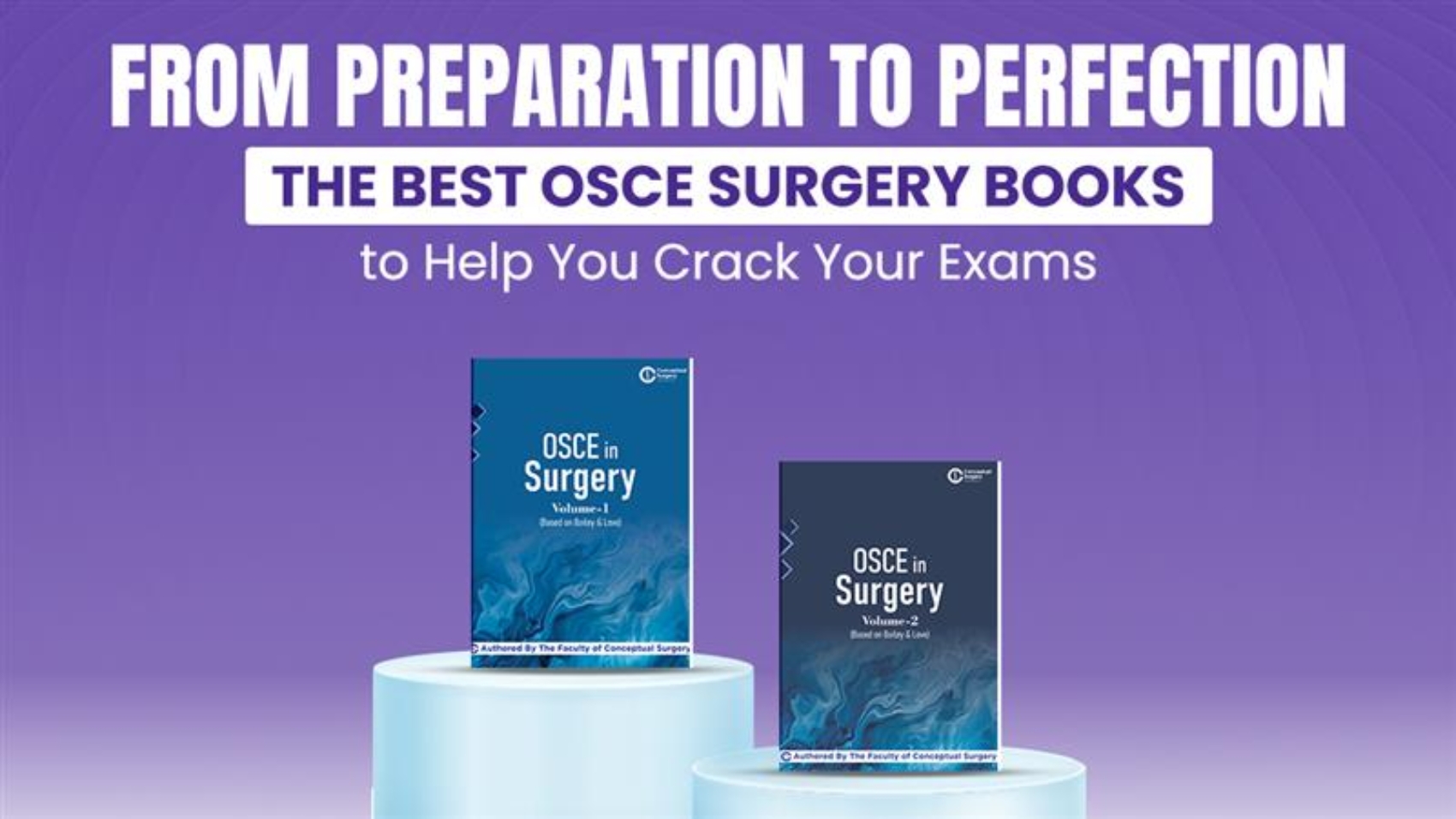
Preparing surgical practical can feel sometimes very overwhelming, especially when OSCEs (Objective Structured Clinical Examinations) play such a conclusive role in clearing your exams. But what if you had a resource designed specifically to simplify this process?
Dr. Apurv Mehra from Team eConceptualintroduces one of the most powerful tools for surgery residents: the Conceptual Surgery OSCE books, crafted under the guidance of Dr. Amrit Nasta and supported by a team of expert educators.
In today’s exam pattern, OSCEs have become a crucial component for DNB residents. They are not just another section—they often determine whether you pass your practical exams. This makes focused and structured preparation absolutely essential.
What Makes These OSCE Books Stand Out?
These books are not your typical theory-heavy guides. Instead, they are designed to match the real exam format:
Chapter-wise and topic-wise structure which is actual for easy way to learn
Clinical scenarios with questions and answers to replicate the real OSCE stations
Concise, exam-oriented content to help you revise your syllabus faster
Color-coded format (questions and answers that are clearly separated) for quick learning
This approach keeps you very well engaged and helps you cover the vast syllabus in minimal time, which is something every resident actually needs.
What’s Inside the Two Volumes?
The OSCE series is divided into two comprehensive volumes:
Volume 1 includes:
General Surgery
Pediatric Surgery
Preoperative Care
Trauma & Burns
Plastic Surgery and Head & Neck
Volume 2 continues with:
The topics will be advance and extended clinical scenarios
The same structured has Q&A format for consistency and ease
Each topic is broken down into very simple, quick-flow questions and answers, which making it easier to grab the core key concepts and recall them during exams.
How These Books Can Transform Your Preparation?
What truly sets these books apart is their ability to train your mind for the OSCE format. Instead of passively reading, you actively engage with clinical scenarios, understand examiner expectations, and learn how to present precise answers.
According to Dr. Apurv Mehra, if you follow the structure and intent behind these books, they can genuinely elevate your performance and give you an edge in your exams.
Final Thoughts
However, If you’re also aiming to clear your surgical practical with so much confidence, along with structured preparation is the key, and these OSCE books are exactly built for that purpose.
So, gear up, stay consistent, and step into your exams better prepared than ever.
Happy learning—and see you on the other side of success!
You know what, there is one question which is frequently asked among young doctors is, ‘What is DNB in Surgery?’ Especially when we talk about postgraduate surgical training in India,
This is one of the most respected postgraduate qualifications, Diplomate of National Board (DNB) in General Surgery, which is identical in recognition and value to an MS (Master of Surgery) degree. However, it contains a training structure, an evaluation system, and an examination process that have their own unique features.
This is your ultimate guide that covers everything about DNB Surgery you need to know, from the DNB entrance exam to eligibility, training modules, the DNB examination, practicals, DNB theory papers, and career prospects after completion.
DNB Examination Structure and Process
1. What is DNB in Surgery? Understanding the Course
So basically, the DNB Surgery is a postgraduate surgical residency training program that is conducted by the National Board of Examinations in Medical Sciences (NBEMS). It’s a very structured program that is especially designed to train doctors in their fundamental surgical skills, which include operative decision-making and proper patient management across all major surgical disciplines.
The DNB qualification holds equal value to the MD/MS degrees awarded by universities and is recognized by the National Medical Commission (NMC) and the Government of India.
This makes it an excellent choice for aspiring surgery residentswho want high-quality, hands-on exposure in real clinical settings.
2. Duration and Course Structure of DNB Surgery
The DNB General Surgery program is basically 3 years long for post-MBBS residents. Those who have already completed their postgraduate diploma in surgery can definitely pursue a two-year secondary DNB course.
Training Overview
Year 1: Basics of surgical anatomy, wound management, aseptic techniques, and first-assist experience in surgeries.
Year 2: Rotations through surgical subspecialties (urology, orthopedics, oncology, plastic surgery), involvement in emergency care, and DNB preparation for theory exams.
Year 3: Independent case management, advanced surgeries, research work, and OSCE training for final practical evaluation.
The surgery residency training program ensures that residents develop not just operative skills but also clinical judgment and research aptitude.
3. Eligibility Criteria for DNB Surgery
If a resident wants to pursue DNB Surgery, they must:
They should have an MBBS degree from a recognized medical institution.
With that, they should have permanent or provisional registration with the NMC or State Medical Council.
Residents need to qualify in the NEET PG examination, which basically serves as the DNB entrance exam for postgraduate medical seats in India.
4. Admission Process for DNB Surgery
Admission to DNB Surgery is concentrated and conducted by the Medical Counselling Committee (MCC), which is based on NEET PG scores.
Steps to Admission
They need to qualify NEET PG / DNB entrance exam.
Then they have to register for MCC counselling, which is officially under the DNB Post-MBBS category.
Residents should be required to participate in the choice filling and locking of preferred hospitals or institutes.
Their Seat allotment is typically based on NEET PG rank and seat matrix.
The Document verification and joining are provided at the allotted center.
DNB training is offered across reputed NBEMS-accredited hospitals, including both government and private medical institutions.
5. Training Experience and Clinical Exposure
During the DNB Surgery training, residents gain subjection to multiple voluntary and emergency surgical cases in overloaded patients in hospitals.
The key features of the DNB Surgery residency program are:
They need to gain experience in various surgical procedures in multiple departments
Residents need to actively participate in ward rounds, operating theaters, and the trauma unit.
It is very much compulsory in research and composition preparation.
They can also participate in OSCE courses and exam preparation sessions before the final practical exam happens.
Regular internal assessment and evaluation by an external examiner.
6. The DNB Examination Pattern and Evaluation
The DNB examination evaluates both theoretical knowledge and clinical competence. It is known for its depth, objectivity, and national-level uniformity.
A. DNB Theory Papers
There are 4 DNB theory papers, each carrying 100 marks.
The DNB Paper pattern includes both short and long-answer questions.
Topics include general surgical principles, gastrointestinal surgery, urology, plastic surgery, pediatric surgery, trauma, and anesthesia.
Residents must achieve a minimum of 50% aggregate to qualify for practicals.
B. Practical / Clinical Examination
You know, when the residents clear their DNB theory, they have to appear for the DNB OSCE (Objective Structured Clinical Examination) and Viva Voce as well.
Residents know that OSCE training is very crucial at this stage, which typically involves simulation-based case discussions, medical image analysis, surgical instrument identification, and clinical decision-making exercises.
The DNB OSCE ensures that each candidate has strong practical skills, awareness of patient safety, and effective clinical decision-making.
7. DNB vs MS in Surgery, Key Differences
Aspect
DNB in Surgery
MS in Surgery
Conducted by
NBEMS
Medical Universities
Training Location
Accredited hospitals
Medical colleges
Evaluation
Centralized DNB exam
University exams
Exposure
High-patient-volume hospitals
Structured college setup
Difficulty Level
Higher (especially DNB theory papers and OSCE)
Moderate
Recognition
Equivalent to MS
Recognized by NMC
Both are recognized qualifications, and a DNB General Surgeon is equally eligible for super-specialty courses (MCh/DNB SS) and teaching positions across India.
8. Daily Life of a DNB Surgery Resident
A surgery residency is demanding yet deeply fulfilling. The day of a DNB trainee involves:
They have to go on early morning ward rounds
Residents have to give pre- and post-operative care
They have to assist and perform surgeries
Attending regular academic discussions and DNB preparation sessions
Residents have to prepare case presentations for the DNB exam and the OSCE course
The training nurtures precision, discipline, and decision-making, the core of every successful surgeon’s identity.
9. Career Opportunities After DNB Surgery
Upon completing DNB in Surgery, multiple paths open up:
General Surgeon: Work in hospitals or private setups.
Teaching Faculty: Eligible for Assistant Professor and higher academic roles.
Private Practice: Build a specialized surgical clinic or group practice.
Super-specialization: Pursue MCh or DNB SS in fields such as:
Urology
Surgical Oncology
Cardiothoracic Surgery
Neurosurgery
Plastic Surgery
International Recognition: Many DNB graduates successfully qualify for PLAB, USMLE, or other global licensing exams.
The DNB qualification thus serves as a solid foundation for advanced SS preparation and global surgical careers.
Conclusion: The Pathway to Surgical Excellence
Can you imagine that pursuing a DNB in Surgery is not just an academic option; it is a professional change.
Overall, the concentrated surgery residency, basically very much challenging the DNB theory, accurate DNB exams, and a practical OSCE course training, this program casts you into a surgeon who balances both of things like technology and science, as well as compassion and exactness.
It is quite difficult for those who put in the hard work and discipline, but you know, DNB Surgery proves to be one of the most rewarding journeys in modern medicine for residents. This program provides global opportunities for teaching, research, and super-specialization for secure their future.
Preparation for NEET SS Surgery can be intimidating, particularly with the huge syllabus, time management during residency, and without proper guidance. But with the right platform, proper books, and expert guides, cracking NEET SS Surgery is not only possible, it’s within reach.
If you are looking to take the super-specialty (SS) residency in Surgery, this blog will give information about the exam pattern, how to prepare strategically, and why Conceptual Surgery is the best way to prepare for NEET SS.
What is NEET SS?
NEET SS (National Eligibility cum Entrance Test for Super Specialty) is an entrance test for admission into DM/MCh courses in India. It is organised by the National Board of Examinations (NBE).
NEET SS Exam Details:
Events
Details
Conducting Body
National Board of Examinations (NBE)
Eligibility
MS/DNB Degree holders (or appearing candidates)
Mode of Exam
Online (CBT)
Duration
2.5 hours (150 minutes)
Type of Questions
MCQs (Multiple Choice Questions)
Number of Questions
150
Total Marks
600
Marking Scheme
+4 for correct, -1 for incorrect
NEET SS Preparation Strategy
Cracking NEET SS Surgery demands a focused strategy, particularly if you are a resident in surgerywith clinical responsibilities to attend to besides studies. Here you will get the idea of how to start your preparation:
1. NEET SS Exam Overview
Learn the subject weightage, topics asked most commonly, and MCQ pattern. Pay attention to high-yield subjects, including oncology, trauma, thyroid, breast, and GIT.
2. Begin Early with Consistency
Make use of your MS/DNB second and third years to develop solid theoretical and clinical principles.
3. Practice MCQs Daily
Daily MCQ practice not only enhances recall but also enhances exam temperament.
4. Revise with Purpose
The last 2 months must be kept aside for revision by way of short notes, earlier attempted MCQs, and mock papers.
Why Select Conceptual Surgery for NEET SS Preparation?
Complete Coverage of SS-Level Topics
Conceptual Surgery is more than PG-level education. The platform is made to educate surgery residents in such a manner that they become NEET SS-ready, through structured learning pathways, operative videos, clinical discussions, and MCQs.
Top Faculty Panel for Surgery Residents
Study with a panel of leading surgeons and academic guide mentors such as Prof. Dr. S. K Nair, Prof. Dr. Arun Kakar, Prof. Dr. R. C. M Kaza, and many more.
NEET SS-Specific Videos and Notes
All the sessions are planned to cover high-yield concepts with explanation laid out specifically for NEET SS. The app also offers NEET SS Surgery notes compiled by toppers and experts.
Top-Rated App for NEET SS Preparation
It could be mobile or desktop, eConceptual app offers seamless access to theory, MCQs, case discussions, and mock tests—under one umbrella.
Best NEET SS Preparation Books
Conceptual Surgery also offers set of 2 books are famous for their clarity, organisation, and MCQ-based learning. Starting from General Surgery to system-wise concepts, they give you just what an NEET SS aspirant requires.
Mock Tests, Live Tests, and Personalised Feedback
The app continuously conducts mock tests with live ranking, topic-wise MCQ sessions, and SS preparation strategy videos to keep you ahead.
Final Words
Cracking NEET SS Surgery is about smart work, right guidance, and focused learning. With Conceptual Surgery App, you’re not just preparing for an exam—you’re preparing to be a better surgeon.
Download the eConceptual App Now
Start your journey with structured courses, surgery-specific notes, and actual mentorship—all specifically designed for NEET SS aspirants.