NEET SS 2026

NEET SS 2026: Two Months Left, A Focused Roadmap to Smarter Surgical Preparation 

Estimated reading time: 3 minutes

Two months out from NEET SS, you likely already know which surgical topics feel comfortable and which ones make you hesitate. What’s hard now is revising all of it while keeping up your clinical understanding, your question practice and your duties on the ward. 

Skip the extra resources. Spend the time linking surgical concepts together, recognising clinical signs and understanding how a case is approached. Conceptual Surgery combines expert-led lectures, clinical demonstrations, mentorship and curated books to support you with that. 

How to Prepare for NEET SS in the Last Two Months? 

1. Identify the Concepts That Still Need Work 

Not every topic needs the same amount of revision. Begin with your weak areas, the mistakes you’ve made before and the concepts you can’t seem to recall. Build your weekly targets around those gaps, and keep revising the core surgical topics alongside. 

2. Connect Theory with Clinical Practice 

Knowing a condition from a textbook is one thing. Spotting it in a patient is another. Practise reading clinical signs, making sense of examination findings and structuring a case presentation. It helps your theory line up with how surgical cases are actually assessed. 

Conceptual Surgery has clinical case demonstrations, patient presentations and clinical examination videos for this kind of hands-on learning. 

3. Use Question Practice to Guide Revision 

When a question session ends, don’t stop at the score. Ask what went wrong. Did you miss a clinical clue? Confuse two conditions? Fail to apply a concept? Go back to the topic behind the question instead of just memorizing the right answer. 

Note down the mistakes you keep repeating, and use that list to plan your next revision session. 

4. Follow a Realistic Two-Month Plan 

Month 1: Revise core surgical concepts, deal with your weak areas and solve questions regularly. 

Month 2: Concentrate on mock tests, repeated revision, clinical understanding and fixing your mistakes. 

Final week: Go back to notes you already know and the important concepts. Don’t bring in a pile of new resources. 

You’re a resident, so your plan has to work around your duties. Targets you can hit every day are worth more than a timetable you can’t keep up. 

Why Conceptual Surgery? 

Conceptual Surgery gives residents and practicing surgeons a way to build up their knowledge and skills at every stage of their careers. 

  • Comprehensive HQ Video Lectures: Learn from teachers with 35–60 years of experience as MS/DNB Surgery examiners. 
  • Clinical Cases & Presentations: See demonstrations of clinical examinations, patient presentations and clinical signs. 
  • Exclusive Mentorship Programs: Take part in live interactive sessions, get your doubts cleared and receive thesis guidance. 
  • Six Curated Books: Back up your learning and revision with a well-organized set of surgical study material. 

Make Your Final Two Months Count 

Preparing for NEET SS while working as a resident takes focus. Find your weak areas, tie concepts to clinical practice, go through your mistakes, and keep revising. 

Expert teaching, clinical demonstrations and mentorship from Conceptual Surgery can support you as you prepare for NEET SS and build your surgical knowledge. 

Revise with direction. Think clinically. Prepare with purpose. 

Share

Dr. Amrit Nasta

DNB Surgery Paper Discussion: GERD, Anti-Reflux Surgery & Bilioma By Dr. Amrit Nasta 

Estimated reading time: 7 minutes

Another important lecture has been added to Conceptual Surgery, covering a few questions that are quite familiar to anyone preparing for DNB Surgery. 

The questions are not very complicated. The real challenge is knowing what to write and how to present it in the exam. 

In this discussion, Dr. Amrit Nasta takes up three useful areas: GERD scoring systems, complications of anti-reflux surgery, and bilioma after cholecystectomy. 

Let’s quickly go through the important points. 

GERD Scoring Systems: What Should You Remember? 

If you get a question on scoring systems for GERD, don’t just write down a list of names. Mention what each score is actually used for. 

The main ones worth remembering are: 

1. DeMeester Score 

Think of 24-hour pH monitoring when you hear DeMeester score. 

A nasal catheter records acid exposure in the distal esophagus over 24 hours. The patient’s symptoms can also be matched with reflux episodes. 

The commonly remembered normal value is: 

DeMeester score <14.7 

A higher score suggests abnormal acid reflux. 

For the exam, write the test, what it measures and the significance of the score. That’s usually enough to build a good answer. 

2. LA Classification 

This one is much more straightforward. 

The Los Angeles classification is used during endoscopy to grade the severity of reflux esophagitis. 

It has four grades: 

  • Grade A 
  • Grade B 
  • Grade C 
  • Grade D 

The grading is based on the extent of mucosal breaks and their relation to the esophageal mucosal folds and circumference. 

If you’re asked about GERD scoring systems, LA grading is one you should not miss. 

3. Quality-of-Life / Symptom Scores 

GERD isn’t only about what is seen on endoscopy. The patient’s symptoms matter too. 

Questionnaire-based scoring can assess things like: 

  • Heartburn 
  • Dysphagia 
  • Frequency and severity of symptoms 
  • Effect on day-to-day life 

These scores can also be compared before and after treatment to see whether the patient has actually improved. 

4. Hill Classification 

The Hill classification is slightly different. 

It is mainly used to assess the gastroesophageal junction and the gastroesophageal flap valve, and is particularly useful when discussing hiatus hernia. 

In simple terms, it gives an idea about how tight or lax the gastroesophageal junction is. 

Quick Way to Remember 

For GERD, keep these four names in mind: 

DeMeester → 24-hour pH study 
LA → Endoscopy 
Quality-of-life score → Symptoms 
Hill → GE junction / hiatus hernia 

That small association can save you time during the exam. 

Complications of Laparoscopic Anti-Reflux Surgery 

This is another question where presentation matters. 

Don’t write every complication in one long paragraph. Divide them into intraoperative, early postoperative and late complications. 

It instantly makes the answer easier to read. 

Intraoperative Complications 

During port insertion, you can have: 

  • Epigastric vessel injury 
  • Bowel injury 
  • Other port-related injuries 

During dissection around the GE junction, possible injuries include: 

  • Esophageal perforation 
  • Gastric perforation 
  • Splenic injury 
  • Injury to the pancreatic tail 
  • Pneumothorax 

Early Postoperative Complications 

Dysphagia is an important one to remember. 

Some patients have temporary dysphagia because of postoperative edema around the wrap. It may settle with time. 

Other early problems can include: 

  • Gas-bloat syndrome 
  • Atelectasis 
  • Infection 
  • Persistent dysphagia 

Late Complications 

Later on, the patient may develop: 

  • Persistent dysphagia 
  • Recurrent or persistent GERD 
  • Inadequate reflux control 
  • Wrap migration or herniation 
  • Rarely, vagal nerve injury 

One Exam Tip 

Whenever you see a question asking for complications, stop yourself from writing a random list. 

Make categories. 

Intraoperative → Early → Late 

It takes almost no extra time but makes your answer look much more organised. 

Bilioma After Cholecystectomy 

Now comes a very practical question: What causes a bilioma after cholecystectomy, and how do you manage it? 

A bilioma is basically a collection of bile outside the biliary system because of a bile leak. 

After cholecystectomy, the first thing you should think about is a cystic duct stump leak. 

What Can Cause the Leak? 

There are several possibilities: 

Cystic duct stump leak 

  • Clip slippage 
  • Ligature failure 

Bile duct injury 

  • Accessory bile duct injury 
  • Right posterior sectoral duct injury 
  • Common hepatic duct injury 
  • CBD injury 

Thermal injury 

A bile duct can also be injured by heat during dissection. 

Distal obstruction 

An unrecognised CBD stone can increase pressure within the biliary system and contribute to leakage from the cystic duct stump. 

Bile spillage during gallbladder perforation can also contribute to a collection. 

For a four-mark question, don’t overcomplicate it. Give the causes in a clear structure and move on. 

How Do You Manage a Bile Leak? 

This is where the clinical situation becomes important. 

Imagine a patient who has undergone cholecystectomy and comes back after a day or two with: 

  • Right upper quadrant pain 
  • Fever 
  • Abdominal tenderness 

A bile leak should be high on your list. 

1. Admit and Assess 

Don’t simply treat it as routine postoperative pain. 

Admit the patient and assess the severity. 

A significant bile leak can become serious if it is not managed appropriately. 

2. Look for the Collection 

Imaging helps confirm whether a bilioma has developed. 

Ultrasound can be used as an initial investigation, while a CT scan can give a better idea about the collection and its extent. 

3. Drain the Bilioma 

Once the collection is identified, the next step is drainage. 

A suitable collection can often be managed with image-guided percutaneous drainage, such as a pigtail catheter. 

If the patient presents with peritonitis or a large infected collection, surgical drainage and lavage may be necessary. 

4. Find the Source of the Leak 

Once the patient is stabilised, the next question is: 

Where exactly is the bile coming from? 

Depending on the situation, MRCP or ERCP can help identify the source. 

5. Treat the Leak 

If the leak is suitable for endoscopic treatment, ERCP with biliary stenting can be used. 

However, major bile duct injuries are a different situation. 

If there is a significant proximal duct injury or an injury that cannot be managed with endoscopic stenting, the patient may eventually require biliary reconstruction. 

What Should You Take Away From This Lecture? 

For a quick revision, remember these points: 

  • DeMeester → 24-hour pH monitoring 
  • LA classification → Endoscopic grading of reflux esophagitis 
  • Hill classification → GE junction / flap valve assessment 
  • For anti-reflux surgery complications, write them as intraoperative, early and late. 
  • Dysphagia is an important postoperative complication. 
  • After cholecystectomy, always consider cystic duct stump leak when a patient develops a bilioma. 
  • Other causes include bile duct injury, accessory duct injury, thermal injury and distal obstruction. 
  • Management of bile leak can be remembered as: 
    Stabilise → Image → Drain → Locate the leak → Treat 
  • ERCP with stenting can help in suitable leaks. 
  • Major bile duct injuries may require delayed reconstruction. 

New Lecture Dropped on Conceptual Surgery! 

Want more such important DNB discussions, repeat questions and exam-focused surgical lectures? 

A new lecture is now available on Conceptual Surgery. 

Download the eConceptual App and subscribe to Conceptual Surgery to access more such high-yield lectures and make your residency preparation more focused. 

Watch Complete Video: DNB Surgery Paper Discussion: GERD, Anti-Reflux Surgery & Bilioma By Dr. Amrit Nasta 

Share

NEET SS 2026 Surgery

NEET SS 2026 General Surgery: How to Build Your Rank While Surviving Residency 

Estimated reading time: 7 minutes

If you are aiming for NEET SS 2026 General Surgery to get your dream MCh seat, you are probably checking the NBEMS website every few days. We all want to know the exact exam dates to plan our lives. 
 
Right now, the exam is expected around December 2026. But let’s be real: even when the dates are announced, your hospital life will not slow down. Residency means endless ward rounds, emergency calls, night shifts, and long hours standing in the OT. Finding a continuous four or five-hour block to study is almost impossible. 
 
What you have right now is a quiet window of time. Squeezing out just one or two hours of steady study every day right now will completely change your results by the end of the year. 

Why You Can’t Cram at the Last Minute?

Surgery is a hands-on field, and the NEET SS exam pattern reflects that. You cannot pass this exam by trying to memorize bullet points or cramming factual lists in the final month. 

The questions are deeply clinical and case-based. 
The examiners want to see if you can think like a senior consultant. They will test your diagnostic skills, your choices inside the OT, and how you handle unexpected complications. 
 
Because your days are unpredictable a single emergency laparotomy can ruin your evening plans you cannot rely on huge weekend study marathons. A slow, steady habit of one or two hours a day on normal working days is the only way to cover this massive syllabus without burning out. 

Where Should You Start? 

Before opening thick textbooks like Sabiston or Bailey & Love, do an honest check of where you stand. 

Ask yourself these four questions: 

  • Which topics do I understand well because of my daily OT exposure? 
  • Which heavy subjects (like oncology or vascular surgery) do I keep avoiding? 
  • Am I confident in handling critical care and fluid management questions? 
  • Where do I get confused when looking at clinical treatment steps? 
     

Do not feel bad about your gaps. The goal is to find your weak spots early so you don’t waste time re-reading things you already know. Divide your topics into three simple lists: Strong, Average, and Needs Work. 

High-Yield Topics to Focus On 

Do not jump from a liver topic in the morning to a thyroid topic at night. It creates confusion. Pick one surgical system, finish its theory, solve its practice questions, and only then move to the next system. 
 
Focus your energy on these highly tested areas: 

1. GI and Hepatobiliary (HPB) Surgery 

This is the most important part of the exam. You must know it inside out. 

  • Key Topics: Stomach cancers, GERD, gallbladder stones and diseases, pancreatic tumors, liver cysts, and portal hypertension. 
  • Tip: Do not just learn the names of the surgeries. Understand why a specific surgical approach is chosen over another. 

2. Endocrine and Breast Surgery 

These are scoring areas if your basic concepts are clear. 

  • Key Topics: Thyroid nodules and cancers (follow the latest guidelines), parathyroid protocols, adrenal tumors, and the complete management of breast cancer. 

3. Trauma and Critical Care 

You see this every day in the casualty, but you need to know the textbook protocols for the exam. 

  • Key Topics: ATLS guidelines, damage control surgery, abdominal compartment syndrome, types of shock, fluid resuscitation, and nutrition for surgical patients. 

4. Pediatric and Neonatal Surgery 

Many residents avoid this section because it feels overwhelming. Do not make that mistake. 

  • Key Topics: Congenital diaphragmatic hernia, TEF (Tracheoesophageal Fistula), intestinal obstructions in newborns, and Hirschsprung’s disease. 

5. Vascular and Thoracic Surgery 

You don’t need to be a superspecialist, but you must know how to handle basic emergencies. 

  • Key Topics: Aortic aneurysms, peripheral arterial disease (PAD), DVT management, and chest trauma protocols. 

The Right Way to Use Previous Years’ Questions (PYQs) 

Do not use past papers just to test your score. Use them to understand the mind of the examiner. They show you exactly how clinical dilemmas are framed and where traps are hidden. 

When you solve a multiple-choice question (MCQ) and get it wrong, do not just look at the right answer and move on. Look at the other three options too. Figure out why they are wrong and in what situation they could be right. That is how you learn deeply. 

A Realistic Daily Target 

Be kind to yourself. Do not set impossible goals on busy hospital days. 

  • On heavy duty or OT days: Aim for 30–40 MCQs. 
  • On weekends or lighter days: Push for 70–80 MCQs. 

Understanding the explanations carefully matters much more than rushing through hundreds of questions. 

How to Remember What You Study?

The biggest mistake is reading a tough topic in January and not looking at it again until October. You will forget most of it. 

Use this simple, rolling revision plan: 

  1. After 48 Hours: Spend 10 minutes skimming the main points you highlighted two days ago. 
  1. After 1 Week: Spend 30 minutes looking over the system during the weekend. 
  1. After 1 Month: Solve a dedicated block of MCQs on that specific topic to check your memory. 

5 Common Mistakes to Avoid 

  • Waiting for the Notification: Waiting for the official timetable before you start studying seriously. 
  • Using Too Many Books: Hopping between three different apps and four textbooks. Stick to one reliable source. 
  • Skipping the Basics: Ignoring critical care, fluids, and nutrition because they don’t feel like “real” surgery. 
  • Passive Reading: Just highlighting lines in a book without testing yourself with questions. 
  • Overconfidence from OT: Assuming that because you saw a surgery in the OT, you know all its textbook complications and staging. 

Final Thoughts

Residency is exhausting, and it will take a lot out of you. But the months leading up to the exam will pass anyway. 

 You do not need to study for 12 hours a day starting tomorrow. You just need to show up for your studies with the same discipline you show up with for your patients.  
 
One hour after your evening rounds, or a few MCQs during a quiet moment in the casualty, will add up to hundreds of productive hours over the year. 
 
Stay steady, keep it simple, and trust your daily efforts. You can do this. 

Ready to Solidify Your Preparation? 

If you want to close the gap between being a busy resident and securing your dream MCh seat, you don’t have to do it alone. 

With Conceptual Surgery, we make your preparation simple, clear, and concept-driven. 

  • System-wise video modules built around the latest exam trends. 
  • Easy breakdowns of complex clinical guidelines and surgical algorithms. 
  • A high-yield question bank featuring authentic past years’ questions. 
  • Guidance from top surgical consultants who help you think like an examiner. 

Click Here to Know More: 
 
Don’t wait for the last-minute rush. Explore our study plans today and start preparing with confidence. 

Share

Dr. Sourav Chowdhury

Brain Tumors Made Simple: High-Yield Neurosurgery Concepts for Surgery Residents 

Brain Tumors Made Simple: High-Yield Neurosurgery Concepts for Surgery Residents

If you’re in surgical residency, you’ve undoubtedly faced brain tumor questions during ward rounds, case presentations, or viva exams. Neurosurgery often carries a reputation for being notoriously dense, but once you anchor yourself to a few foundational principles, the pathology becomes highly logical.

At Conceptual Surgery, we focus on stripping away the unnecessary noise so you can connect textbook theory directly to clinical practice. High-yield sessions like this are regularly updated on the Conceptual App, helping postgraduates solidify their core concepts while saving precious study time.

Understanding the Intracranial Space

A brain tumor is simply an abnormal cellular growth within the cranium or its surrounding membranes. While we classify them histologically as benign or malignant, the clinical reality is that any intracranial mass is potentially dangerous. Because the adult skull is a rigid, closed vault, even a histologically benign growth can cause devastating herniation syndromes.

Clinical Pearl: Location often trumps histology. A tiny, benign tumor in the brainstem or fourth ventricle can be far more catastrophic than a large, low-grade astrocytoma in a silent area of the frontal lobe.

Where Do Brain Tumors Actually Originate?

A common misconception is that primary brain tumors arise from neurons. In reality, mature neurons rarely replicate. Instead, the vast majority of primary central nervous system (CNS) tumors originate from glial cells—the supporting framework of the brain.

  • Astrocytes: The structural anchors that maintain the blood-brain barrier. (Give rise to Astrocytomas).
  • Oligodendrocytes: The cells responsible for myelinating CNS axons. (Give rise to Oligodendrogliomas).
  • Ependymal Cells: The ciliated lining of the ventricles and central canal. (Give rise to Ependymomas).
  • Microglia: The resident macrophages of the brain.

Adult Brain Tumors: The High-Yield Breakdown

Residents often trip up on the distinction between primary and secondary lesions.

The most common brain tumors encountered in adults are actually metastatic (secondary) tumors—cells that have traveled via the bloodstream from primary malignancies elsewhere, most commonly the lung, breast, melanoma, or kidney.

When it comes to primary adult tumors, these four should be at the top of your revision list:

1. Glioblastoma Multiforme (GBM)

GBM is the most common primary malignant brain tumor in adults. It is highly aggressive, infiltrates widely along white matter tracts (often crossing the corpus callosum as a “butterfly glioma”), and carries a notoriously challenging prognosis.

2. Astrocytoma

Varying from low-grade (pilocytic) to high-grade (anaplastic), these tumors arise from astrocytes and represent a broad spectrum of clinical behavior.

3. Oligodendroglioma

Classically presenting with calcification on CT scans and a “fried-egg” appearance on histology, these are essential to recognize in exam vignettes.

4. Meningioma

This is a perennial favorite for viva exams. Meningiomas are the most common primary brain tumor overall. They arise from the arachnoid cap cells, are typically benign, and sit outside the brain parenchyma (extra-axial). Do not confuse “most common primary tumor” (Meningioma) with “most common primary malignant tumor” (GBM).

Pediatric vs. Adult Tumors: The Anatomical Divide

The presentation, types, and locations of brain tumors in children are fundamentally different from those in adults.

Feature Adult Brain Tumors Pediatric Brain Tumors 
Primary Location Supratentorial (Cerebral hemispheres) Infratentorial (Posterior fossa, cerebellum, brainstem) 
Common Malignancy Glioblastoma Multiforme (GBM) Medulloblastoma 
Common Benign Lesion Meningioma Pilocytic Astrocytoma / Craniopharyngioma 

Core Pediatric Tumors to Remember:

  • Medulloblastoma: Highly malignant tumor of the posterior fossa, prone to CSF seeding.
  • Brainstem Glioma: Diffuse tumors with a challenging surgical profile due to critical nuclei locations.
  • Ependymoma: Frequently arises in the fourth ventricle, presenting with early hydrocephalus.
  • Craniopharyngioma: Sellar/suprasellar tumors derived from Rathke’s pouch, often causing visual and endocrine deficits.

Why Pediatric Tumors Are Easily Missed?

Diagnosing intracranial masses in infants and young children requires a high index of suspicion because the early presentation is incredibly subtle.

Because infants have open fontanelles and unfused cranial sutures, their skulls can expand to accommodate a slow-growing mass. Consequently, classic signs of increased intracranial pressure (ICP) like severe headaches or projectile vomiting may not appear until the tumor is quite large.

Instead, a child might simply present with developmental regression, irritability, poor feeding, or a subtle cross of the eyes.

Red Flags for Increased ICP in Children:

  • Persistent, unexplained vomiting (especially in the morning)
  • New-onset seizures
  • Regression or delay in developmental milestones
  • Rapidly increasing head circumference (crossing percentiles)
  • “Sunsetting” eyes (downward gaze due to pressure on the midbrain tectum)

High-Yield Summary Table

If you only remember a few sentences for your next ward round or exam, make it these:

Clinical Question High-Yield Answer 
Most common brain tumor overall Metastasis (Lung, Breast, etc.) 
Most common primary brain tumor Meningioma 
Most common primary malignant brain tumor Glioblastoma Multiforme (GBM) 
Most common malignant pediatric brain tumor Medulloblastoma 
Adult tumor territory Supratentorial 
Pediatric tumor territory Infratentorial
 

Final Thoughts for the Surgical Resident

Neurosurgery can feel overwhelming when you try to memorize every classification, grading system, and molecular marker in isolation. However, if you master the structural patterns—understanding cell lineages, adult vs. pediatric anatomy, and the physics of the closed cranium—the clinical details fall into place naturally.

Rote memorization fails under the pressure of a viva exam or a busy emergency shift. That is exactly why we built Conceptual Surgery. We focus on the why behind clinical presentations so you can confidently apply your knowledge at the bedside and in the exam hall.

If you found this breakdown helpful, you can access the full, deep-dive video lecture along with hundreds of other residency-focused sessions on the app.

Watch the Full Session:

🎓 Brain Tumor: An Overview | Dr. Sourav Chowdhury | Conceptual Surgery

DNB Master Solutions in Surgery (Vol. 1 & 2)

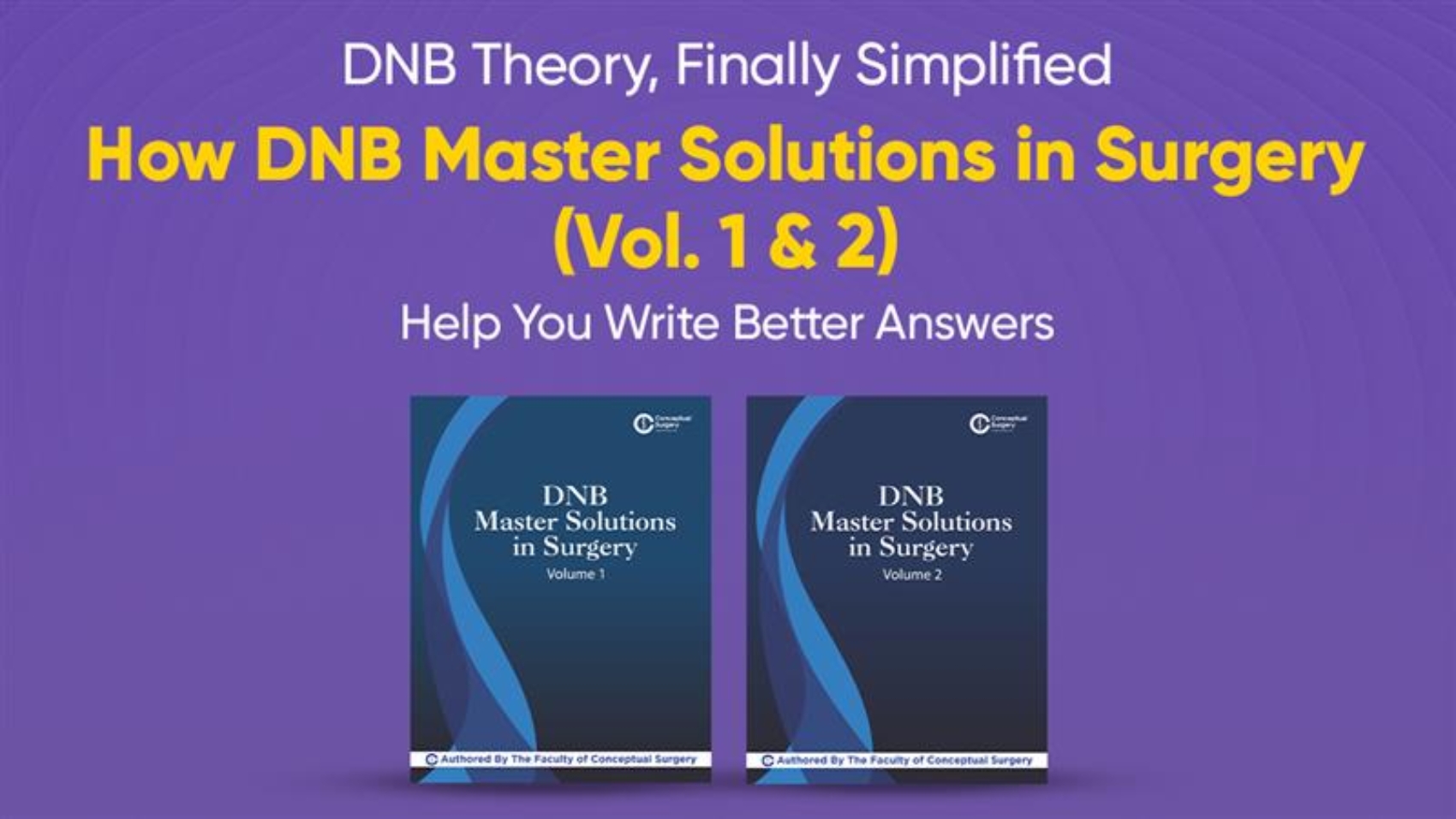
DNB Theory, Finally Simplified: How DNB Master Solutions in Surgery (Vol. 1 & 2) Help You Write Better Answers 

Estimated reading time: 4 minutes

If you’re preparing for the DNB theory exam, you’ve probably realized by now that knowing the subject isn’t the main issue; it’s writing the answer the right way under exam conditions. That shift, from knowledge to presentation, is where most surgery residents people lose marks. 

That’s exactly where DNB Master Solutions in Surgery – Volume 1 & Volume 2 by the faculty of Conceptual Surgery starts to make sense. These books don’t try to overload you—they help you focus on what actually gets asked and how to answer it properly. 

Volume 1: Recent Papers, Real Exam Insight (2024–2023) 

Volume 1 feels more like working with the latest exam mindset. 

It includes: 

  • Solved papers from 2024–2023  
  • Around 40 papers and 400 questions  
  • Clear, structured answers that are easy to follow  

What makes this volume especially useful is that it reflects current trends. When you go through it, you start noticing how questions are being framed now and what examiners expect in answers today. 

It also puts a strong focus on repeated, high-yield topics like hernia, wound management, biostatistics, and radiology. Instead of reading them once, you encounter them in different forms across questions—which actually helps in retention. 

If you’re closer to the exam, this is the volume you’ll probably rely on more for fine-tuning your preparation. 

Volume 2: Building the Base with Past Papers (2022–2020) 

Volume 2 complements Volume 1 by covering slightly older papers (2022–2020), but that doesn’t make it any less important. 

It includes: 

  • Solved papers from 2022–2020  
  • Around 40 papers and 400 questions  
  • Simple, easy-to-remember answers  

This volume is more about building your foundation. 

When you start with it, you get comfortable with: 

  • Common question patterns  
  • Answer structure  
  • How much detail is actually needed  

It’s a good place to begin because it eases you into answer writing without the pressure of “latest trends.” Once that base is set, moving to Volume 1 feels much smoother. 

What Both Volumes Do Well?(And Why It Matters) 

Across both books, a few things stay consistent: 

  • Real exam questions: You’re not guessing what’s important—you’re practicing what has already been asked  
  • Answer-writing clarity: The solutions are structured in a way you can actually reproduce in exams  
  • Time-saving: Everything is compiled—no need to search multiple sources  
  • Better revision: Easy to revisit before exams without feeling lost  

And if you’re using the Conceptual Surgery app alongside, the video + book combination makes revision even stronger. 

If you want to get a quick feel of how both DNB Master Solutions in Surgery – Volume 1 & Volume 2 are structured, you can explore the sample pages here: 

Volume 1: 

Volume 2: 

How to Use Them Without Overcomplicating Things?

A simple way to approach it: 

  • Start with Volume 2 to get comfortable with patterns and answer writing  
  • Move to Volume 1 to understand recent trends and refine your approach  
  • Closer to exams, revise both with a focus on repeated questions  

The goal isn’t to finish them quickly—it’s to start thinking in the format the exam expects. 

Final Thought 

Most resources help you study more. These books help you write better. 

And for DNB theory, that’s the difference between knowing the answer and actually scoring marks, something every surgery resident aiming for NEET SS surgery or higher exams eventually realizes. 

If used properly, DNB Master Solutions in Surgery – Volume 1 & Volume 2 gives you a clear, practical edge without making preparation unnecessarily complicated. 

Share

FET Exam

Cracking FET 2026 in One Month: Step-by-Step Guide for Conceptual Surgery 

Estimated reading time: 6 minutes

You’ve got one month to prepare for FET. One month. And you’re aiming for a superspecialty seat through FNB programs. Sounds impossible, right? 

It’s not. But you can’t afford to waste a single day. 

The Fellowship Entrance Test isn’t like your usual medical exams. NBEMS didn’t design it to reward people who cram facts the night before. Surgery candidates especially—they’re looking for something different. Can you think through a clinical problem? Do you actually understand the concept, or did you just memorize it long enough to write it down? 

A lot of people preparing for NEET SS also take FET. Makes sense, it’s another door into superspecialty training. Sometimes the backup plan becomes the main plan. 

Here’s how you make one month work. 

What FET Actually Tests (And Why That Matters)?

Before opening a single book, understand what you’re walking into. 

FET gets you into FNB programs across specialties. For surgery, it’s not testing whether you remember facts. It’s testing whether you can work through clinical scenarios. Whether you understand why something happens, not just that it happens. 

People preparing for NEET SS Surgery often sit for FET too. Same reason—it’s another legitimate path into superspecialty training. 

The FET 2026 Exam Pattern 

You need to know the structure before you start studying. Otherwise you’re preparing blind. 

Here’s what you’re dealing with: 

  • Computer-based exam 
  • Multiple choice questions 
  • Total questions depend on the NBEMS notification 
  • Takes about 2–3 hours 
  • Everything’s in English 

What they’re really checking: 

  • Do you know the basics cold? 
  • Can you use that knowledge when it matters clinically? 
  • Is your understanding actually solid, or just surface-level? 

Go through old FET question papers. Look at the FET 2026 pattern if it’s available. You’ll start seeing what matters. 

The Surgery Syllabus: Too Much to Cover, So Don’t Try 

The FET syllabus for surgery is massive. There’s huge overlap with NEET SS Surgery content. But here’s the hard truth: in 30 days, you cannot cover everything. Trying to do that guarantees you’ll know a little about everything and not enough about anything. 

What you should actually focus on: 

  • General surgery basics 
  • GI surgery 
  • Hepatobiliary and pancreatic surgery 
  • Colorectal surgery 
  • Surgical oncology fundamentals 
  • Trauma and critical care 
  • Perioperative management 
  • Surgical anatomy and physiology 

Depth beats breadth here. Always. 

Week-by-Week: How to Actually Use This Month 
Week 1: Stop Rushing, Start Building 

First week isn’t about questions. It’s about making sure your foundation isn’t shaky. 

Go through the high-yield topics. Use whatever concise notes or reference material you trust. Diagrams help. Flowcharts help. Decision trees, anything visual that makes the concept click and stay clicked. 

Good video lectures on conceptual surgery? Use them. But don’t get lost watching 50 different explanations of the same thing. 

What you’re after: Solid grasp of the topics that keep appearing in FET year after year. 

Week 2: Start Connecting Dots 

Now you solve problems. 

Pull out topic-wise MCQs from previous FET papers. Work through them, but don’t just check if you got it right. Connect what you’re reading in theory to what’s being asked in questions. 

Keep a running note of concepts that show up repeatedly. Track your mistakes. Write them down somewhere you’ll actually look at again. 

This is where knowing transforms into being able to use what you know. 

Week 3: Test Yourself Like It’s Real 

Take full-length mocks that mirror the FET 2026 structure. Not casually. Set a timer. Sit in one place. No phone. Simulate the actual exam as closely as possible. 

Then—and this matters more than the test itself—go through every single question afterward. Not just the ones you got wrong. All of them. Understand the logic. Understand why the wrong answers are wrong. 

At this level, one properly analyzed mock is worth more than five you just speed through for a score. 

Week 4: Lock It In 

Final week is not for learning new stuff. 

Review your short notes. Review your mistake log. Focus on the high-yield topics you know are tested frequently. 

Do not, seriously, do not pick up a new textbook or resource now. You’re tightening bolts, not building new furniture. 

What Actually Works (From People Who’ve Done This)?

Some tested advice for a one-month sprint: 

  • Go deep on fewer topics rather than skimming many 
  • Revise the same material multiple times instead of reading it once 
  • Pick two or three solid resources and stick with them 
  • Solve MCQs daily, but spend real time analyzing them 
  • Think like a surgeon making decisions, not a student recalling facts 
  • Study in focused bursts your brain can’t sustain 12-hour marathons for 30 days straight 
The Boring Admin Stuff You Can’t Ignore 

While you’re buried in surgery notes, don’t forget: 

  • Fill the FET application form properly and before the deadline 
  • Download your FET admit card as soon as it’s live 
  • Note down exam dates and any instructions 
  • Keep checking for FET result updates 

One missed deadline erases all your preparation. Don’t be that person. 

Why FET + NEET SS Makes Sense for Surgery Aspirants?

If you’re targeting SS Surgery, taking both FET and NEET SS isn’t overkill, it’s smart. 

NEET SS Surgery is brutal competition. FET opens up more seats through FNB programs. More seats, better chances. Simple math. 

Here’s What It Comes Down To 

Preparing for FET Surgery in 30 days isn’t about how long you sit with books open. It’s about how sharp your revision is and whether you can actually apply concepts under pressure. 

Focused preparation. Understanding the exam pattern. Using old question papers intelligently. Revising consistently instead of cramming desperately. 

That’s how you crack FET, even when the clock’s against you. 

Stay disciplined. Trust the process you’re following. And walk into that exam knowing you used every one of those 30 days well. 

Share

NEET SS Preparation

Why Conceptual Surgery Is the Smartest Platform for NEET SS Aspirants

Estimated reading time: 2 minutes

Dear aspirants, as NEET SS is almost one month away, most aspirants are worried about finishing the syllabus, revising effectively, and understanding what the exam actually expects.

So it’s not the time to go for a random resource; in fact, it is time to choose where choosing the right platform can completely change your preparation.

Conceptual Surgery has become one of the most reliable choices because it focuses on clarity, clinical understanding, and exam-oriented learning.

Why Conceptual Surgery Works So Well for NEET SS Preparation?
1. Lectures by Senior MS/DNB Examiners

The classes are created and taught by teachers who have been examiners for decades.
They explain how answers are evaluated, how to approach long questions, and what not to waste time on. This helps you study smart instead of studying randomly.

2. Strong Focus on Clinical Examination and Case-Based Learning

NEET SS is shifting more toward clinical thinking.
Conceptual Surgery helps you develop that skill through:

  • Clinical examination demonstrations
  • Case presentations
  • Clinical signs shown on real patients

This builds confidence for both the exam and future surgical practice.

3. Complete Exam-Oriented Preparation in One Place

You do not have to search for different resources elsewhere.
The platform includes:

  • Updated surgical guidelines and techniques
  • Viva and practical exam training
  • Theory notes and structured discussions
  • Live PG courses
  • Live MCQ discussions
  • Recent exam questions and solved papers
  • A detailed question bank for practice
  • High-yield pearls for last-minute revision
  • Hardcopy Clinical Examination in Surgery books
  • Live discussions on rare and important cases

Everything you need is organised in a way that is easy to revise and easy to follow.

4. Teachers With Real Experience in Exam Patterns

The faculty includes some of the most respected names in surgery.
They simplify complex concepts, share practical insights from decades of experience, and guide you on how to write answers that score.

Why Conceptual Surgery Stands Out as the Best Platform for NEET SS?
  • Structured and organised preparation
  • Clear explanation of high-yield topics
  • Strong clinical foundation
  • Reliable mentorship
  • Complete coverage of theory, clinical skills, and MCQs
  • Efficient revision tools for the last month

At this stage of preparation, clarity and direction matter more than anything else and Conceptual Surgery provides you both, which makes it one of the best choices for NEET SS aspirants who want a focused, practical, and effective preparation plan.

Share