DNB Surgery Practical Exam

DNB Surgery Practical Exam: Common Mistakes That Can Cost You Marks 

Estimated reading time: 5 minutes

The DNB Surgery Practical Exam isn’t just about what you know. It’s about how you examine a patient, present a case, interpret findings, explain your thinking, and answer questions from the examiner. 

Most residents prep hard for theory. Then they treat practical prep differently. And that’s where small mistakes happen. A wrong examination step. A messy case presentation. Fumbling during viva. Any of these can hurt your score. 

The point isn’t to give long answers or show off everything you know. It’s to show you can handle a surgical case logically, safely, and with confidence. 

Here’s what to actually avoid during your DNB Surgery Practical Exam. 

1. Starting the Examination Without a Clear Approach 

Common mistake: diving into patient examination without any plan. 

Before you start, know how you’ll approach the patient. Introduce yourself. Build some rapport. Check their general condition. Get relevant history. Do the right examination. Find important clinical signs. 

Having a system keeps you organized. Shows the examiner you actually know how to work through a case. 

2. Giving an Unstructured Case Presentation 

A good case presentation? Clear. Concise. Clinically relevant. 

Don’t jump between history, examination, tests, and diagnosis. Present it logically. Highlight findings that actually support your assessment. 

Simple flow: 

Patient Profile → History → Examination → Investigations → Diagnosis → Management Plan 

You don’t need to mention everything you saw. Focus on what actually matters for this case. 

3. Memorizing Findings Without Understanding Their Significance 

Just identifying a clinical finding isn’t enough in a practical. 

Mention an investigation or clinical sign? Be ready when the examiner asks what it means and how it changes your approach. 

Stop memorizing random facts. Instead ask yourself: 

What is this finding? Why does it matter? How does it change what I’ll do? 

This makes your answers actually clinical. Not just textbook facts. 

4. Jumping to Management Without Explaining Your Reasoning 

Some candidates hear a surgical case and immediately start listing procedures and drugs. 

Don’t do that. 

Explain how you’re thinking through it. 

Consider the patient’s condition. Diagnosis. Severity. Relevant risks. Available tests. Surgical options. Postoperative care. Then present your plan. 

Doesn’t have to be long. The examiner just needs to understand why you’d pick that approach. 

5. Overcomplicating Viva Answers 

Viva gets harder when you try to pack too much into every answer. 

Know the answer? Say it clearly. Don’t add random details just to look smart. 

Try this: 

Think → Answer → Explain if They Ask 

Keeps it focused. Gives the examiner room to dig deeper if they want. 

6. Ignoring Communication and Bedside Manner 

The practical exam evaluates how you work with the patient too. 

Don’t rush through examination, ignore patient comfort, or do things without explaining. Simple stuff matters: introduce yourself, explain what you’re doing, stay professional, communicate clearly. 

These things make you look confident and organized. 

7. Preparing Only Through Reading 

Just reading notes? Not enough for practical prep. 

You need to actually practice. Present cases out loud. Examine real patients. Interpret tests. Discuss management. Answer viva questions aloud. 

Practice with colleagues. Figure out gaps in your thinking. Make your answers sound natural. 

Make DNB Surgery Preparation More Exam-Focused 

Practical prep gets stronger when you connect it to theory. Going through previous DNB questions helps you see what gets tested repeatedly and how to frame answers better. 

That’s where Conceptual Surgery’s DNB Master Solutions can help your prep. 

DNB Master Solutions in Surgery – Volume 1 

Volume 1 has solved DNB Surgery papers from 2024–23. Actual exam questions with structured solutions. Focused on making answers easier to understand, revise, and use during the exam. 

Works with the Conceptual Surgery App. Combine book revision with video learning. 

DNB Master Solutions in Surgery – Volume 2 

Volume 2 covers solved DNB Surgery papers from 2022–20. Another set of previous year questions to practice and revise. 

Together, they help you get familiar with DNB question style while improving your answer-writing and revision. 

How to Practice Before the Practical Exam?

As exam time gets closer, make your prep more active: 

  • Practice presenting common surgical cases out loud. 
  • Revise important clinical signs and tests. 
  • Discuss management plans for common cases. 
  • Practice short direct viva answers. 
  • Review previous DNB questions. 
  • Figure out where your clinical thinking needs work. 

The more you explain your thinking aloud, the easier it gets to talk confidently during the actual exam. 

Final Takeaway 

The DNB Surgery Practical Exam isn’t about remembering massive amounts of information. It’s about showing how you approach a patient and think through surgical problems. 

Be systematic during examination. Keep your case presentation structured. Understand why your findings matter. Explain your management decisions. Keep viva answers clear. 

Know the case. Think clinically. Present clearly. Answer confidently.

Share

DNB Master Solutions in Surgery (Vol. 1 & 2)

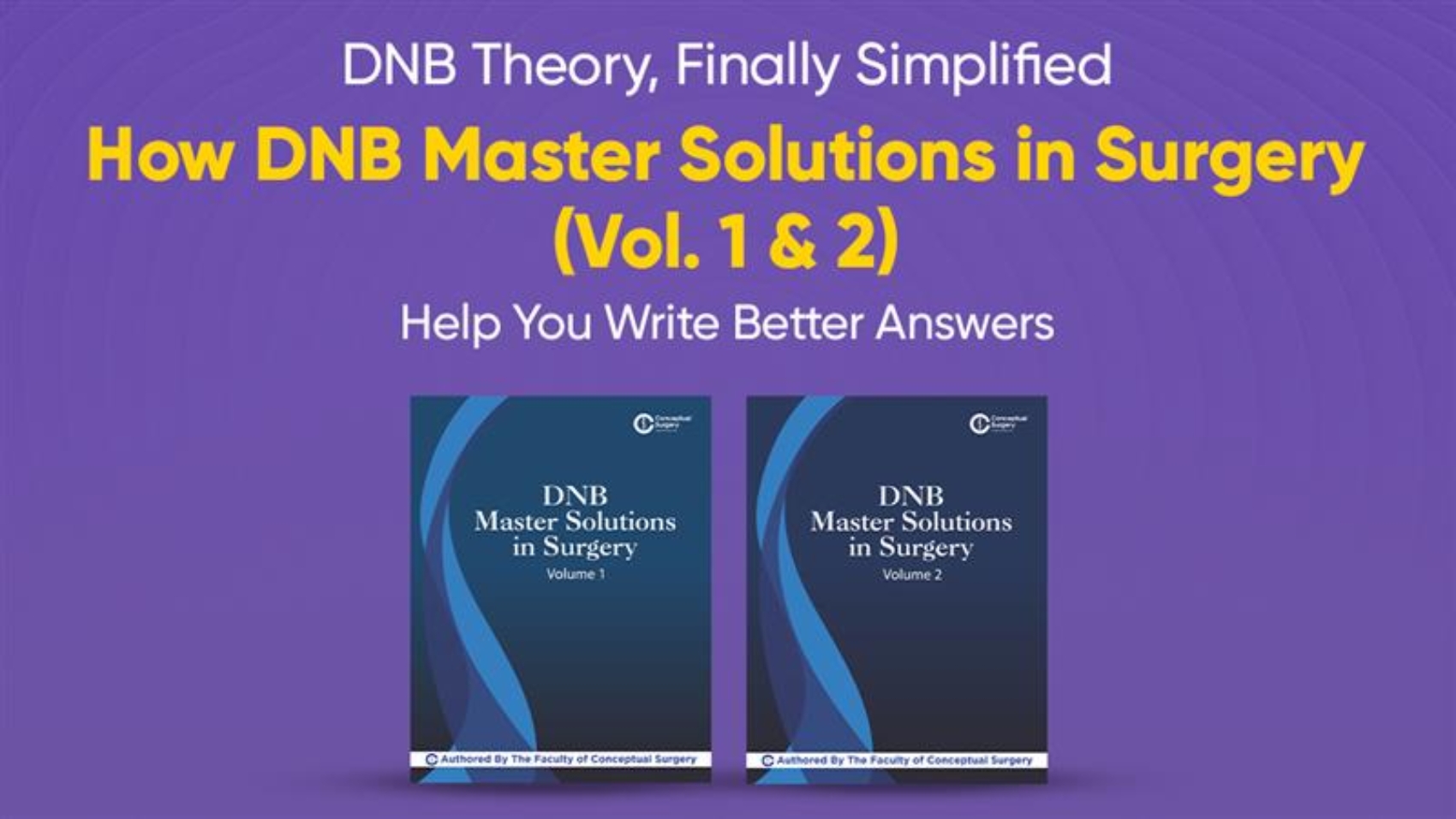
DNB Theory, Finally Simplified: How DNB Master Solutions in Surgery (Vol. 1 & 2) Help You Write Better Answers 

Estimated reading time: 4 minutes

If you’re preparing for the DNB theory exam, you’ve probably realized by now that knowing the subject isn’t the main issue; it’s writing the answer the right way under exam conditions. That shift, from knowledge to presentation, is where most surgery residents people lose marks. 

That’s exactly where DNB Master Solutions in Surgery – Volume 1 & Volume 2 by the faculty of Conceptual Surgery starts to make sense. These books don’t try to overload you—they help you focus on what actually gets asked and how to answer it properly. 

Volume 1: Recent Papers, Real Exam Insight (2024–2023) 

Volume 1 feels more like working with the latest exam mindset. 

It includes: 

  • Solved papers from 2024–2023  
  • Around 40 papers and 400 questions  
  • Clear, structured answers that are easy to follow  

What makes this volume especially useful is that it reflects current trends. When you go through it, you start noticing how questions are being framed now and what examiners expect in answers today. 

It also puts a strong focus on repeated, high-yield topics like hernia, wound management, biostatistics, and radiology. Instead of reading them once, you encounter them in different forms across questions—which actually helps in retention. 

If you’re closer to the exam, this is the volume you’ll probably rely on more for fine-tuning your preparation. 

Volume 2: Building the Base with Past Papers (2022–2020) 

Volume 2 complements Volume 1 by covering slightly older papers (2022–2020), but that doesn’t make it any less important. 

It includes: 

  • Solved papers from 2022–2020  
  • Around 40 papers and 400 questions  
  • Simple, easy-to-remember answers  

This volume is more about building your foundation. 

When you start with it, you get comfortable with: 

  • Common question patterns  
  • Answer structure  
  • How much detail is actually needed  

It’s a good place to begin because it eases you into answer writing without the pressure of “latest trends.” Once that base is set, moving to Volume 1 feels much smoother. 

What Both Volumes Do Well?(And Why It Matters) 

Across both books, a few things stay consistent: 

  • Real exam questions: You’re not guessing what’s important—you’re practicing what has already been asked  
  • Answer-writing clarity: The solutions are structured in a way you can actually reproduce in exams  
  • Time-saving: Everything is compiled—no need to search multiple sources  
  • Better revision: Easy to revisit before exams without feeling lost  

And if you’re using the Conceptual Surgery app alongside, the video + book combination makes revision even stronger. 

If you want to get a quick feel of how both DNB Master Solutions in Surgery – Volume 1 & Volume 2 are structured, you can explore the sample pages here: 

Volume 1: 

Volume 2: 

How to Use Them Without Overcomplicating Things?

A simple way to approach it: 

  • Start with Volume 2 to get comfortable with patterns and answer writing  
  • Move to Volume 1 to understand recent trends and refine your approach  
  • Closer to exams, revise both with a focus on repeated questions  

The goal isn’t to finish them quickly—it’s to start thinking in the format the exam expects. 

Final Thought 

Most resources help you study more. These books help you write better. 

And for DNB theory, that’s the difference between knowing the answer and actually scoring marks, something every surgery resident aiming for NEET SS surgery or higher exams eventually realizes. 

If used properly, DNB Master Solutions in Surgery – Volume 1 & Volume 2 gives you a clear, practical edge without making preparation unnecessarily complicated. 

Share

How-to-Crack-Any-Thyroid-Case

How to Crack Any Thyroid Case — Complete Surgical Approach By Prof. Dr. Anurag Mishra 

Estimated reading time: 4 minutes

When it comes to surgical cases, thyroid is one topic you simply cannot afford to get wrong. The good part? If your basics are clear and your approach is structured, you can confidently handle almost any thyroid case in exams or clinics. 

Let’s break it down in a simple, practical way. 

Understanding the Thyroid — A Quick Recap 

Before jumping into cases, you need a mental picture of the thyroid gland. 

The thyroid lies in the front of the neck, just below the thyroid cartilage. It has: 

  • A central isthmus 
  • Two lobes on either side 

It is often described as a shield-shaped organ, sitting prominently in the anterior neck. 

👉 A very important clinical point: 
Any swelling in the front of the neck should be considered thyroid unless proven otherwise. 

Why Thyroid Swellings Matter 

As the thyroid enlarges, it can extend into the thoracic inlet — the space between: 

  • Vertebra posteriorly 
  • First ribs laterally 
  • Manubrium sterni anteriorly 

When this happens, the gland may compress nearby structures, especially veins, since they are easily compressible. This leads to pressure symptoms, which are clinically important. 

Key Anatomical Relations You Must Remember 

  • The thyroid is firmly attached to the larynx, so it moves with swallowing (deglutition). 
  • A pyramidal lobe may be present, extending upwards. 
  • It is connected embryologically to the tongue via the thyroglossal duct. If this persists, it can form a thyroglossal cyst, which moves with tongue protrusion. 
  • The gland is closely related to: 
  • Parathyroids 
  • Inferior thyroid artery (important surgical landmark, located deep behind the gland) 

How to Clinically Classify a Thyroid Swelling 

When you examine a thyroid swelling, classify it into: 

  1. Diffuse (smooth enlargement) 
    → Entire gland enlarged, no nodules 
  1. Solitary thyroid nodule 
    → Single nodule in one lobe 
  1. Multinodular goiter 
    → Multiple nodules in one or both lobes 

👉 If it’s a solitary nodule, always specify which lobe is involved. 
 

The 5 Questions You Must Answer in Every Thyroid Case 

This is the core of cracking any thyroid case. 

Whenever you present or think about a case, answer these five things: 

1. Anatomy 

  • Is it thyroid? 
  • Which lobe is involved? 
  • Is the isthmus involved? 

2. Pathology 

  • Diffuse / nodular / multinodular 
  • Benign or malignant (if possible) 

3. Etiology 

  • Iodine deficiency 
  • Familial 
  • Malignancy-related mutations 

4. Stage of Disease 

  • Size of swelling 
  • Local pressure effects 
  • Lymph node involvement 
  • Metastasis 

5. Effect on the Patient 

  • Functional impact 
  • Symptoms affecting daily life 

👉 If you can answer these five points clearly, your diagnosis is almost complete. 

History Taking in Thyroid Cases 

History is where your diagnosis begins. 

1. Neck Swelling 

Ask about: 

  • Duration 
  • Progression 
  • Rapid increase in size → may suggest malignancy 

2. Pressure Symptoms 

Large thyroid swellings can compress nearby structures: 

  • Esophagus → Dysphagia 
  • Trachea → Dyspnea 
  • Recurrent laryngeal nerve → Hoarseness 
  • Severe cases → Stridor 

3. Functional Symptoms 

You must always assess thyroid function. 

Hyperthyroidism (High activity) 

Think of it like a high adrenaline state: 

  • Weight loss 
  • Palpitations 
  • Tremors 
  • Heat intolerance 
  • Anxiety 

👉 This happens because thyroid hormones increase adrenergic receptor activity, making the body more responsive to adrenaline. 

Hypothyroidism (Low activity) 

Opposite picture: 

  • Weight gain 
  • Lethargy 
  • Cold intolerance 

4. Endemic History 

Earlier, goiter was common in iodine-deficient regions like the Himalayas. 
Interestingly, it was once seen as a normal or even desirable feature in some communities. 

Now, with widespread use of iodized salt, this has reduced significantly. 

5. Important Risk Factors 

Always ask about: 

  • Radiation exposure in childhood 
  • Family history of thyroid cancer or endocrine disorders 
  • Previous thyroid disease or surgery 

👉 One practical tip: 
When taking history from female patients, make sure you clarify maternal family history, as they may sometimes refer to the husband’s side instead. 

Final Takeaway 

Thyroid cases are not difficult if your approach is systematic. 
Don’t try to memorize everything randomly—just stick to a structured framework: 

  • Identify the swelling 
  • Classify it 
  • Answer the 5 key questions 
  • Take a focused history 

Do this every time, and you’ll rarely go wrong. 

Share

FET Exam

Cracking FET 2026 in One Month: Step-by-Step Guide for Conceptual Surgery 

Estimated reading time: 6 minutes

You’ve got one month to prepare for FET. One month. And you’re aiming for a superspecialty seat through FNB programs. Sounds impossible, right? 

It’s not. But you can’t afford to waste a single day. 

The Fellowship Entrance Test isn’t like your usual medical exams. NBEMS didn’t design it to reward people who cram facts the night before. Surgery candidates especially—they’re looking for something different. Can you think through a clinical problem? Do you actually understand the concept, or did you just memorize it long enough to write it down? 

A lot of people preparing for NEET SS also take FET. Makes sense, it’s another door into superspecialty training. Sometimes the backup plan becomes the main plan. 

Here’s how you make one month work. 

What FET Actually Tests (And Why That Matters)?

Before opening a single book, understand what you’re walking into. 

FET gets you into FNB programs across specialties. For surgery, it’s not testing whether you remember facts. It’s testing whether you can work through clinical scenarios. Whether you understand why something happens, not just that it happens. 

People preparing for NEET SS Surgery often sit for FET too. Same reason—it’s another legitimate path into superspecialty training. 

The FET 2026 Exam Pattern 

You need to know the structure before you start studying. Otherwise you’re preparing blind. 

Here’s what you’re dealing with: 

  • Computer-based exam 
  • Multiple choice questions 
  • Total questions depend on the NBEMS notification 
  • Takes about 2–3 hours 
  • Everything’s in English 

What they’re really checking: 

  • Do you know the basics cold? 
  • Can you use that knowledge when it matters clinically? 
  • Is your understanding actually solid, or just surface-level? 

Go through old FET question papers. Look at the FET 2026 pattern if it’s available. You’ll start seeing what matters. 

The Surgery Syllabus: Too Much to Cover, So Don’t Try 

The FET syllabus for surgery is massive. There’s huge overlap with NEET SS Surgery content. But here’s the hard truth: in 30 days, you cannot cover everything. Trying to do that guarantees you’ll know a little about everything and not enough about anything. 

What you should actually focus on: 

  • General surgery basics 
  • GI surgery 
  • Hepatobiliary and pancreatic surgery 
  • Colorectal surgery 
  • Surgical oncology fundamentals 
  • Trauma and critical care 
  • Perioperative management 
  • Surgical anatomy and physiology 

Depth beats breadth here. Always. 

Week-by-Week: How to Actually Use This Month 
Week 1: Stop Rushing, Start Building 

First week isn’t about questions. It’s about making sure your foundation isn’t shaky. 

Go through the high-yield topics. Use whatever concise notes or reference material you trust. Diagrams help. Flowcharts help. Decision trees, anything visual that makes the concept click and stay clicked. 

Good video lectures on conceptual surgery? Use them. But don’t get lost watching 50 different explanations of the same thing. 

What you’re after: Solid grasp of the topics that keep appearing in FET year after year. 

Week 2: Start Connecting Dots 

Now you solve problems. 

Pull out topic-wise MCQs from previous FET papers. Work through them, but don’t just check if you got it right. Connect what you’re reading in theory to what’s being asked in questions. 

Keep a running note of concepts that show up repeatedly. Track your mistakes. Write them down somewhere you’ll actually look at again. 

This is where knowing transforms into being able to use what you know. 

Week 3: Test Yourself Like It’s Real 

Take full-length mocks that mirror the FET 2026 structure. Not casually. Set a timer. Sit in one place. No phone. Simulate the actual exam as closely as possible. 

Then—and this matters more than the test itself—go through every single question afterward. Not just the ones you got wrong. All of them. Understand the logic. Understand why the wrong answers are wrong. 

At this level, one properly analyzed mock is worth more than five you just speed through for a score. 

Week 4: Lock It In 

Final week is not for learning new stuff. 

Review your short notes. Review your mistake log. Focus on the high-yield topics you know are tested frequently. 

Do not, seriously, do not pick up a new textbook or resource now. You’re tightening bolts, not building new furniture. 

What Actually Works (From People Who’ve Done This)?

Some tested advice for a one-month sprint: 

  • Go deep on fewer topics rather than skimming many 
  • Revise the same material multiple times instead of reading it once 
  • Pick two or three solid resources and stick with them 
  • Solve MCQs daily, but spend real time analyzing them 
  • Think like a surgeon making decisions, not a student recalling facts 
  • Study in focused bursts your brain can’t sustain 12-hour marathons for 30 days straight 
The Boring Admin Stuff You Can’t Ignore 

While you’re buried in surgery notes, don’t forget: 

  • Fill the FET application form properly and before the deadline 
  • Download your FET admit card as soon as it’s live 
  • Note down exam dates and any instructions 
  • Keep checking for FET result updates 

One missed deadline erases all your preparation. Don’t be that person. 

Why FET + NEET SS Makes Sense for Surgery Aspirants?

If you’re targeting SS Surgery, taking both FET and NEET SS isn’t overkill, it’s smart. 

NEET SS Surgery is brutal competition. FET opens up more seats through FNB programs. More seats, better chances. Simple math. 

Here’s What It Comes Down To 

Preparing for FET Surgery in 30 days isn’t about how long you sit with books open. It’s about how sharp your revision is and whether you can actually apply concepts under pressure. 

Focused preparation. Understanding the exam pattern. Using old question papers intelligently. Revising consistently instead of cramming desperately. 

That’s how you crack FET, even when the clock’s against you. 

Stay disciplined. Trust the process you’re following. And walk into that exam knowing you used every one of those 30 days well. 

Share

Dr. Pawanindra Lal

How to Crack MS/DNB Short Cases: Inguinal Hernia Made Simple A Step-by-Step Guide by Prof. Dr. Pawanindra Lal

Short cases in MS and DNB exams can be intimidating, not because they are difficult, but because one small mistake can cost you precious marks. Among all short cases, inguinal hernia is one of the most commonly asked, and also one of the most scoring, if approached correctly. 

In this blog, Prof. Dr. Pawanindra Lal breaks down exactly how examiners expect you to examine, present, diagnose, and manage a case of inguinal hernia. If you master this format, half your battle is already won.

Step 1: Start with a Focused History 

When the examiner hands you the case, the patient will usually say: 

“Doctor, I have a swelling in my groin.” 

That’s your cue to ask only the most relevant questions. 

The three most important questions: 
  1. Where is the swelling? 
    – Groin / extending into scrotum? 
  1. Since how long is the swelling present? 
    – Duration tells you whether it’s chronic or complicated. 
  1. Any events related to the swelling? 
  1. History of irreducibility 
  1. Abdominal distension with vomiting (suggesting obstruction) 
  1. Any emergency surgery in the past 
Look for causes that increase abdominal pressure: 
  • Chronic cough (COPD) 
  • Chronic constipation 
  • Straining during urination (LUTS) 

These are the most common contributing factors examiners expect you to mention. 

Step 2: Examination Must Be in Standing & Supine Position 

A hernia is best seen when the patient is standing. 

Always say: 

“I examined the patient in both standing and supine position.” 

Large hernias may already be visible in lying down position, but mentioning both positions shows proper clinical method. 

Step 3: Inspection — The Most Important Step 

On inspection, follow the classic 5 S’s of swelling: 

  • Site 
  • Size 
  • Shape 
  • Surface 
  • Surrounding skin 
What should you look for? 

✔ Is the swelling: 

  • Inguinal only 
  • Inguinoscrotal 
  • Completely scrotal (complete hernia) 

✔ Is there a visible cough impulse? 
This is a hallmark of hernia and is absent only in obstructed hernia. 

✔ Look for: 

  • Skin stretching 
  • Discoloration 
  • Deviation of penis 
  • Visible peristalsis (in large hernias) 
  • Surgical scars 
  • Umbilical hernia (always examine the whole abdomen) 
Important Differentials 

Not every scrotal swelling is a hernia. It could be: 

  • Hydrocele 
  • Testicular tumor 
  • Epididymal swelling 
  • Scrotal wall lesion 

So never jump to conclusions. 

Step 4: Identify the Type of Hernia on Inspection 

Use the pubic tubercle as your landmark. 

Hernia Type Position 
Indirect inguinal hernia Above & medial to pubic tubercle 
Direct inguinal hernia Bulge in Hesselbach’s triangle 
Femoral hernia Below & lateral to pubic tubercle 

A careful look can already give you a strong clue even before palpation. 

Step 5: Palpation — Confirm Your Findings 

Start with the 2 T’s: 

  • Temperature 
  • Tenderness 

Then confirm: 

  • Site of swelling 
  • Whether you can get above the swelling 
  • Whether pubic tubercle is palpable 

If you cannot get above the swelling, it is an inguinoscrotal hernia. 

Step 6: The Only Test You Need — Deep Ring Occlusion Test 

Forget finger invagination, Zieman’s test, or three-finger test. 
Examiners only want one test: 

Deep Ring Occlusion Test 

Prerequisite: Hernia must be reducible. 

Method: 
  1. Reduce the hernia completely 
  1. Occlude the deep ring with your thumb 
  1. Ask patient to cough or stand 
Interpretation: 
  • If hernia does not reappear → Indirect hernia 
  • If hernia still appears → Direct hernia 

If the hernia is irreducible, you cannot perform the test — and should clearly say so. 

Step 7: Final Diagnosis — This Is Where You Score 

Your diagnosis should be complete and structured: 

“This is a right-sided, complete, reducible, indirect inguinal hernia with enterocele.” 

Breakdown: 
  • Right sided 
  • Complete (reaching bottom of scrotum) 
  • Reducible 
  • Indirect (confirmed by deep ring occlusion test) 
  • Enterocele (bowel content — elastic feel) 

If doughy and partially reducible → likely omentocele 

Step 8: Management — Speak Like a Surgeon 

Your answer should show awareness of both modern and classical surgery: 

“Depending on the patient’s fitness and my training, I would offer laparoscopic repair (TAPP/TEP). If not suitable, I would perform open Lichtenstein tension-free hernioplasty.” 

This shows: 
  • Knowledge of current practice 
  • Practical surgical training 
  • Safe decision-making 
Final Words 

Short cases are not about showing off — they are about showing clarity, structure, and confidence. 

If you follow this exact format: 

  • Focused history 
  • Systematic inspection 
  • Logical palpation 
  • Correct test 
  • Clear diagnosis 
  • Safe management 

You will never fear an inguinal hernia short case again. 

As Prof. Dr. Pawanindra Lal rightly says — 
Once you understand the anatomy and follow the steps, the case presents itself. 

Share