DNB Surgery Theory

DNB Surgery Theory Cleared. Now, Are You Ready for Practicals? 

Estimated reading time: 5 minutes

The DNB Surgery Theory Examination is over. But there’s one thing you shouldn’t lose sight of:  
The DNB Surgery Practical Examination is next. 

And practical preparation is not simply another round of theory revision. It’s time to change the way you prepare. 

Theory Asked What You Know. Practicals Will Ask What You Can Do. 

In the theory examination, you had time to think through your answers. 

In the practical examination, you may have a patient, a clinical finding, an investigation, or a case in front of you, and the examiner expects you to know what comes next. 

You need to be ready to: 

  • Take and present a surgical case 
  • Perform a systematic clinical examination 
  • Identify important clinical signs 
  • Arrive at a differential diagnosis 
  • Interpret investigations 
  • Explain your management plan 
  • Discuss surgical procedures 
  • Answer viva questions confidently 

The focus is no longer just on remembering facts. It is about clinical judgement. 

So, What Should Your Preparation Look Like Now? 

This is the stage where you should spend less time passively reading and more time practising your approach to surgical cases. 

1. Start With Case Presentations 

    Practise presenting common and important surgical cases in a clear sequence. 

    Work on: 

    History → Examination → Clinical Findings → Differential Diagnosis → Investigations → Diagnosis → Management 

    You should be able to explain not only what the diagnosis is, but why you arrived at it. 

    2.Strengthen Your Clinical Examination 

      Surgery practicals demand confidence in examination. Revise the important clinical signs and, more importantly, practise identifying them on actual patients. 

      Don’t just know the sign from a textbook. Know how to look for it. 

      3.Revise Procedures and Surgical Techniques 

        Be prepared to discuss the principles, indications, steps, complications, and postoperative care of important procedures. The examiner may take your answer beyond the diagnosis. 

        Be ready for: “What will you do next?” 

        4. Don’t Ignore Instruments, Images & Investigations 

          Practical preparation can include identifying surgical instruments, interpreting imaging and investigations, and discussing their relevance to the case. 

          Practise looking at something unfamiliar and thinking: 

          What am I seeing? What does it mean? What would I do about it? 

          1. Prepare for the Viva 

          A good practical performance can quickly turn into a difficult one when the viva begins. Practice answering questions aloud. 

          Be ready for: 

          • Differential diagnoses 
          • Investigations 
          • Management decisions 
          • Operative indications 
          • Surgical complications 
          • Postoperative care 
          • Emergency situations 
          • Recent advances 

          Don’t just prepare the answer. Prepare for the next question. 
          Also Read: DNB Surgery Practical Exam: Common Mistakes That Can Cost You Marks 

          Your Preparation Needs to Become More Hands-On 

          At this stage, another complete textbook reading may not be the best use of your time. 

          • Take a case. 
          • Present it. 
          • Examine it. 
          • Discuss the diagnosis. 
          • Interpret the investigations. 
          • Plan the management. 
          • Then challenge yourself with viva questions. 

          That is the kind of practice that builds practical confidence. 

          This Is Where Conceptual Surgery Comes In 

          At Conceptual Surgery, the focus is not limited to theory preparation. 

          The platform is designed to help Surgery residents strengthen their knowledge, clinical skills, examination approach, and practical readiness throughout residency. 

          1. Clinical Cases & Presentations 

          Learn through demonstrations of clinical examination, case presentation, and important clinical signs, helping you understand how surgical cases are approached in practice. 

          2.Clinical Examination & Demonstrations 

          Build confidence in examining patients and recognizing findings that matter during clinical discussions and practical examinations. 

          3. Viva & Practical Exam Training

          Prepare for the questions that can come your way during practical examinations and learn to approach answers with greater clarity. 

          4.Surgical Procedures & Techniques 

          Understand important surgical procedures, updated guidelines, and newer techniques with guidance from experienced surgeons. 

          5.Theory Support 

          Your practical preparation still needs a strong theoretical foundation. Revise important concepts, high-yield topics, previous questions, and exam-focused material alongside your clinical preparation. 
           
          Also Read: The Best OSCE Surgery Books to Help You Crack Your Exams 

          To Our Residents Preparing for Practicals 

          If you’ve cleared your DNB Surgery theory, take a moment to appreciate the achievement. But don’t let the relief turn into a preparation gap. The practical examination needs its own preparation. 

          • Start practising your cases. 
          • Revise your clinical signs. 
          • Work on your presentation. 
          • Brush up your procedures. 
          • Practise your viva. 

          And keep asking yourself: 

          “If this case comes tomorrow, can I handle it?” 

          If the answer isn’t yes yet, you still have time to work on it. 

          Don’t Wait for the Last Few Days 

          Practical confidence doesn’t appear overnight. It comes from repeatedly seeing cases, discussing them, presenting them, and learning from your mistakes. 

          So start now. Read less passively. Practise more actively. 

          Because when you’re standing in front of the examiner, you don’t want to remember the textbook. 

          You want to remember what to do. 

          Your Next DNB Surgery Milestone Starts Now 

          Theory is cleared. 

          Now it’s time to turn your knowledge into clinical confidence. 

          Examine the patient. 
          Present the case. 
          Think like a surgeon. 
          Answer the viva. 

          Your DNB Surgery practical is not just another examination. 

          It is your opportunity to show how you think, how you approach a patient, and how you apply your surgical knowledge. 

          Now, Are You Ready for Practicals? 
          Subscribe Conceptual Surgery and start preparing for your practical exam. 

          Share

          DNB Surgery Practical Exam

          DNB Surgery Practical Exam: Common Mistakes That Can Cost You Marks 

          Estimated reading time: 5 minutes

          The DNB Surgery Practical Exam isn’t just about what you know. It’s about how you examine a patient, present a case, interpret findings, explain your thinking, and answer questions from the examiner. 

          Most residents prep hard for theory. Then they treat practical prep differently. And that’s where small mistakes happen. A wrong examination step. A messy case presentation. Fumbling during viva. Any of these can hurt your score. 

          The point isn’t to give long answers or show off everything you know. It’s to show you can handle a surgical case logically, safely, and with confidence. 

          Here’s what to actually avoid during your DNB Surgery Practical Exam. 

          1. Starting the Examination Without a Clear Approach 

          Common mistake: diving into patient examination without any plan. 

          Before you start, know how you’ll approach the patient. Introduce yourself. Build some rapport. Check their general condition. Get relevant history. Do the right examination. Find important clinical signs. 

          Having a system keeps you organized. Shows the examiner you actually know how to work through a case. 

          2. Giving an Unstructured Case Presentation 

          A good case presentation? Clear. Concise. Clinically relevant. 

          Don’t jump between history, examination, tests, and diagnosis. Present it logically. Highlight findings that actually support your assessment. 

          Simple flow: 

          Patient Profile → History → Examination → Investigations → Diagnosis → Management Plan 

          You don’t need to mention everything you saw. Focus on what actually matters for this case. 

          3. Memorizing Findings Without Understanding Their Significance 

          Just identifying a clinical finding isn’t enough in a practical. 

          Mention an investigation or clinical sign? Be ready when the examiner asks what it means and how it changes your approach. 

          Stop memorizing random facts. Instead ask yourself: 

          What is this finding? Why does it matter? How does it change what I’ll do? 

          This makes your answers actually clinical. Not just textbook facts. 

          4. Jumping to Management Without Explaining Your Reasoning 

          Some candidates hear a surgical case and immediately start listing procedures and drugs. 

          Don’t do that. 

          Explain how you’re thinking through it. 

          Consider the patient’s condition. Diagnosis. Severity. Relevant risks. Available tests. Surgical options. Postoperative care. Then present your plan. 

          Doesn’t have to be long. The examiner just needs to understand why you’d pick that approach. 

          5. Overcomplicating Viva Answers 

          Viva gets harder when you try to pack too much into every answer. 

          Know the answer? Say it clearly. Don’t add random details just to look smart. 

          Try this: 

          Think → Answer → Explain if They Ask 

          Keeps it focused. Gives the examiner room to dig deeper if they want. 

          6. Ignoring Communication and Bedside Manner 

          The practical exam evaluates how you work with the patient too. 

          Don’t rush through examination, ignore patient comfort, or do things without explaining. Simple stuff matters: introduce yourself, explain what you’re doing, stay professional, communicate clearly. 

          These things make you look confident and organized. 

          7. Preparing Only Through Reading 

          Just reading notes? Not enough for practical prep. 

          You need to actually practice. Present cases out loud. Examine real patients. Interpret tests. Discuss management. Answer viva questions aloud. 

          Practice with colleagues. Figure out gaps in your thinking. Make your answers sound natural. 

          Make DNB Surgery Preparation More Exam-Focused 

          Practical prep gets stronger when you connect it to theory. Going through previous DNB questions helps you see what gets tested repeatedly and how to frame answers better. 

          That’s where Conceptual Surgery’s DNB Master Solutions can help your prep. 

          DNB Master Solutions in Surgery – Volume 1 

          Volume 1 has solved DNB Surgery papers from 2024–23. Actual exam questions with structured solutions. Focused on making answers easier to understand, revise, and use during the exam. 

          Works with the Conceptual Surgery App. Combine book revision with video learning. 

          DNB Master Solutions in Surgery – Volume 2 

          Volume 2 covers solved DNB Surgery papers from 2022–20. Another set of previous year questions to practice and revise. 

          Together, they help you get familiar with DNB question style while improving your answer-writing and revision. 

          How to Practice Before the Practical Exam?

          As exam time gets closer, make your prep more active: 

          • Practice presenting common surgical cases out loud. 
          • Revise important clinical signs and tests. 
          • Discuss management plans for common cases. 
          • Practice short direct viva answers. 
          • Review previous DNB questions. 
          • Figure out where your clinical thinking needs work. 

          The more you explain your thinking aloud, the easier it gets to talk confidently during the actual exam. 

          Final Takeaway 

          The DNB Surgery Practical Exam isn’t about remembering massive amounts of information. It’s about showing how you approach a patient and think through surgical problems. 

          Be systematic during examination. Keep your case presentation structured. Understand why your findings matter. Explain your management decisions. Keep viva answers clear. 

          Know the case. Think clinically. Present clearly. Answer confidently.

          Share

          DNB Master Solutions in Surgery (Vol. 1 & 2)

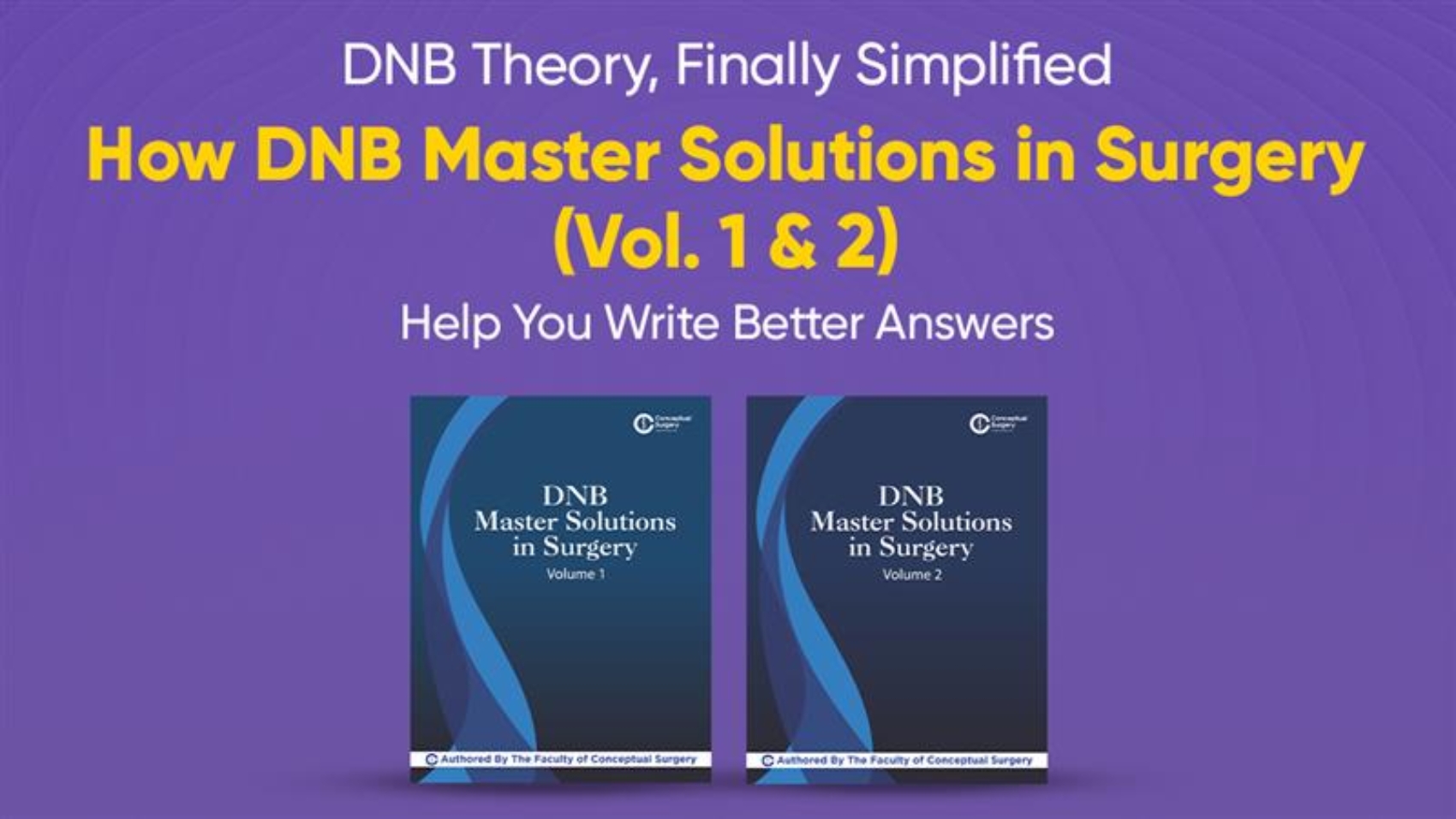
          DNB Theory, Finally Simplified: How DNB Master Solutions in Surgery (Vol. 1 & 2) Help You Write Better Answers 

          Estimated reading time: 4 minutes

          If you’re preparing for the DNB theory exam, you’ve probably realized by now that knowing the subject isn’t the main issue; it’s writing the answer the right way under exam conditions. That shift, from knowledge to presentation, is where most surgery residents people lose marks. 

          That’s exactly where DNB Master Solutions in Surgery – Volume 1 & Volume 2 by the faculty of Conceptual Surgery starts to make sense. These books don’t try to overload you—they help you focus on what actually gets asked and how to answer it properly. 

          Volume 1: Recent Papers, Real Exam Insight (2024–2023) 

          Volume 1 feels more like working with the latest exam mindset. 

          It includes: 

          • Solved papers from 2024–2023  
          • Around 40 papers and 400 questions  
          • Clear, structured answers that are easy to follow  

          What makes this volume especially useful is that it reflects current trends. When you go through it, you start noticing how questions are being framed now and what examiners expect in answers today. 

          It also puts a strong focus on repeated, high-yield topics like hernia, wound management, biostatistics, and radiology. Instead of reading them once, you encounter them in different forms across questions—which actually helps in retention. 

          If you’re closer to the exam, this is the volume you’ll probably rely on more for fine-tuning your preparation. 

          Volume 2: Building the Base with Past Papers (2022–2020) 

          Volume 2 complements Volume 1 by covering slightly older papers (2022–2020), but that doesn’t make it any less important. 

          It includes: 

          • Solved papers from 2022–2020  
          • Around 40 papers and 400 questions  
          • Simple, easy-to-remember answers  

          This volume is more about building your foundation. 

          When you start with it, you get comfortable with: 

          • Common question patterns  
          • Answer structure  
          • How much detail is actually needed  

          It’s a good place to begin because it eases you into answer writing without the pressure of “latest trends.” Once that base is set, moving to Volume 1 feels much smoother. 

          What Both Volumes Do Well?(And Why It Matters) 

          Across both books, a few things stay consistent: 

          • Real exam questions: You’re not guessing what’s important—you’re practicing what has already been asked  
          • Answer-writing clarity: The solutions are structured in a way you can actually reproduce in exams  
          • Time-saving: Everything is compiled—no need to search multiple sources  
          • Better revision: Easy to revisit before exams without feeling lost  

          And if you’re using the Conceptual Surgery app alongside, the video + book combination makes revision even stronger. 

          If you want to get a quick feel of how both DNB Master Solutions in Surgery – Volume 1 & Volume 2 are structured, you can explore the sample pages here: 

          Volume 1: 

          Volume 2: 

          How to Use Them Without Overcomplicating Things?

          A simple way to approach it: 

          • Start with Volume 2 to get comfortable with patterns and answer writing  
          • Move to Volume 1 to understand recent trends and refine your approach  
          • Closer to exams, revise both with a focus on repeated questions  

          The goal isn’t to finish them quickly—it’s to start thinking in the format the exam expects. 

          Final Thought 

          Most resources help you study more. These books help you write better. 

          And for DNB theory, that’s the difference between knowing the answer and actually scoring marks, something every surgery resident aiming for NEET SS surgery or higher exams eventually realizes. 

          If used properly, DNB Master Solutions in Surgery – Volume 1 & Volume 2 gives you a clear, practical edge without making preparation unnecessarily complicated. 

          Share