DNB Surgery Final Theory 2026

DNB Surgery Final Theory 2026: Important Topics, Revision Strategy & Answer-Writing Tips 

The DNB General Surgery Final Theory Examination is an important milestone in every surgery resident’s postgraduate journey. With the examination approaching, effective revision, clinical understanding and structured answer writing become essential. 

As exma is near and limited preparation time remaining, residents should focus on important surgical concepts, previous-year question papers and practising structured answers. 

In this blog, we cover important topics for DNB Surgery Theory 2026, practical revision strategies and answer-writing tips to help you prepare effectively. 

DNB Surgery Theory Exam 2026: Important Topics to Revise 

The General Surgery syllabus covers several surgical specialties. During the final revision phase, prioritise core concepts, commonly encountered clinical conditions and management-based topics. 

1. Gastrointestinal Surgery 

  • Acute intestinal obstruction and perforation peritonitis 
  • Appendicitis and its complications 
  • Peptic ulcer disease 
  • Gastrointestinal bleeding 
  • Colorectal and oesophageal carcinoma 
  • Inflammatory bowel disease 
  • Intestinal fistulas 

2. Hepatobiliary and Pancreatic Surgery 

  • Acute and chronic pancreatitis 
  • Obstructive jaundice 
  • Gallstone disease and its complications 
  • Carcinoma gallbladder and pancreas 
  • Portal hypertension 
  • Liver abscess and hydatid cyst 

3. Surgical Oncology 

  • Carcinoma breast 
  • Carcinoma thyroid 
  • Gastric and colorectal carcinoma 
  • Oesophageal carcinoma 
  • TNM staging 
  • Principles of chemotherapy and radiotherapy 

4. Trauma and Emergency Surgery 

  • ATLS principles and initial trauma assessment 
  • Haemorrhagic shock 
  • Blunt and penetrating abdominal trauma 
  • Splenic and liver injuries 
  • Burns and fluid resuscitation 
  • Compartment syndrome 
  • Damage control surgery 

5. Breast, Thyroid and Endocrine Surgery 

  • Evaluation of breast lumps 
  • Breast carcinoma management 
  • Solitary thyroid nodule 
  • Multinodular goitre 
  • Thyroid malignancies 
  • Hyperparathyroidism 
  • Pheochromocytoma 

6. Hernia and Vascular Surgery 

  • Inguinal and femoral hernia 
  • Incisional and ventral hernia 
  • Obstructed and strangulated hernia 
  • Peripheral arterial disease 
  • Varicose veins 
  • Deep vein thrombosis 
  • Diabetic foot 

7. General Surgical Principles 

  • Wound healing 
  • Fluid and electrolyte management 
  • Surgical infections and sepsis 
  • Blood transfusion 
  • Nutritional support 
  • Postoperative complications 
  • Minimally invasive and robotic surgery 

This is a focused revision checklist, not an official prediction of examination questions. Refer to the NBEMS syllabus for complete coverage. 

How to Prepare for DNB Surgery Theory Exam 2026? 

With limited time remaining, a structured revision approach can help you make better use of your preparation hours. 

1. Prioritise Core Topics 

Revise important surgical conditions, clinical presentations, investigations, treatment protocols and operative procedures. Avoid starting multiple new books or resources at this stage. 

2. Practise Previous-Year Question Papers 

DNB Surgery previous-year question papers help you understand question patterns and identify frequently tested concepts. Practise writing answers rather than simply reading the questions. 

3. Prepare Short Revision Notes 

Keep concise notes covering: 

  • Important classifications and staging systems 
  • Diagnostic criteria 
  • Treatment algorithms 
  • Surgical indications 
  • Complications and management 
  • Important diagrams and flowcharts 

4. Focus on Clinical and Case-Based Questions 

For every major surgical condition, practise answering the following: 

  • How will you approach the patient? 
  • What investigations will you order? 
  • How will you establish the diagnosis? 
  • What is the definitive management? 
  • What complications should be anticipated? 

5. Revise Recent Advances 

Include minimally invasive surgery, robotic surgery, ERAS protocols, advances in surgical oncology and newer diagnostic techniques in your revision. 

DNB Surgery Answer-Writing Tips 

Good answer presentation helps communicate your understanding clearly. Follow these techniques during the theory examination. 

1. Start with a Relevant Introduction: Begin with a concise definition or explanation directly related to the question. 

2. Use Headings and Subheadings: Organise answers into sections such as clinical features, investigations, diagnosis, management and complications. 

3. Include Diagrams and Flowcharts: Use labelled surgical anatomy diagrams, classification charts and management algorithms wherever relevant. 

4. Write Management Stepwise: For clinical questions, follow a logical sequence: assessment, stabilisation, investigations, definitive management and postoperative care. 

5. Manage Time Effectively: Practise complete papers under timed conditions. Avoid spending excessive time on one answer. 

A 12-Day DNB Surgery Revision Strategy 

With the examination beginning on 19 November, the following plan can help residents organise their final revision from 7–18 November. 

Days Revision Focus 
7–8 Nov Gastrointestinal surgery 
9 Nov Hepatobiliary and pancreatic surgery 
10 Nov Breast, thyroid and endocrine surgery 
11 Nov Surgical oncology 
12–13 Nov Trauma and emergency surgery 
14 Nov Hernia and vascular surgery 
15–16 Nov Other surgical subspecialties 
17 Nov General surgical principles and recent advances 
18 Nov Previous-year questions and rapid revision 

Alongside daily revision, practise timed answers and revisit topics where your understanding needs improvement. 

Prepare Smarter with Conceptual Surgery 

Balancing residency duties, emergency cases and examination preparation can be challenging for surgery residents. A structured learning approach can help organise revision and strengthen clinical understanding. 

Conceptual Surgery offers expert-led academic sessions, surgical discussions and learning resources for postgraduate residents. 

For focused DNB theory preparation, explore the DNB Theory Edge Programme, designed to support residents through structured theory preparation, previous-year questions and answer-writing practice. 

Final Words 

Success in the DNB Surgery Final Theory Examination requires more than memorising facts. Strong concepts, clinical reasoning, consistent revision and clear answer presentation are equally important. 

Focus on important topics, solve previous-year question papers and practise structured answers. Make your final revision systematic and approach the examination with confidence. 

Prepare well. Revise strategically. Give your best in DNB Surgery Theory 2026. 

Frequently Asked Questions 

1. When is the DNB Surgery Theory Exam 2026? 

The DNB Final Theory Examination for the December 2026 session is scheduled from 19–22 November 2026. 

2. Which topics are important for DNB Surgery Theory? 

Gastrointestinal surgery, hepatobiliary surgery, surgical oncology, trauma, breast and thyroid surgery, hernia and general surgical principles are important revision areas. 

3. Are previous-year papers useful for DNB Surgery preparation? 

Yes. They help residents understand question patterns, identify recurring concepts and practise structured answer writing. 

4. How can I improve my DNB Surgery answer writing? 

Use clear headings, labelled diagrams, flowcharts and stepwise management approaches. Practise complete answers under timed conditions. 

Share

DNB vs MS General Surgery

DNB vs MS General Surgery: Which One Should You Choose After NEET PG 2026? 

Estimated reading time: 7 minutes

NEET PG 2026 is over. You have spent months preparing for the exam, and now you are waiting for the result and counselling. But there is another question already taking up space in your head: 

“If I get surgery, should I choose MS General Surgery or DNB General Surgery?” 

Maybe you have heard that MS is better.  Maybe someone told you that DNB from a good hospital is actually a better option. 

Then you start searching: DNB vs MS General Surgery. 

Is DNB equivalent to MS? 

If you are confused between the two, let’s clear up the basics first. 

DNB vs MS General Surgery: What Is the Difference? 

Both are postgraduate pathways in General Surgery after Bachelor of Medicine and Bachelor of Surgery (MBBS) and the National Eligibility cum Entrance Test for Postgraduate (NEET-PG). 

Master of Surgery (MS) in General Surgery is a postgraduate degree awarded through a recognised medical university or institution. 

Diplomate of National Board (DNB) in General Surgery is a postgraduate qualification awarded by the National Board of Examinations in Medical Sciences (NBEMS) after training at an accredited hospital or institution. 

So, broadly: 

Details MS General Surgery DNB General Surgery 
Duration 3 years 3 years 
Entrance NEET PG NEET PG 
Qualification MS DNB 
Training Medical college/institution NBEMS-accredited institution 
Focus Clinical + academic + surgical Clinical + academic + surgical 

On paper, this looks fairly straightforward. 

The confusion starts when you try to decide which one is actually better for your career. 

Is DNB Equivalent to MS? 

This is probably the first thing most NEET PG candidates want to know. 

The answer is not as simple as the discussions on counselling groups make it sound. 

DNB is a recognised postgraduate medical qualification. However, the eligibility requirements for particular academic or faculty positions depend on the latest applicable NMC regulations. 

So, don’t reject a DNB seat simply because someone says: 

“DNB is not equal to MS.” 

At the same time, don’t assume that every DNB seat is automatically better than every MS seat. 

There is another factor that matters enormously: 

Where are you doing your residency? 

And for General Surgery, this can make a very big difference. 

DNB vs MS Surgery: Which Has Better Surgical Exposure? 

If you are choosing surgery because you actually want to become a surgeon, this should be one of your biggest considerations. 

Think about it this way. 

You can have: 

MS General Surgery in a medical college with limited operative exposure 

or 

DNB General Surgery in a high-volume hospital with a large number of surgical cases. 

Which resident will have the better surgical training? 

You can’t answer that just by looking at MS or DNB. 

The hospital matters. 

Before choosing a seat, find out: 

  • How many patients does the department see? 
  • How busy is the OPD? 
  • How many surgeries are performed? 
  • How many residents share the workload? 
  • How much OT exposure do residents get? 
  • When do residents start operating? 
  • What is the emergency workload? 
  • Is there good laparoscopic exposure? 
  • What kind of cases are commonly seen? 
  • How involved are the consultants? 

For surgery, patient volume and hands-on training can make a huge difference. 

Is DNB More Difficult Than MS? 

You may have already heard: 

“DNB is very difficult to pass.” 

Don’t let this one statement decide your career. 

DNB has its own examination and assessment system through NBEMS. MS has its university examination system. 

Both require preparation. 

And honestly, General Surgery residency itself is demanding. 

Whether you join MS or DNB, you can expect: 

  • Ward duties 
  • OPD 
  • OT 
  • Emergency calls 
  • Night duties 
  • Postoperative care 
  • Academic sessions 
  • Research/thesis work 
  • Theory preparation 
  • Practical and viva preparation 

The workload will depend heavily on the hospital and department. 

A busy DNB hospital can be extremely demanding. 

So can a government medical college offering MS. 

DNB vs MS Salary: Which Pays More? 

This is another question that comes up almost immediately. 

“DNB vs MS salary — who earns more?” 

There isn’t a fixed salary advantage simply because one person has DNB and another has MS. 

During residency, stipend depends on the institution and applicable rules. 

After residency, your income can depend on: 

  • Hospital 
  • City 
  • Experience 
  • Surgical skills 
  • Type of practice 
  • Patient volume 
  • Further specialisation 
  • Private practice 

So don’t choose your postgraduate course only on the assumption that one qualification automatically gives you a higher salary. 

Your training and experience will matter much more in the long run. 

Can DNB General Surgery Students Do MCh or DrNB? 

Yes, an important point if you already have a super-speciality in mind. 

After General Surgery, you may want to move into areas such as: 

  • Urology 
  • Surgical Gastroenterology 
  • Surgical Oncology 
  • Plastic Surgery 
  • Pediatric Surgery 
  • Cardiothoracic Surgery 
  • Vascular Surgery 

DNB General Surgery can be a pathway to eligible super-speciality programmes, depending on the eligibility criteria of the particular course and admission year. 

So choosing DNB does not mean that you have to stop at General Surgery. 

You can continue building your career through further specialisation. 

So, Is DNB Better Than MS? 

Not necessarily. 

And MS is not automatically better either. 

A good DNB seat can be a better choice than an average MS seat. 

A good MS seat can be a better choice than a weak DNB seat. 

That’s why the better question isn’t: 

“DNB or MS?” 

It is: 

“Which specific institute will give me better training?” 

And this becomes especially important when you start filling your NEET PG counselling choices. 

What Should You Look At Before Choosing? 

Don’t rank your choices only as: 

MS > DNB 

Instead, compare the actual colleges and hospitals. 

Look at: 

  • Patient load 
  • OT exposure 
  • Emergency work 
  • Hands-on opportunities 
  • Number of residents 
  • Faculty 
  • Academics 
  • Stipend 
  • Fees 
  • Location 
  • Future opportunities 

And most importantly: 

Talk to current residents. 

Ask them what their day actually looks like. 

How much do they operate? 

How much do they assist? 

How are emergency duties? 

How is the teaching? 

Would they choose the same hospital again? 

These answers can be much more useful than a generic DNB vs MS ranking. 

Conclusion: 

If you have finished NEET PG and are currently waiting for counselling, don’t get stuck in the MS-versus-DNB debate. Both can lead to a successful career in General Surgery. 

What matters is the quality of training you receive during those three years. 

So when you make your counselling list, don’t just ask: 

“Which qualification is better?” 

Ask: 

“Where will I get the surgical training I need?” 

In the next part, we’ll go one step further and compare Government MS vs Private MS vs DNB, surgical exposure, academics, salary, super-specialty plans and how to actually choose between two surgery seats during NEET PG counselling. 

Share

DNB Surgery Theory

DNB Surgery Theory Cleared. Now, Are You Ready for Practicals? 

Estimated reading time: 5 minutes

The DNB Surgery Theory Examination is over. But there’s one thing you shouldn’t lose sight of:  
The DNB Surgery Practical Examination is next. 

And practical preparation is not simply another round of theory revision. It’s time to change the way you prepare. 

Theory Asked What You Know. Practicals Will Ask What You Can Do. 

In the theory examination, you had time to think through your answers. 

In the practical examination, you may have a patient, a clinical finding, an investigation, or a case in front of you, and the examiner expects you to know what comes next. 

You need to be ready to: 

  • Take and present a surgical case 
  • Perform a systematic clinical examination 
  • Identify important clinical signs 
  • Arrive at a differential diagnosis 
  • Interpret investigations 
  • Explain your management plan 
  • Discuss surgical procedures 
  • Answer viva questions confidently 

The focus is no longer just on remembering facts. It is about clinical judgement. 

So, What Should Your Preparation Look Like Now? 

This is the stage where you should spend less time passively reading and more time practising your approach to surgical cases. 

1. Start With Case Presentations 

    Practise presenting common and important surgical cases in a clear sequence. 

    Work on: 

    History → Examination → Clinical Findings → Differential Diagnosis → Investigations → Diagnosis → Management 

    You should be able to explain not only what the diagnosis is, but why you arrived at it. 

    2.Strengthen Your Clinical Examination 

      Surgery practicals demand confidence in examination. Revise the important clinical signs and, more importantly, practise identifying them on actual patients. 

      Don’t just know the sign from a textbook. Know how to look for it. 

      3.Revise Procedures and Surgical Techniques 

        Be prepared to discuss the principles, indications, steps, complications, and postoperative care of important procedures. The examiner may take your answer beyond the diagnosis. 

        Be ready for: “What will you do next?” 

        4. Don’t Ignore Instruments, Images & Investigations 

          Practical preparation can include identifying surgical instruments, interpreting imaging and investigations, and discussing their relevance to the case. 

          Practise looking at something unfamiliar and thinking: 

          What am I seeing? What does it mean? What would I do about it? 

          1. Prepare for the Viva 

          A good practical performance can quickly turn into a difficult one when the viva begins. Practice answering questions aloud. 

          Be ready for: 

          • Differential diagnoses 
          • Investigations 
          • Management decisions 
          • Operative indications 
          • Surgical complications 
          • Postoperative care 
          • Emergency situations 
          • Recent advances 

          Don’t just prepare the answer. Prepare for the next question. 
          Also Read: DNB Surgery Practical Exam: Common Mistakes That Can Cost You Marks 

          Your Preparation Needs to Become More Hands-On 

          At this stage, another complete textbook reading may not be the best use of your time. 

          • Take a case. 
          • Present it. 
          • Examine it. 
          • Discuss the diagnosis. 
          • Interpret the investigations. 
          • Plan the management. 
          • Then challenge yourself with viva questions. 

          That is the kind of practice that builds practical confidence. 

          This Is Where Conceptual Surgery Comes In 

          At Conceptual Surgery, the focus is not limited to theory preparation. 

          The platform is designed to help Surgery residents strengthen their knowledge, clinical skills, examination approach, and practical readiness throughout residency. 

          1. Clinical Cases & Presentations 

          Learn through demonstrations of clinical examination, case presentation, and important clinical signs, helping you understand how surgical cases are approached in practice. 

          2.Clinical Examination & Demonstrations 

          Build confidence in examining patients and recognizing findings that matter during clinical discussions and practical examinations. 

          3. Viva & Practical Exam Training

          Prepare for the questions that can come your way during practical examinations and learn to approach answers with greater clarity. 

          4.Surgical Procedures & Techniques 

          Understand important surgical procedures, updated guidelines, and newer techniques with guidance from experienced surgeons. 

          5.Theory Support 

          Your practical preparation still needs a strong theoretical foundation. Revise important concepts, high-yield topics, previous questions, and exam-focused material alongside your clinical preparation. 
           
          Also Read: The Best OSCE Surgery Books to Help You Crack Your Exams 

          To Our Residents Preparing for Practicals 

          If you’ve cleared your DNB Surgery theory, take a moment to appreciate the achievement. But don’t let the relief turn into a preparation gap. The practical examination needs its own preparation. 

          • Start practising your cases. 
          • Revise your clinical signs. 
          • Work on your presentation. 
          • Brush up your procedures. 
          • Practise your viva. 

          And keep asking yourself: 

          “If this case comes tomorrow, can I handle it?” 

          If the answer isn’t yes yet, you still have time to work on it. 

          Don’t Wait for the Last Few Days 

          Practical confidence doesn’t appear overnight. It comes from repeatedly seeing cases, discussing them, presenting them, and learning from your mistakes. 

          So start now. Read less passively. Practise more actively. 

          Because when you’re standing in front of the examiner, you don’t want to remember the textbook. 

          You want to remember what to do. 

          Your Next DNB Surgery Milestone Starts Now 

          Theory is cleared. 

          Now it’s time to turn your knowledge into clinical confidence. 

          Examine the patient. 
          Present the case. 
          Think like a surgeon. 
          Answer the viva. 

          Your DNB Surgery practical is not just another examination. 

          It is your opportunity to show how you think, how you approach a patient, and how you apply your surgical knowledge. 

          Now, Are You Ready for Practicals? 
          Subscribe Conceptual Surgery and start preparing for your practical exam. 

          Share

          Celebrating 5 Years of Conceptual Surgery

          Celebrating 5 Years of Conceptual Surgery: Five Years of Learning, Mentorship, and Surgical Excellence 

          Estimated reading time: 3 minutes

          Five years ago, Conceptual Surgery started because surgery residents needed something different. Not just video lectures. Something practical, structured, actually useful for the work they do every day. 

          Since then, thousands of residents have used it. To get better at surgery. To prepare for exams. To understand what they’re doing, not just memorize facts. 

          Today we’re marking five years. But honestly, it’s more about thanking everyone who’s trusted this platform. Your feedback. Your support. That’s what made it work. 

          To say thanks, we’re running a special offer. 

          5th Anniversary Special 

          Flat ₹11,000 OFF 

          1 Month FREE 

          Available on Single Plan and Buddy Plan 

          Use Code: CONCEPTUAL 

          Works across all eConceptual specialty platforms 

          Limited time only 

          This is a good time if you’ve been thinking about it. Whether you’re starting residency or preparing for university exams. 

          Why Residents Actually Use Conceptual Surgery?

          • The Lectures Actually Make Sense 

          Faculty who’ve spent decades teaching surgery. Who examine MS and DNB residents. They know what matters and what doesn’t. Each lecture connects theory to what you actually see in the OR and wards. Not just abstract concepts. 

          • Real Patient Cases 

          Surgery isn’t learned from books. You learn by seeing things. 

          That’s why we focus on: 

          • Clinical examination demonstrations 
          • Real patient case presentations 
          • Important clinical signs you need to recognize 
          • Practical bedside approaches 
          • Cases from university exams 

          Residents get confident faster during ward postings. Viva exams feel less scary too. 

          Actual Mentorship 

          Learning is different when someone’s actually helping you. 

          You get: 

          • Live interactive sessions where you can ask questions 
          • Classes specifically to clear doubts 
          • Guidance on your thesis 
          • Mentorship throughout residency 

          The point is you’re not just studying alone. Someone’s actually invested in you getting better. 

          Two Ways to Access It 

          Solo Plan 

          You. Full access. All features. For people who want to study at their own pace without worrying about sharing. 

          Buddy Plan 

          Two people from the same specialty. Same cost split. Individual accounts for each person. Works for friends, batchmates, people studying together. 

          Five Years and Counting 

          Every resident who watched a lecture after a long shift. Every doubt that got cleared. Every person who actually passed their exam. That’s what these five years mean. 

          We haven’t changed what we’re doing. High-quality surgical education. Real mentorship. Clinical learning that matters beyond just passing exams. 

          And we’re not done. More surgeons coming through. More learning happening. More residents getting better at what they do. 

          Take Advantage of the Anniversary Offer 

          Flat ₹11,000 OFF (GRAB THIS OFFER NOW) 

          1 Month FREE on Single & Buddy Plans 

          Use Code: CONCEPTUAL 

          Limited time 

          Five years is worth celebrating. And we want you to be part of what comes next. 

          Thanks for being part of this. Here’s to many more years of residents getting better at surgery.

          Share

          DNB Final Surgery

          One Month Strategy for DNB Final Surgery Exam : A Survival Guide for Surgery Residents 

          One Month Strategy for DNB Final Surgery Exam : A Survival Guide for Surgery Residents ​

          Estimated reading time: 5 minutes

          The last month before DNB Final Surgery should focus on revision, clinical case presentation, viva preparation, instruments, and commonly asked surgical topics. Instead of trying to read everything again, residents should stay focused on practical understanding, repeated revision, and confidence building. 

          Introduction 

          Every surgery resident knows how stressful the month before DNB Finals can get. 

          There are emergency duties, long OT hours, ward work, pending revisions, sleep issues, and that constant feeling that no matter how much you study, something is still left. 

          Most residents enter the final month thinking they need to study harder than ever. But honestly, the last few weeks are not about reading every textbook again. 

          What Should Surgery Residents Focus on in the Last Month? 

          The final month should mainly focus on high-yield and commonly discussed surgical topics. 

          Gastrointestinal Surgery 

          This is one area you simply cannot ignore. 

          Focus on: 

          • Intestinal obstruction  
          • Perforation peritonitis  
          • Hernia  
          • GI malignancies  
          • Pancreatitis  
          • Colorectal surgery basics  
          • Upper GI bleed  

          Try to understand management flow instead of memorizing isolated points. 

          During viva, examiners usually want to see whether your approach is logical and clinically safe. 

          Hepatobiliary and Pancreatic Surgery 

          A very common area in theory and practical discussions. 

          Important topics: 

          • Gallstone disease  
          • Obstructive jaundice  
          • Liver abscess  
          • Portal hypertension  
          • Pancreatic tumors  

          Focus more on investigations, staging, and management planning. 

          Trauma Surgery 

          Trauma remains one of the most important areas for DNB Surgery. 

          Focus on: 

          • ATLS principles  
          • Polytrauma  
          • Splenic injury  
          • Chest trauma  
          • Fluid management  
          • Shock  

          Most residents study trauma theoretically but struggle when viva becomes practical and case-based. 

          Try to think clinically while revising. 

          Breast, Thyroid, and Vascular Surgery 

          These are commonly asked in long cases and viva. 

          Important topics: 

          • Breast carcinoma  
          • Thyroid swellings  
          • Varicose veins  
          • Diabetic foot  
          • Peripheral vascular disease  

          Practice differential diagnosis and clinical approach properly. 

          How Should Surgery Residents Study During the Last Month? 

          You do not need unrealistic 16-hour study schedules during residency. 

          A simple and consistent routine works much better. 

          Morning 

          Revise one major topic and make short notes or flowcharts. 

          Afternoon 

          Use OT and ward exposure for practical learning: 

          • Instruments  
          • Surgical anatomy  
          • Case discussions  
          • Postoperative management  
          Evening 

          Practice viva questions and long case presentation. 

          Night 

          Rapid revision of staging systems, classifications, and investigations. 

          The goal is retention and confidence, not exhaustion. 

          Why Are Clinical Presentation and Viva So Important? 

          Because DNB Surgery is heavily clinical. 

          Many residents know the answer in their head but struggle while presenting it confidently during viva. 

          Practice: 

          • Long cases  
          • Short cases  
          • Differential diagnosis  
          • Investigations  
          • Operative planning  
          • Complications  

          Whenever you answer, try to follow a structure: 

          1. Diagnosis  
          1. Differential diagnosis  
          1. Investigations  
          1. Management  
          1. Complications  

          Structured answers automatically sound better and more mature. 

          Topics Residents Often Ignore 
          Instruments and Sutures 

          Most residents postpone instruments till the final few days, but this is one of the most important scoring areas in practicals. 

          Know: 

          • Basic instruments  
          • Staplers  
          • Drains  
          • Sutures  
          • Laparoscopic instruments  
          • Energy devices  

          Also know: 

          • Uses  
          • Advantages  
          • Complications  
          Postoperative Management 

          This is commonly discussed during viva but often ignored during revision. 

          Focus on: 

          • Fluid management  
          • Electrolyte imbalance  
          • Sepsis  
          • DVT prophylaxis  
          • Nutrition  
          • Wound infection  

          Practical decision-making matters a lot in surgery viva. 

          Looking for the Right Resource? 

          One of the biggest problems during DNB Final Surgery preparation is finding a resource that is simple, practical, and actually useful during the last month. 

          That’s why many surgery residents now prefer Conceptual Surgery for structured and exam-oriented preparation. Over the years, Conceptual Surgery has slowly become a preferred choice for residents preparing for DNB Finals, NEET SS, and higher surgical studies because of its 360-degree approach toward surgical learning. 

          Many residents find it useful because the teaching stays clinically relevant and practical instead of becoming unnecessarily complicated. Its lectures and revision content focus heavily on: 

          • Case-based discussions  
          • Clinical reasoning  
          • Viva preparation  
          • Operative concepts  
          • Instruments  
          • High-yield surgical topics  

          A lot of residents especially use it during the final month for rapid revision and concept clarity because it helps simplify difficult topics and keeps preparation focused. 

          And honestly, in the last month, having one trusted resource is much more useful than collecting ten different notes. 

          A Simple 4-Week Plan for the Final Month 
          Week 1 

          Focus on: 

          • GI surgery  
          • Trauma  
          • Hepatobiliary surgery  
          • Breast and thyroid  
          Week 2 

          Revise: 

          • Instruments  
          • Sutures  
          • Postoperative management  
          • Fluids and electrolytes  
          Week 3 

          Start: 

          • Mock viva  
          • Long case presentation  
          • Previous year discussions  
          • Integrated revision  
          Week 4 

          Only revise: 

          • High-yield notes  
          • Staging systems  
          • Instruments  
          • Common complications  
          • Viva flowcharts  

          Avoid starting new topics during the final week. 

          Conclusion 

          The last month before DNB Final Surgery is not about trying to study everything again. 

          It is about becoming clinically confident and exam-ready. 

          You need: 

          • Repeated revision  
          • Better presentation  
          • Clinical understanding  
          • Viva confidence  
          • Consistency  

          Stay focused, keep revising, and trust the preparation you have already done over the years. 

          A structured final month can genuinely improve both confidence and performance during DNB Finals. 

          FAQs 

          Ques 1: How many hours should surgery residents study in the last month? 

          Ans 1: Consistent revision with clinical discussion is much more effective than studying continuously for very long hours. 

          Ques 2: Which subjects are most important for DNB Final Surgery? 

          Ans 2: GI surgery, trauma, hepatobiliary surgery, postoperative management, and instruments are among the highest-yield topics. 

          Ques 3: Are instruments important in DNB practicals? 

          Ans 3: Yes. Instruments, sutures, and operative discussions are extremely important during practical exams and viva. 

          Ques 4: Should residents start new books in the final month? 

          Ans 4: No. The final month should mainly focus on revision, practical preparation, viva discussion, and strengthening concepts already studied. 

          Share

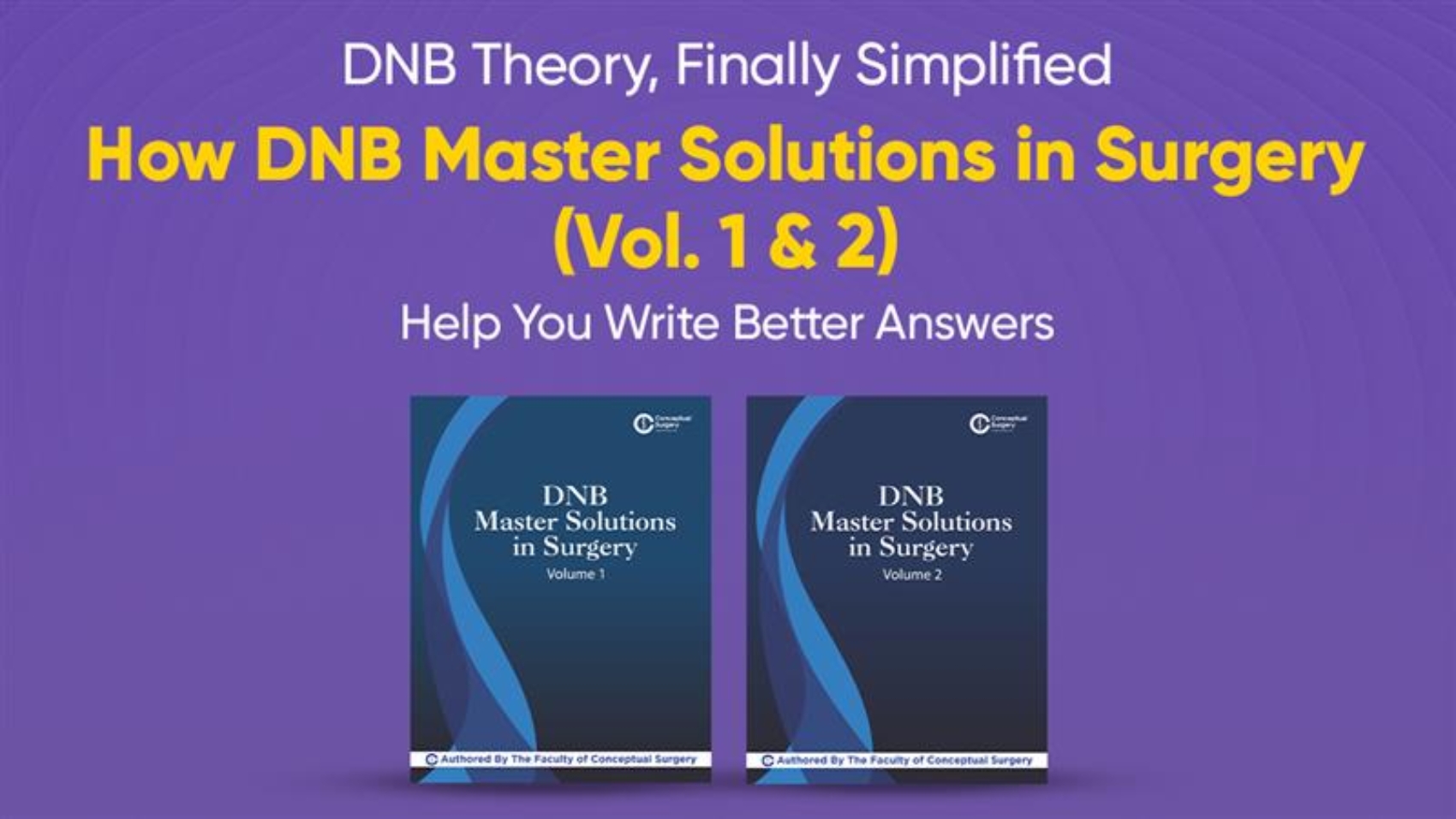
          DNB Master Solutions in Surgery (Vol. 1 & 2)

          DNB Theory, Finally Simplified: How DNB Master Solutions in Surgery (Vol. 1 & 2) Help You Write Better Answers 

          Estimated reading time: 4 minutes

          If you’re preparing for the DNB theory exam, you’ve probably realized by now that knowing the subject isn’t the main issue; it’s writing the answer the right way under exam conditions. That shift, from knowledge to presentation, is where most surgery residents people lose marks. 

          That’s exactly where DNB Master Solutions in Surgery – Volume 1 & Volume 2 by the faculty of Conceptual Surgery starts to make sense. These books don’t try to overload you—they help you focus on what actually gets asked and how to answer it properly. 

          Volume 1: Recent Papers, Real Exam Insight (2024–2023) 

          Volume 1 feels more like working with the latest exam mindset. 

          It includes: 

          • Solved papers from 2024–2023  
          • Around 40 papers and 400 questions  
          • Clear, structured answers that are easy to follow  

          What makes this volume especially useful is that it reflects current trends. When you go through it, you start noticing how questions are being framed now and what examiners expect in answers today. 

          It also puts a strong focus on repeated, high-yield topics like hernia, wound management, biostatistics, and radiology. Instead of reading them once, you encounter them in different forms across questions—which actually helps in retention. 

          If you’re closer to the exam, this is the volume you’ll probably rely on more for fine-tuning your preparation. 

          Volume 2: Building the Base with Past Papers (2022–2020) 

          Volume 2 complements Volume 1 by covering slightly older papers (2022–2020), but that doesn’t make it any less important. 

          It includes: 

          • Solved papers from 2022–2020  
          • Around 40 papers and 400 questions  
          • Simple, easy-to-remember answers  

          This volume is more about building your foundation. 

          When you start with it, you get comfortable with: 

          • Common question patterns  
          • Answer structure  
          • How much detail is actually needed  

          It’s a good place to begin because it eases you into answer writing without the pressure of “latest trends.” Once that base is set, moving to Volume 1 feels much smoother. 

          What Both Volumes Do Well?(And Why It Matters) 

          Across both books, a few things stay consistent: 

          • Real exam questions: You’re not guessing what’s important—you’re practicing what has already been asked  
          • Answer-writing clarity: The solutions are structured in a way you can actually reproduce in exams  
          • Time-saving: Everything is compiled—no need to search multiple sources  
          • Better revision: Easy to revisit before exams without feeling lost  

          And if you’re using the Conceptual Surgery app alongside, the video + book combination makes revision even stronger. 

          If you want to get a quick feel of how both DNB Master Solutions in Surgery – Volume 1 & Volume 2 are structured, you can explore the sample pages here: 

          Volume 1: 

          Volume 2: 

          How to Use Them Without Overcomplicating Things?

          A simple way to approach it: 

          • Start with Volume 2 to get comfortable with patterns and answer writing  
          • Move to Volume 1 to understand recent trends and refine your approach  
          • Closer to exams, revise both with a focus on repeated questions  

          The goal isn’t to finish them quickly—it’s to start thinking in the format the exam expects. 

          Final Thought 

          Most resources help you study more. These books help you write better. 

          And for DNB theory, that’s the difference between knowing the answer and actually scoring marks, something every surgery resident aiming for NEET SS surgery or higher exams eventually realizes. 

          If used properly, DNB Master Solutions in Surgery – Volume 1 & Volume 2 gives you a clear, practical edge without making preparation unnecessarily complicated. 

          Share

          PDCET Exam

          What is the PDCET Exam? Exam Date, Pattern and Why It Matters for Surgery Residents 

          Estimated reading time: 3 minutes

          For diploma holders in Surgery, PDCET is not just another entrance exam. It is the exam that decides where you will train next, the kind of surgical exposure you will get, and the direction your career will take. 

          After completing a post-diploma, most residents aim to enter DNB Surgery and continue higher surgical training. PDCET is the only pathway for that. A good rank means access to better institutions, stronger mentorship, and wider operative exposure. 

          With PDCET 2026 scheduled on 12 April 2026, this is the right time to begin preparation with a clear plan and proper guidance. 

          What is the PDCET Exam? Know in Detail 

          PDCET stands for Post Diploma Centralized Entrance Test. It is conducted by the National Board of Examinations (NBE) for doctors who have completed their Post Diploma and want to pursue Post Diploma DNB courses. 

          Surgery residents, this exam allows your entry into DNB Surgery (Post Diploma) programmes in government and private hospitals across the country. 

          Simply put, PDCET is the exam that takes you from diploma training to advanced surgical specialisation. 

          PDCET 2026 Exam Date 
          • Date: Sunday, 12 April 2026 
          • Mode: Computer-based examination 
          • Centres: Conducted at multiple centres across India 
          PDCET Exam Pattern 

          The paper is designed to test your understanding of core surgery and clinical decision-making. 

          Component Details 
          Mode Computer-based test 
          Duration 2 hours 
          Questions 120 multiple-choice questions 
          Marking 4 marks for every correct answer 
          Negative marking 1 mark deducted for every wrong answer 
          Subject Surgery only 
          Why is PDCET Important? 

          PDCET is a turning point in a surgeon’s career. It determines: 

          • Where you will receive your advanced training 
          • The quality of operative exposure you will get 
          • The mentors who will shape your clinical thinking 
          • The confidence with which you step into independent practice 

          A strong rank gives you better choices and stronger training centres. 

          How Conceptual Surgery Supports Your Preparation?

          Surgery is not a subject you can master by reading alone. It needs guidance, experience, and structured learning from teachers who understand both clinical practice and examination requirements. 

          Conceptual Surgery is built to provide exactly that. 

          What makes Conceptual Surgery different? 

          High-quality video lectures 
          Recorded exclusively by senior teachers with 35 to 60 years of experience as MS and DNB examiners. 

          Clinical case demonstrations 
          Real patient examinations, case presentations, and demonstration of clinical signs — just like in ward rounds and exams. 

          Mentorship programmes 
          Live interactive sessions, regular doubt-clearing discussions, and thesis guidance to support residents through every stage of training. 

          A strong academic ecosystem 

          • 300+ years of combined teaching experience 
          • 30+ expert faculty members 
          • 5,000+ hours of learning content being added gradually 
          • Dedicated academic support from experienced professionals 

          Conceptual Surgery is designed to help residents grow steadily — every day, every year, and throughout their surgical career. 

          Final Thoughts 

          PDCET is not just an entrance test. It is the foundation of your future as a surgeon. 

          With the exam scheduled for 12 April 2026, this is the time to prepare with discipline, consistency, and the right mentorship. 

          If you want to build strong concepts, sharpen your clinical judgement, and train under the best teachers, your preparation must begin now. 

          And with the guidance of Conceptual Surgery, you can move towards PDCET with confidence and clarity. 

          Share

          Dr. Pawanindra Lal

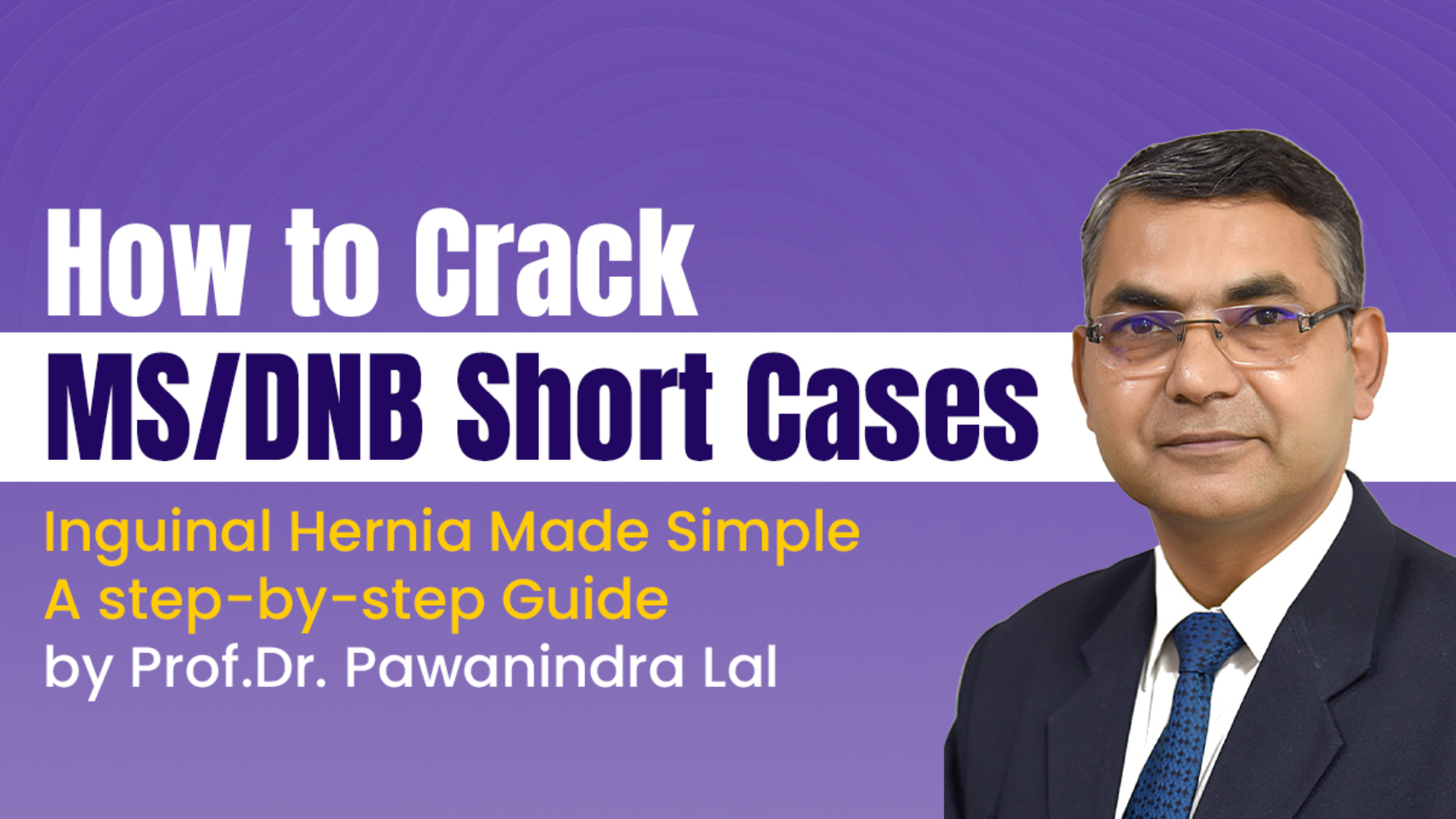
          How to Crack MS/DNB Short Cases: Inguinal Hernia Made Simple A Step-by-Step Guide by Prof. Dr. Pawanindra Lal

          Short cases in MS and DNB exams can be intimidating, not because they are difficult, but because one small mistake can cost you precious marks. Among all short cases, inguinal hernia is one of the most commonly asked, and also one of the most scoring, if approached correctly. 

          In this blog, Prof. Dr. Pawanindra Lal breaks down exactly how examiners expect you to examine, present, diagnose, and manage a case of inguinal hernia. If you master this format, half your battle is already won.

          Step 1: Start with a Focused History 

          When the examiner hands you the case, the patient will usually say: 

          “Doctor, I have a swelling in my groin.” 

          That’s your cue to ask only the most relevant questions. 

          The three most important questions: 
          1. Where is the swelling? 
            – Groin / extending into scrotum? 
          1. Since how long is the swelling present? 
            – Duration tells you whether it’s chronic or complicated. 
          1. Any events related to the swelling? 
          1. History of irreducibility 
          1. Abdominal distension with vomiting (suggesting obstruction) 
          1. Any emergency surgery in the past 
          Look for causes that increase abdominal pressure: 
          • Chronic cough (COPD) 
          • Chronic constipation 
          • Straining during urination (LUTS) 

          These are the most common contributing factors examiners expect you to mention. 

          Step 2: Examination Must Be in Standing & Supine Position 

          A hernia is best seen when the patient is standing. 

          Always say: 

          “I examined the patient in both standing and supine position.” 

          Large hernias may already be visible in lying down position, but mentioning both positions shows proper clinical method. 

          Step 3: Inspection — The Most Important Step 

          On inspection, follow the classic 5 S’s of swelling: 

          • Site 
          • Size 
          • Shape 
          • Surface 
          • Surrounding skin 
          What should you look for? 

          ✔ Is the swelling: 

          • Inguinal only 
          • Inguinoscrotal 
          • Completely scrotal (complete hernia) 

          ✔ Is there a visible cough impulse? 
          This is a hallmark of hernia and is absent only in obstructed hernia. 

          ✔ Look for: 

          • Skin stretching 
          • Discoloration 
          • Deviation of penis 
          • Visible peristalsis (in large hernias) 
          • Surgical scars 
          • Umbilical hernia (always examine the whole abdomen) 
          Important Differentials 

          Not every scrotal swelling is a hernia. It could be: 

          • Hydrocele 
          • Testicular tumor 
          • Epididymal swelling 
          • Scrotal wall lesion 

          So never jump to conclusions. 

          Step 4: Identify the Type of Hernia on Inspection 

          Use the pubic tubercle as your landmark. 

          Hernia Type Position 
          Indirect inguinal hernia Above & medial to pubic tubercle 
          Direct inguinal hernia Bulge in Hesselbach’s triangle 
          Femoral hernia Below & lateral to pubic tubercle 

          A careful look can already give you a strong clue even before palpation. 

          Step 5: Palpation — Confirm Your Findings 

          Start with the 2 T’s: 

          • Temperature 
          • Tenderness 

          Then confirm: 

          • Site of swelling 
          • Whether you can get above the swelling 
          • Whether pubic tubercle is palpable 

          If you cannot get above the swelling, it is an inguinoscrotal hernia. 

          Step 6: The Only Test You Need — Deep Ring Occlusion Test 

          Forget finger invagination, Zieman’s test, or three-finger test. 
          Examiners only want one test: 

          Deep Ring Occlusion Test 

          Prerequisite: Hernia must be reducible. 

          Method: 
          1. Reduce the hernia completely 
          1. Occlude the deep ring with your thumb 
          1. Ask patient to cough or stand 
          Interpretation: 
          • If hernia does not reappear → Indirect hernia 
          • If hernia still appears → Direct hernia 

          If the hernia is irreducible, you cannot perform the test — and should clearly say so. 

          Step 7: Final Diagnosis — This Is Where You Score 

          Your diagnosis should be complete and structured: 

          “This is a right-sided, complete, reducible, indirect inguinal hernia with enterocele.” 

          Breakdown: 
          • Right sided 
          • Complete (reaching bottom of scrotum) 
          • Reducible 
          • Indirect (confirmed by deep ring occlusion test) 
          • Enterocele (bowel content — elastic feel) 

          If doughy and partially reducible → likely omentocele 

          Step 8: Management — Speak Like a Surgeon 

          Your answer should show awareness of both modern and classical surgery: 

          “Depending on the patient’s fitness and my training, I would offer laparoscopic repair (TAPP/TEP). If not suitable, I would perform open Lichtenstein tension-free hernioplasty.” 

          This shows: 
          • Knowledge of current practice 
          • Practical surgical training 
          • Safe decision-making 
          Final Words 

          Short cases are not about showing off — they are about showing clarity, structure, and confidence. 

          If you follow this exact format: 

          • Focused history 
          • Systematic inspection 
          • Logical palpation 
          • Correct test 
          • Clear diagnosis 
          • Safe management 

          You will never fear an inguinal hernia short case again. 

          As Prof. Dr. Pawanindra Lal rightly says — 
          Once you understand the anatomy and follow the steps, the case presents itself. 

          Share

          DNB Surgery

          DNB in Surgery: Complete Guide to Exam, Training, and Career Opportunities

          Estimated reading time: 6 minutes

          You know what, there is one question which is frequently asked among young doctors is, ‘What is DNB in Surgery?’ Especially when we talk about postgraduate surgical training in India, 

          This is one of the most respected postgraduate qualifications, Diplomate of National Board (DNB) in General Surgery, which is identical in recognition and value to an MS (Master of Surgery) degree. However, it contains a training structure, an evaluation system, and an examination process that have their own unique features.

          This is your ultimate guide that covers everything about DNB Surgery you need to know, from the DNB entrance exam to eligibility, training modules, the DNB examination, practicals, DNB theory papers, and career prospects after completion.

          DNB Examination Structure and Process
          1. What is DNB in Surgery? Understanding the Course

          So basically, the DNB Surgery is a postgraduate surgical residency training program that is conducted by the National Board of Examinations in Medical Sciences (NBEMS). It’s a very structured program that is especially designed to train doctors in their fundamental surgical skills, which include operative decision-making and proper patient management across all major surgical disciplines.

          The DNB qualification holds equal value to the MD/MS degrees awarded by universities and is recognized by the National Medical Commission (NMC) and the Government of India.

          This makes it an excellent choice for aspiring surgery residents who want high-quality, hands-on exposure in real clinical settings.

          2. Duration and Course Structure of DNB Surgery

          The DNB General Surgery program is basically 3 years long for post-MBBS residents. Those who have already completed their postgraduate diploma in surgery can definitely pursue a two-year secondary DNB course.

          Training Overview
          • Year 1: Basics of surgical anatomy, wound management, aseptic techniques, and first-assist experience in surgeries.
          • Year 2: Rotations through surgical subspecialties (urology, orthopedics, oncology, plastic surgery), involvement in emergency care, and DNB preparation for theory exams.
          • Year 3: Independent case management, advanced surgeries, research work, and OSCE training for final practical evaluation.

          The surgery residency training program ensures that residents develop not just operative skills but also clinical judgment and research aptitude.

          3. Eligibility Criteria for DNB Surgery

          If a resident wants to pursue DNB Surgery, they must:

          • They should have an MBBS degree from a recognized medical institution.
          • With that, they should have permanent or provisional registration with the NMC or State Medical Council.
          • Residents need to qualify in the NEET PG examination, which basically serves as the DNB entrance exam for postgraduate medical seats in India.
          4. Admission Process for DNB Surgery

          Admission to DNB Surgery is concentrated and conducted by the Medical Counselling Committee (MCC), which is based on NEET PG scores.

          Steps to Admission
          1. They need to qualify NEET PG / DNB entrance exam.
          2. Then they have to register for MCC counselling, which is officially under the DNB Post-MBBS category.
          3. Residents should be required to participate in the choice filling and locking of preferred hospitals or institutes.
          4. Their Seat allotment is typically based on NEET PG rank and seat matrix.
          5. The Document verification and joining are provided at the allotted center.

          DNB training is offered across reputed NBEMS-accredited hospitals, including both government and private medical institutions.

          5. Training Experience and Clinical Exposure

          During the DNB Surgery training, residents gain subjection to multiple voluntary and emergency surgical cases in overloaded patients in hospitals. 

          The key features of the DNB Surgery residency program are:
          • They need to gain experience in various surgical procedures in multiple departments
          • Residents need to actively participate in ward rounds, operating theaters, and the trauma unit.
          • It is very much compulsory in research and composition preparation.
          • They can also participate in OSCE courses and exam preparation sessions before the final practical exam happens.

          Regular internal assessment and evaluation by an external examiner.

          6. The DNB Examination Pattern and Evaluation

          The DNB examination evaluates both theoretical knowledge and clinical competence. It is known for its depth, objectivity, and national-level uniformity.

          A. DNB Theory Papers
          • There are 4 DNB theory papers, each carrying 100 marks.
          • The DNB Paper pattern includes both short and long-answer questions.
          • Topics include general surgical principles, gastrointestinal surgery, urology, plastic surgery, pediatric surgery, trauma, and anesthesia.
          • Residents must achieve a minimum of 50% aggregate to qualify for practicals.
          B. Practical / Clinical Examination

          You know, when the residents clear their DNB theory, they have to appear for the DNB OSCE (Objective Structured Clinical Examination) and Viva Voce as well. 

          Residents know that OSCE training is very crucial at this stage, which typically involves simulation-based case discussions, medical image analysis, surgical instrument identification, and clinical decision-making exercises. 

          The DNB OSCE ensures that each candidate has strong practical skills, awareness of patient safety, and effective clinical decision-making.

          7. DNB vs MS in Surgery, Key Differences
          AspectDNB in SurgeryMS in Surgery
          Conducted byNBEMSMedical Universities
          Training LocationAccredited hospitalsMedical colleges
          EvaluationCentralized DNB examUniversity exams
          ExposureHigh-patient-volume hospitalsStructured college setup
          Difficulty LevelHigher (especially DNB theory papers and OSCE)Moderate
          RecognitionEquivalent to MSRecognized by NMC

          Both are recognized qualifications, and a DNB General Surgeon is equally eligible for super-specialty courses (MCh/DNB SS) and teaching positions across India.

          8. Daily Life of a DNB Surgery Resident
          A surgery residency is demanding yet deeply fulfilling. The day of a DNB trainee involves:
          • They have to go on early morning ward rounds
          • Residents have to give pre- and post-operative care
          • They have to assist and perform surgeries
          • Attending regular academic discussions and DNB preparation sessions
          • Residents have to prepare case presentations for the DNB exam and the OSCE course

          The training nurtures precision, discipline, and decision-making, the core of every successful surgeon’s identity.

          9. Career Opportunities After DNB Surgery
          Upon completing DNB in Surgery, multiple paths open up:
          1. General Surgeon: Work in hospitals or private setups.
          2. Teaching Faculty: Eligible for Assistant Professor and higher academic roles.
          3. Private Practice: Build a specialized surgical clinic or group practice.
          4. Super-specialization: Pursue MCh or DNB SS in fields such as:
            • Urology
            • Surgical Oncology
            • Cardiothoracic Surgery
            • Neurosurgery
            • Plastic Surgery
          5. International Recognition: Many DNB graduates successfully qualify for PLAB, USMLE, or other global licensing exams.

          The DNB qualification thus serves as a solid foundation for advanced SS preparation and global surgical careers.

          Conclusion: The Pathway to Surgical Excellence

          Can you imagine that pursuing a DNB in ​​Surgery is not just an academic option; it is a professional change.

          Overall, the concentrated surgery residency, basically very much challenging the DNB theory, accurate DNB exams, and a practical OSCE course training, this program casts you into a surgeon who balances both of things like technology and science, as well as compassion and exactness.

          It is quite difficult for those who put in the hard work and discipline, but you know, DNB Surgery proves to be one of the most rewarding journeys in modern medicine for residents. This program provides global opportunities for teaching, research, and super-specialization for secure their future.

          Share

          Conceptual Surgery

          Diwali Dhamaka Offer – Make Your Residency Smarter with Conceptual Surgery | Flat ₹12k Off + 3 Months Free

          Estimated reading time: 2 minutes

          Residency life in surgery isn’t easy — long hours, never-ending cases, and a mind that’s constantly juggling between OT and exam prep. But what if this Diwali, you could take one step that makes your journey smoother, simpler, and sharper?

          That’s exactly what Conceptual Surgery is here for — a space built by real surgeons who know what residency actually feels like. Whether you’re in MS or DNB, or preparing for NEET SS, this platform gives you everything you need to build confidence — not just for exams, but for your surgical career.

          And yes, the timing couldn’t be better. Because this Diwali, the biggest offer of the year is here for you!

          Diwali Dhamaka Offer

          Flat ₹12,000 OFF + 3 Months Extra FREE
          Valid from 3rd October (12:00 AM) to 23rd October (11:59 PM)
          Use Code: ECBLOG before the lights go out!

          Why Residents Trust Conceptual Surgery?
          • Complete, System-Wise Learning
            From head and neck to GI, breast, urology, and vascular — every system is broken down clearly so you understand why you’re doing what you do.
          • Real Surgical Demonstrations
            Step into the OT from wherever you are. Watch real surgical procedures explained by experienced surgeons who’ve lived those moments themselves.
          • Exam-Focused Prep
            Structured notes, concise theory, and NEET SS-style MCQs — everything you need to stay ready without wasting a single hour.
          • Mentorship That Feels Personal
            Learn from teachers who actually care. Ask questions, get feedback, and attend live sessions that don’t just teach — they inspire.
          This Diwali, Don’t Just Celebrate — Upgrade Your Residency

          Conceptual Surgery isn’t just about videos or notes — it’s about thinking like a surgeon. Hundreds of MS/DNB residents and NEET SS toppers have already built their foundation here, guided by India’s top faculty.

          If you’ve been waiting for the right time to join, this is it. Because offers like this don’t come twice in a year.

          Share