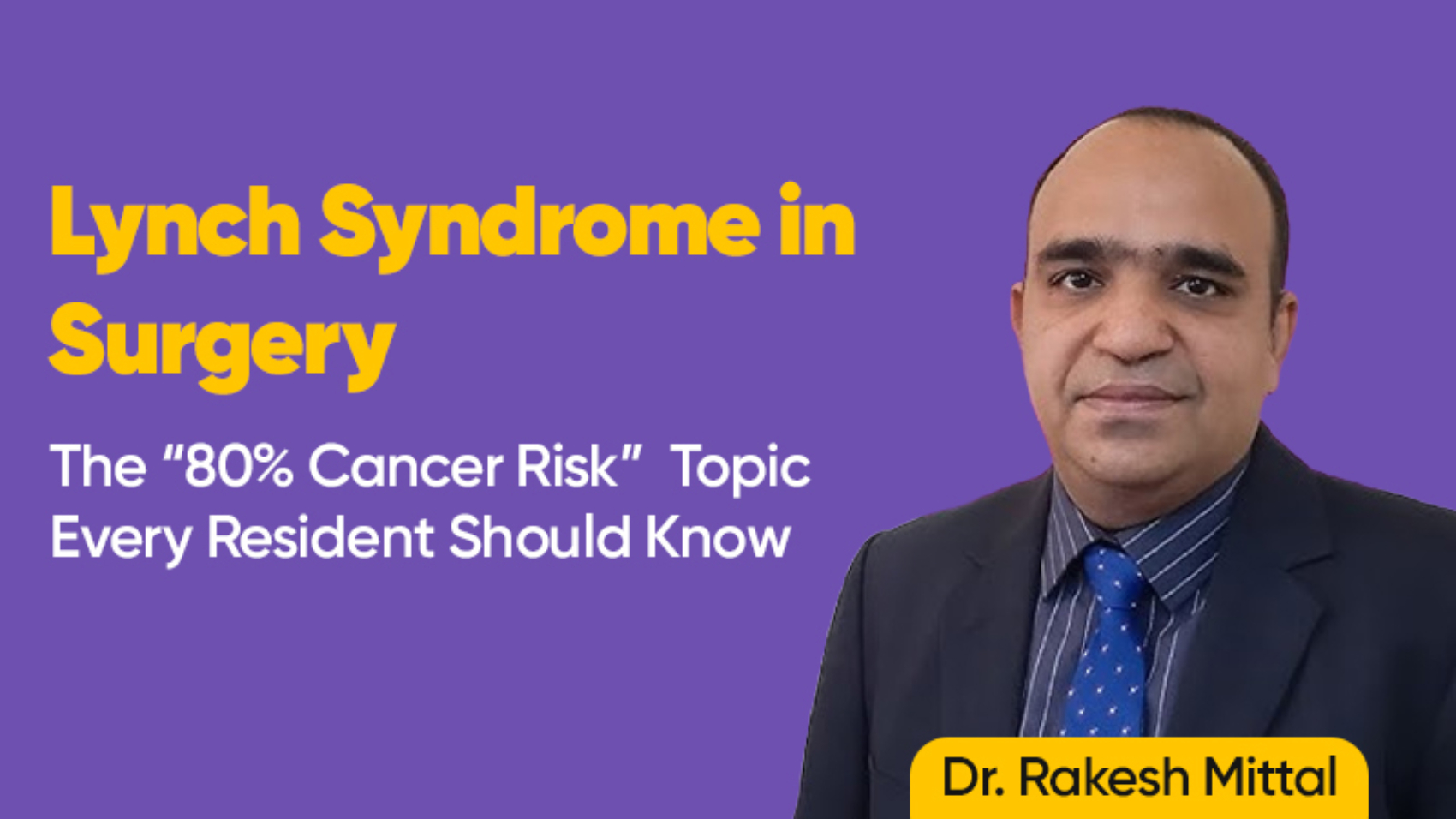
Dr. Rakesh Mittal

Lynch Syndrome in Surgery: The “80% Cancer Risk” Topic Every Resident Should Know 

Lynch Syndrome in Surgery : The "80% Cancer Risk" Topic Every Resident Should Know

Estimated reading time: 5 minutes

Some topics in surgery keep showing up again and again — in ward discussions, viva, case presentations, and entrance exams. Lynch syndrome is one of those topics. 

Recently, Dr. Rakesh Mittal discussed the important concepts related to Lynch syndrome in a simple and practical way, especially the points students usually confuse with FAP. If you’re a surgery resident preparing for exams or trying to strengthen your GI surgery basics, this is one topic worth revising properly. 

What is Lynch Syndrome? 

Lynch syndrome, also known as HNPCC (Hereditary Non-Polyposis Colorectal Cancer), is the most common hereditary colorectal cancer syndrome. 

The important thing to remember is that these patients usually do not develop hundreds of polyps like FAP patients do. Even without multiple polyps, their risk of developing colorectal cancer remains very high because the actual problem lies in defective DNA repair. 

That’s what makes this condition clinically important.

Watch Video: 80% Cancer Risk? 🤯 Lynch Syndrome Explained by Dr. Rakesh Mittal 

Why Does Everyone Remember the “80% Risk”? 

One of the most commonly asked facts about Lynch syndrome is its cancer risk. 

The lifetime risk of colorectal cancer is nearly 80%. 

That number alone makes it an important exam topic. 

Many residents compare it directly with FAP. In FAP, the risk of colorectal cancer is almost 100% if untreated, which is why FAP is considered more aggressive overall. But Lynch syndrome is still dangerous because cancers develop early and often without the warning sign of diffuse polyposis. 

So the absence of multiple polyps should never make you think the condition is harmless. 

It’s Not Just About Colon Cancer 

Another important point discussed was that Lynch syndrome is associated with cancers in other organs too. 

Common associated cancers include: 

  • Endometrial cancer  
  • Ovarian cancer  
  • Gastric cancer  
  • Small bowel cancer  

In female patients, the risk of endometrial carcinoma is especially significant and may reach around 30–50%. 

So whenever a younger patient presents with colorectal cancer along with a strong family history or associated gynecological cancers, Lynch syndrome should always be kept in mind. 

The Typical Site of Cancer 

One classic exam point is the location of the tumor. 

In Lynch syndrome, cancers are more commonly seen in the proximal colon, meaning the right side of the colon is more frequently involved. 

That makes it different from many sporadic colorectal cancers seen in older patients. 

The average age of diagnosis is usually around 45 years, which is much younger than the usual colorectal cancer population. For surgery residents, that age difference itself can become an important clinical clue. 

The Genetics You Should Definitely Remember 

This is the part that frequently appears in MCQs and viva. 

Lynch syndrome occurs because of mutations in DNA mismatch repair genes. 

The two most important genes are: 

  • MLH1  
  • MSH2  

These are the genes most commonly associated with Lynch syndrome and are repeatedly asked in exams. 

The mutation leads to defective DNA repair and causes microsatellite instability (MSI), which eventually increases the risk of cancer development. 

A simple way to remember it: 

Lynch syndrome = mismatch repair defect + microsatellite instability 

Lynch Syndrome vs FAP: Easy Way to Differentiate 

Students often mix these two hereditary colorectal cancer syndromes, but the comparison becomes easy if you focus on the basics. 

FAP 
  • Hundreds to thousands of polyps  
  • APC gene mutation  
  • Nearly 100% cancer risk  
Lynch Syndrome 
  • Few or no polyps  
  • Mismatch repair gene defect  
  • Strong association with right-sided colon cancer and extracolonic cancers  

Once these points are clear, most exam questions become straightforward. 

Why This Matters During Residency?

Lynch syndrome is not just an exam topic. In real clinical practice, identifying hereditary cancer syndromes changes the entire approach to patient management. 

It affects: 

  • screening strategies,  
  • family counseling,  
  • surveillance plans,  
  • and long-term follow-up.  

Recognizing these patterns early can make a huge difference not only for the patient, but also for family members who may be at risk. 

That’s why surgery residents are expected to know these syndromes well — not just theoretically, but clinically too. 

Quick Revision Before You Leave 

If you want to revise Lynch syndrome in one minute, remember these points: 

  • Most common hereditary colorectal cancer syndrome  
  • Lifetime colorectal cancer risk around 80%  
  • Right-sided/proximal colon cancers are common  
  • MLH1 and MSH2 are the key genes  
  • Associated with endometrial and ovarian cancers  
  • Autosomal dominant inheritance  

These are the exact points that repeatedly appear in surgery exams, GI discussions, and oncology postings. 

Conceptual Surgery — Supporting Residents Throughout Residency 

Surgical residency can feel overwhelming at times. Between long duties, emergency calls, ward work, academics, presentations, and exam preparation, finding the right guidance becomes extremely important. 

That’s where Conceptual Surgery continues to help surgery residents across the country. 

From experienced faculty and structured teaching to high-yield discussions, study material, practical concepts, books, and the right academic resources — everything is designed to make residency learning more focused and manageable. 

Every year, thousands of residents join Conceptual Surgery to strengthen their concepts, improve confidence during residency, and prepare better for exams and clinical practice. 

Whether it’s ward learning, viva preparation, theory revision, or surgical concepts, Conceptual Surgery aims to support residents at every step of their journey.

Share

Web 20 copy

The First Year of Surgery Residency: What You’re Not Prepared For  

Estimated reading time: 4 minutes

You’ve made it. After years of preparation, exams, and uncertainty, you finally have your surgery seat. But as your first reporting day gets closer, a different kind of anxiety kicks in: “What is this year actually going to be like?” 

The truth? Your first year will challenge you in ways no entrance exam ever did. It isn’t just about what you know; it’s about how you function under pressure. 

The Reality Check: It’s Not   Just Books 

You might walk in thinking your medical knowledge will carry you through. But as a first-year resident (JR1), you are the backbone of the unit. You’ll be expected to: 

  • Manage the Chaos: Wards, admissions, paperwork, and blood samples. 
  • The OT Transition: Moving from a quiet observer to an active assistant. 
  • The Physical Toll: Staying functional on minimal sleep and maximum caffeine. 

It feels overwhelming because it is overwhelming. Consistency beats brilliance in the wards, and learning how a hospital actually runs is just as vital as knowing the steps of a cholecystectomy. 

Bridge the Gap with Conceptual Surgery 

While the hospital teaches you survival, Conceptual Surgery teaches you mastery. We provide residents and practitioners with the learning material to enhance their skills at every stage of their career, ensuring you aren’t just “getting through” the year, but truly growing. 

Learn with Clarity, Not Confusion 

Instead of figuring everything out through trial and error, having the right guidance can save you time and effort. Learning from experienced faculty who have spent decades teaching and examining surgery helps you focus on what truly matters—understanding concepts clearly and approaching them the right way, both for exams and real clinical practice. 

Master Clinical Exams 

The ward is fast-paced, and sometimes you miss the nuances. Our platform offers: 

  • Demonstrations of clinical examinations. 
  • In-depth case presentations. 
  • Real-world identification of clinical signs in patients. 
Exclusive Mentorship & Support 

You don’t have to figure it out alone. Our mentorship programs ensure you achieve standard-setting education through: 

  • Live Interactive Sessions to discuss real-world scenarios. 
  • Doubt Clearing Sessions for those “why did we do that?” moments. 
  • Thesis Guidance to take the weight off your academic requirements. 
Choose Your Subscription Plan 

Ready to start? We have flexible options to fit your needs, whether you’re studying alone or with a colleague: 

  • Solo Plan: One subscription. Full access to every feature on the eConceptual App. 
  • Buddy Plan: Two users, same specialty. Share the cost and unlock the full platform individually on both accounts. 
  • Combo Buddy Plan: Two users, different specialties. Each gets complete access to their own specialty plus all common features. 
Survival Tip: Take Feedback Seriously, Not Personally 

There will be days when you feel you’ve failed or when a senior’s critique hits hard. Remember: Every surgeon you admire once stood exactly where you are. They were tired, unsure, and figuring it out. 

The first few months are about showing up and staying organized in the chaos. It does get better. You will become faster, sharper, and more confident. 

Special Offer for New Subscribers 

Ready to turn your residency into a success story? Get the complete collection of 6 expert-curated books when you join the Conceptual Surgery family today. 

“Conceptual Surgery provides a chance to all residents and practitioners to enhance their knowledge and skills every day, every year, and every decade.” 

[Order now your books and elevate your residency] 

Share

Surgery Residents

Why Surgery Residency? Govt vs Private Hospitals – A Resident’s Dilemma

Estimated reading time: 5 minutes

Choosing surgery residency is not a normal decision, it’s a humanity calling—one that requires resilience and a love for healing through precision. To become a surgeon, your journey starts with choosing the best Surgery Residency Program. Another big question is: Government vs Private Hospitals—is one superior to the other?

Let’s discuss what truly counts in deciding between government and private hospitals for your surgical residency programs and why it matters to your path to becoming one of the best surgery residents.

Why Choose Surgery? 

Before we get into the hospital debate, let’s pose the question and discuss: Why surgery?

  • Immediate Impact: Surgery provides the opportunity to make an instant impact on a patient’s life within hours
  • Skill + Intelligence: It combines manual skill with keen clinical insight
  • Infinite Learning: No two operations are ever exactly alike
  • Prestige and Admiration: Surgeons tend to be seen as among the most competent experts in medicine

It is no surprise that some of the most committed individuals opt for surgical specialities and pursue top surgical residency programs to hone their craft.

Also Read: Important Tips to Ace Your First-Year Surgery Residency with Conceptual Surgery

The Debate of Govt vs Private Hospitals

Both hospitals have their own pros and cons. To have clarity, let’s discuss each point-wise:

1. Number of Cases (Advantage: Government Hospitals)

In government hospitals, the volume of patients is quite good. As a surgical resident, this implies:

  • Greater hands-on exposure to emergency as well as elective surgeries
  • Exposure to varied pathologies, including late-stage presentations
  • Learning to function within resource-deficient environments—making you flexible
  • This unrefined, intense exposure is exactly what usually gives the nation’s best surgery residents
2. Infrastructure & Resources (Advantage: Private Hospitals)

Private hospitals usually excel at:

  • State-of-the-art technology and OT equipment
  • Cleaner premises and improved ward administration
  • Scope to acquire robotic or laparoscopic skills early on

But many surgery residents complain of a more observational than participatory role in private establishments, particularly in the initial phases.

3. Mentorship & Faculty Involvement
  • While both setups have brilliant minds, private institutions may offer more structured teaching programs and dedicated time for academic discussions.
  • Government hospitals, rich in academia, are where professors are too busy and may not always have the time for intense mentorship, unless you take the initiative.
4. Work Culture & Pressure

Government hospitals teach survival and resilience. Long hours, limited staff, and unpredictable emergencies are the norm. But this also means:

  • You become independent faster
  • You learn to make important decisions in a hurry

Private hospitals provide a more structured, sometimes corporate environment, but can have rigid hierarchies, particularly in surgery departments.

5. Future Prospects
  • Residency at a top-ranked government hospital is generally considered a badge of honour. Graduates from such institutions are reputed to be confident surgeons who can tackle any challenge.
  • However, a residency surgery from a prestigious private institute will also open doors, particularly if you have international fellowship ambitions in mind, or high-tech areas of surgery like robotic surgery or organ transplant.

Also Read: Common Mistakes: Surgery Residents Should Avoid During Residency

So, Which is Better?

There’s no one-size-fits-all answer. The best hospital for surgical residency depends on your needs:

  • Want massive case exposure? Go to the government hospitals
  • Seeking organised academics and state-of-the-art facilities? Go to the private hospitals

Ultimately, it’s not all about the hospital—it’s about you. The ideal surgery residency is the one where you develop, challenge limits, and seize every learning moment.

How Can Conceptual Surgery Help You During Residency?

Conceptual Surgery is solely designed for you to provide a 360-degree approach during your surgery residency. It provides: 

  • Expert-Led Surgical Learning: Learn from India’s leading surgical educators who simplify complex procedures and concepts with clarity.
  • Comprehensive Surgical Training: From clinical examination to operative techniques, gain complete exposure to both fundamental and advanced surgical skills.
  • Practical Demonstration Videos: Watch step-by-step videos on how to perform surgeries, following updated guidelines and the latest techniques.
  • Focused Exam Preparation: Access solved question papers, recent exam Q&As, viva training, and high-yield pearls to ace your practical and theory exams.
  • Live PG Courses & MCQ Discussions: Join interactive sessions to revise key topics, clear doubts, and sharpen your problem-solving skills in real-time.
  • Hardcopy Book Support: Get the clinical examination in surgery book set, your trusted bedside and exam companion.
  • Flexible and Structured Learning: Access content anytime through the eConceptual App, perfect for busy residency schedules.
Conclusion:

Wherever you get trained, becoming one of the best surgery residents demands dedication, curiosity, and humility. Whether in the dimly lit OT light of a government facility or helping with a robotic operation in a top-tier private hospital, all experience is valuable.

Make informed decisions. And once you’re in, don’t hold anything back. Because the scalpel doesn’t know where you trained—it only responds to skill.

Our Most Watched Videos:

Share

Surgery Residency

Which Path Should You Choose After Surgery Residency? Fellowship vs. Scholarship

Estimated reading time: 4 minutes

Completing a surgical residency is a great milestone. But what Next? Should you go into further specialization through a fellowship or do research with a scholarship? Both are very different from each other and both have advantages and disadvantages, and the decision would depend on your career objectives, interests, and priorities. Let’s read this blog to get more clarity.

The Fellowship Path: Specializing for Precision

A fellowship is the next obvious step for surgeons as they always want to specialise in a particular practice area. The fellowship period allows advanced training that focuses on some specific areas. A fellowship provides advanced training in a surgical subspecialty, such as:

  • Cardiothoracic Surgery
  • Surgical Oncology
  • Trauma and Critical Care
  • Transplant Surgery
  • Pediatric Surgery
Why Choose a Fellowship?
  1. Mastery of a Subspecialty: Fellowship provides intensive training, which helps you become an expert in the chosen field. Such expertise differentiates you from others in the job market, which is otherwise competitive.
  1. Higher Earning Potential: Specialists tend to be paid more than general surgeons, which means a fellowship would be a long-term investment for better pay.
  1. Job Market Demand: The need for specialized care by the healthcare industry necessitates an increasing number of highly advanced surgeons.
  1. Academic and Leadership Opportunities: Fellowships typically pave the way to academic jobs, research experience, and medical facility leadership opportunities.
Challenges to Consider:
  • Extended Training: Fellowships usually take 1 and 3 years, making your training more time-consuming.
  • Heavy Workload: The intense schedule and challenging cases can be challenging.
The Scholarship Path: 

A scholarship is best suited for surgeons interested in academic medicine and innovation. Research areas include clinical trials, surgical innovations, and healthcare policies.

Advantages of a Scholarship:
  • Research Expertise: A scholarship provides the opportunity to get into research, potentially contributing to breakthrough discoveries in medicine.
  • Academic career advancement: Helping you on your way to becoming a professor, a department head, or even a thought leader in surgery.
  • Influence Beyond the OR: These research-oriented careers entail the formulation of surgical practices, policies, and innovations in the community, hence it increases your impact.
  • Global Recognition: You and your research will be published; international conferences, ideas, and projects will get you that professional recognition you need.
Disadvantages of having a Scholarship: 
  • Limited Clinical Practice: Research-oriented positions may involve taking a step back from the operating room.
  • Lower Immediate Financial Returns: Compared to a fellowship, scholarships do not necessarily translate into immediate financial payback, especially if your interest is in academia.
  • Competitive Grants: Funding for research can be very competitive and time-consuming.
Making the Choice: Key Factors to Consider
  • Career Goals: Do you have a passion for patient care and clinical practice? Then fellowship is the way to go. If you are interested in innovation and academic contributions, then a scholarship would be the better choice.
  • Work-Life Balance: Fellowships are often very long hours in the OR, whereas research can be more predictable.
  • Financial Priorities: If financial independence and higher earnings are your goals, a fellowship might provide quicker rewards. Scholarships can offer long-term gains but may involve initial sacrifices.
  • Personal Interests: Do you love the precision and focus of surgery, or are you fascinated by the broader challenges and discoveries in medicine?
Conclusion: Align with Your Passion

Both fellowships and scholarships are transformative, offering unique opportunities to grow. The key is self-reflection—understand your priorities and seek guidance from mentors. Whether you choose the precision of surgery or the innovation of research, both paths lead to impactful careers in medicine.

Remember, there’s no wrong choice—only the one that aligns with your ambitions. Choose wisely, and shape your legacy in the world of surgery.


Share